
 Facebook
 Google
 GitHub
 Linkedin
Basic Electricity
Ohm’s Law Practice Worksheet With Answers
23 questions By Tony R. Kuphaldt
-
Question 13 of 23
When an electric current passes through a conductor offering some electrical resistance, the temperature of that conductor increases above ambient. Why is this? Of what practical importance is this effect?
Reveal answerElectrical resistance is analogous to mechanical friction: electrons cannot freely flow through a resistance, and the “friction” they encounter translates some of their energy into heat, just as the friction in a worn mechanical bearing translates some of the kinetic energy of it’s rotation into heat, or the friction between a person’s hands while rubbing them together on a cold day translates some of the motion into heat.
Notes:This is a good starting point for a discussion on work, energy, and power. Power, of course, may be directly calculated by multiplying voltage by current, and is measured in watts. It also provides an opportunity to discuss some of the practical limitations of electrical conductors.
-
Question 14 of 23
For a given amount of electric current, which resistor will dissipate the greatest amount of power: a small value (low-resistance) resistor, or a high value (high-resistance) resistor? Explain your answer.
Reveal answerA resistor with a high resistance rating (many “ohms” of resistance) will dissipate more heat power than a lower-valued resistor, given the same amount of electric current through it.
Notes:This question is designed to make students think qualitatively about the relationship between current, resistance, and power. I have found that qualitative (non-numeric) analysis is often more challenging than asking students to calculate answers quantitatively (with numbers). Often, simple math is a kind of barrier behind which students seek refuge from true understanding of a topic. In other words, it is easier to punch keys on a calculator (or even perform calculations with paper and pencil) than to really think about the inter-relationships of variables in a physical problem. Yet, a qualitative understanding of electrical systems is vital to fast and efficient troubleshooting.
-
Question 15 of 23
Plot the relationship between power and current for a 2 Ω resistor on this graph:
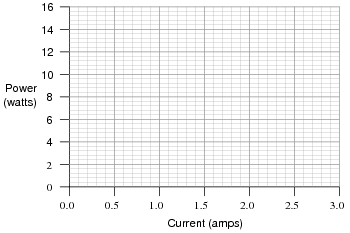
What pattern do you see represented by plot? How does this compare with the graphical relationship between voltage and current for a resistor?
Reveal answerThe more current through the resistor, the more power dissipated. However, this is not a linear function!
Notes:Students need to become comfortable with graphs, and creating their own simple graphs is an excellent way to develop this understanding. A graphical representation of the Ohm’s Law (actually, Joule’s Law) power function allows students another “view” of the concept.
If students have access to either a graphing calculator or computer software capable of drawing 2-dimensional graphs, encourage them to plot the functions using these technological resources.





The questions are very interesting.