
 Facebook
 Google
 GitHub
 Linkedin
Analog Integrated Circuits
Open-Loop OpAmp Circuits
19 questions By Tony R. Kuphaldt
-
Question 7 of 19
What does the phrase open-loop voltage gain mean with reference to an operational amplifier? For a typical opamp, this gain figure is extremely high. Why is it important that the open-loop voltage gain be high when using an opamp as a comparator?
Reveal answer“Open-loop voltage gain” simply refers to the differential voltage gain of the amplifier, without any connections “feeding back” the amplifier’s output signal to one or more of its inputs. A high gain figure means that a very small differential voltage is able to drive the amplifier into saturation.
Notes:The word “saturation” is used often in electronics, especially in reference to amplifiers. Discuss the meaning and significance of this term with your students, especially in reference to comparator circuits, where the opamp is being used simply to compare to voltages and tell which one is greater.
-
Question 8 of 19
A student is operating a simple comparator circuit and documenting the results in a table:
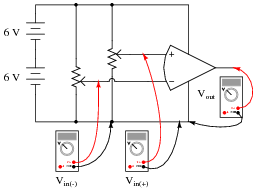
MMMM MMMM MMMM MMMM Vin( ) Vin(−) Vout 3.00 V 1.45 V 10.5 V 3.00 V 2.85 V 10.4 V 3.00 V 3.10 V 1.19 V 3.00 V 6.75 V 1.20 V Vin( ) Vin(−) Vout 2.36 V 6.50 V 1.20 V 4.97 V 6.50 V 1.21 V 7.05 V 6.50 V 10.5 V 9.28 V 6.50 V 10.4 V Vin( ) Vin(−) Vout 10.4 V 9.87 V 10.6 V 1.75 V 1.03 V 10.5 V 0.31 V 1.03 V 10.5 V 5.50 5.65 V 1.19 V One of these output voltage readings is anomalous. In other words, it does not appear to be “correct”. This is very strange, because these figures are real measurements and not predictions! Perplexed, the student approaches the instructor and asks for help. The instructor sees the anomalous voltage reading and says two words: latch-up. With that, the student goes back to research what this phrase means, and what it has to do with the weird output voltage reading.
Identify which of these output voltage measurements is anomalous, and explain what “latch-up” has to do with it.
Reveal answerLatch-up occurs when one of the input voltage signals approaches too close to one of the power supply rail voltages. The result is the op-amp output saturating “high” even if it isn’t supposed to.
Challenge question: suppose we expected both input voltages to range between 0 and 10 volts during normal operation of this comparator circuit. What could we change in the circuit to allow this range of operation and avoid latch-up?
Notes:Ask your students what they found in their research on “latch-up,” and if this is an idiosyncrasy of all op-amp models, or just some.
Incidentally, the curved op-amp symbol has no special meaning. This symbol was quite popular for representing op-amps during their early years, but has since fallen out of favor. I show it here just to inform your students, in case they ever happen to encounter one of these symbols in an old electronic schematic.
-
Question 9 of 19
In this automatic cooling fan circuit, a comparator is used to turn a DC motor on and off when the sensed temperature reaches the “setpoint” established by the potentiometer:
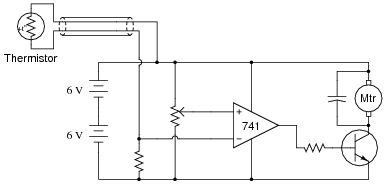
The circuit works just as it is supposed to in turning the motor on and off, but it has a strange problem: the transistor gets warm when the motor is off! Oddly enough, the transistor actually cools down when the motor turns on.
Describe what you would measure first in troubleshooting this problem. Based on the particular model of op-amp used (a model LM741C), what do you suspect is the problem here?
Reveal answerThe problem here is that the model 741 op-amp cannot “swing” its output rail-to-rail. An op-amp with rail-to-rail output voltage capability would not make the transistor heat up in the “off” mode.
Challenge question: what purpose does the capacitor serve in this circuit? Hint: the capacitor is not required in a “perfect world,” but it helps eliminate spurious problems in the real world!
Notes:I’ve actually encountered this transistor heating problem in designing and building a very similar DC motor control circuit using the 741. There is a way to overcome this problem without switching to a different model of op-amp!
After discussing the nature of the problem with your students, you should talk about the virtues of getting a “low performance” op-amp such as the model 741 to work in a scenario like this rather than changing to an op-amp model capable of rail-to-rail operation. In my estimation, switching to a more modern op-amp in a circuit as simple as this is “cheating”. There is nothing about this circuit that fundamentally taxes the capabilities of a 741 op-amp. All it takes is a little creativity to make it work properly.


