Facebook
 Google
 GitHub
 Linkedin
Analog Integrated Circuits
Open-Loop OpAmp Circuits
19 questions By Tony R. Kuphaldt
-
Question 10 of 19
Explain the operation of this sound-activated relay circuit:
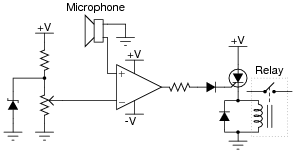
Reveal answerThe relay will energize if a loud enough sound is detected by the microphone. The threshold volume is set by the potentiometer.
Follow-up question: how could we equip this circuit with the ability to turn the relay off once it has been turned on?
Notes:There is a lot going on in this circuit that is not addressed in the answer I give. The basic purpose of the circuit should be fairly clear to understand, but the function of several components deserve further explanation. Ask your students to explain the functions of the diode on the comparator’s output, the diode in parallel with the relay coil, the zener diode in parallel with the potentiometer, and the SCR.
-
Question 11 of 19
Calculate the amount of resistance that the thermistor much reach in order to turn the cooling fan on:

Reveal answerThermistor resistance = 5.547 kΩ
Notes:Ask your students how they arrived at their solution for this question. There is definitely more than one way to do it!
-
Question 12 of 19
Predict how the operation of this thermostat circuit (where the cooling fan motor is supposed to turn on when the temperature gets too high) will be affected as a result of the following faults. Consider each fault independently (i.e. one at a time, no multiple faults):
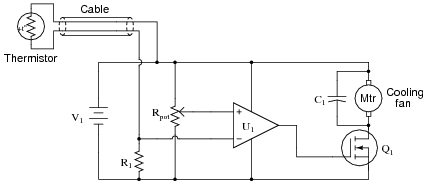
- Cable fails open:
- Comparator U1 fails with output saturated positive:
- Resistor R1 fails open:
- Capacitor C1 fails shorted:
- Transistor Q1 fails shorted (drain-to-source):
For each of these conditions, explain why the resulting effects will occur.
Reveal answer- Cable fails open: Fan turns on and never turns off.
- Comparator U1 fails with output saturated positive: Fan turns on and never turns off.
- Resistor R1 fails open: Fan refuses to turn on.
- Capacitor C1 fails shorted: Fan refuses to turn on, transistor Q1 likely fails due to overheating when it tries to energize fan.
- Transistor Q1 fails shorted (drain-to-source): Fan turns on and never turns off.
Notes:The purpose of this question is to approach the domain of circuit troubleshooting from a perspective of knowing what the fault is, rather than only knowing what the symptoms are. Although this is not necessarily a realistic perspective, it helps students build the foundational knowledge necessary to diagnose a faulted circuit from empirical data. Questions such as this should be followed (eventually) by other questions asking students to identify likely faults based on measurements.