Facebook
 Google
 GitHub
 Linkedin
Analog Integrated Circuits
Open-Loop OpAmp Circuits
19 questions By Tony R. Kuphaldt
-
Question 13 of 19
Predict how the operation of this thermostat circuit (where the cooling fan motor is supposed to turn on when the temperature gets too high) will be affected as a result of the following faults. Consider each fault independently (i.e. one at a time, no multiple faults):

- Cable fails open:
- Comparator U1 fails with output saturated positive:
- Resistor R1 fails open:
- Cable fails shorted:
- Transistor Q1 fails shorted (drain-to-source):
For each of these conditions, explain why the resulting effects will occur.
Reveal answer- Cable fails open: Fan turns on and never turns off.
- Comparator U1 fails with output saturated positive: Fan refuses to turn on.
- Resistor R1 fails open: Fan refuses to turn on.
- Cable fails shorted: Fan refuses to turn on.
- Transistor Q1 fails shorted (drain-to-source): Fan turns on and never turns off.
Notes:The purpose of this question is to approach the domain of circuit troubleshooting from a perspective of knowing what the fault is, rather than only knowing what the symptoms are. Although this is not necessarily a realistic perspective, it helps students build the foundational knowledge necessary to diagnose a faulted circuit from empirical data. Questions such as this should be followed (eventually) by other questions asking students to identify likely faults based on measurements.
-
Question 14 of 19
Predict how the operation of this sound-activated relay circuit will be affected as a result of the following faults. Consider each fault independently (i.e. one at a time, no multiple faults):
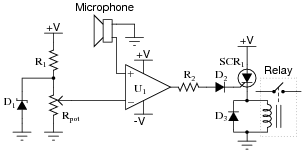
- Zener diode D1 fails open:
- Resistor R1 fails open:
- Resistor R2 fails open:
- Microphone voice coil fails open:
- Comparator U1 fails with output saturated positive:
- Diode D3 fails shorted:
For each of these conditions, explain why the resulting effects will occur.
Reveal answer- Zener diode D1 fails open: Volume threshold increases (relay may not energize at all).
- Resistor R1 fails open: Any sound at all will energize the relay.
- Resistor R2 fails open: Relay refuses to energize.
- Microphone voice coil fails open: Relay energizes randomly, as comparator input is now sensitive to static electricity.
- Comparator U1 fails with output saturated positive: Relay immediately energizes, whether or not there is sound.
- Diode D3 fails shorted: Relay refuses to energize, SCR will likely be damaged due to overheating after a sound event.
Notes:The purpose of this question is to approach the domain of circuit troubleshooting from a perspective of knowing what the fault is, rather than only knowing what the symptoms are. Although this is not necessarily a realistic perspective, it helps students build the foundational knowledge necessary to diagnose a faulted circuit from empirical data. Questions such as this should be followed (eventually) by other questions asking students to identify likely faults based on measurements.
-
Question 15 of 19
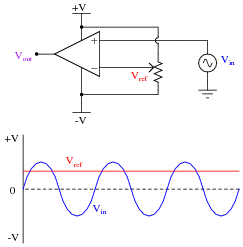
Trace the output waveform of this comparator circuit:
Reveal answer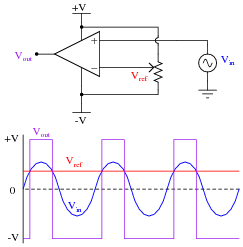
Follow-up question: explain what the phrase duty cycle means with reference to a “square” or “pulse” waveform.
Notes:During discussion, ask your students to explain how the output waveform of this comparator circuit comes to be, step by step. Ask them how they arrived at their solution, and if there is a way this AC/DC problem can be simplified to one that is DC only for easier analysis (determining what the output voltage will do for a certain set of input conditions).