
 Facebook
 Google
 GitHub
 Linkedin
Discrete Semiconductor Devices and Circuits
Oscillator Circuits
49 questions By Tony R. Kuphaldt
-
Question 13 of 49
One way to achieve the phase shift necessary for regenerative feedback in an oscillator circuit is to use multiple RC phase-shifting networks:

What must the voltage gain be for the common-emitter amplifier if the total voltage attenuation for the three phase-shifting RC networks is -29.25 dB?
Reveal answerThe amplifier’s voltage gain must be (at least) 29.25 dB.
Notes:This question probes students’ comprehension of the Barkhausen criterion: that total loop gain must be equal or greater than unity in order for sustained oscillations to occur.
-
Question 14 of 49
RC phase-shift oscillator circuits may be constructed with different numbers of RC sections. Shown here are schematic diagrams for three- and four-section RC oscillators:


What difference will the number of sections in the oscillator circuit make? Be as specific as you can in your answer.
Reveal answerThe amount of phase shift per RC section will be different in each circuit, as well as the operating frequency (given the same R and C component values).
Notes:In either case, the point of the RC stages is to phase-shift the feedback signal by 180o. It is an over-simplification, though, to say that each stage in the three-section circuit shifts the signal by 60, and/or that each stage in the four-section circuit shifts the signal by 45o. The amount of phase-shift in each section will not be equal (with equal R and C values) due to the loading of each section by the previous section(s).
-
Question 15 of 49
Calculate the output voltages of this Wien bridge circuit, if the input voltage is 10 volts RMS at a frequency of 159.155 Hz:
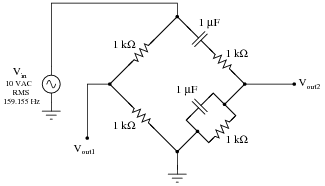
Reveal answerVout1 = 5.00 VAC RMS ∠ 0o
Vout2 = 3.33 VAC RMS ∠ 0o
Notes:This question provides an excellent opportunity for your students to review AC circuit analysis, as well as pave the way for questions regarding Wien bridge oscillator circuits!


