Facebook
 Google
 GitHub
 Linkedin
AC Electric Circuits
Series and Parallel AC Circuits
75 questions By Tony R. Kuphaldt
-
Question 34 of 75
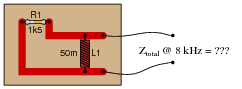
Calculate the total impedance of this LR circuit, once using nothing but scalar numbers, and again using complex numbers:
Reveal answerScalar calculations
R1 = 1.5 kΩ GR1 = 666.7 μS
XL1 = 2.513 kΩ BL1 = 397.9 μS
Ytotal = √{G2 B2} = 776.4 μS
Ztotal = [1/(Ytotal)] = 1.288 kΩ
Complex number calculations
R1 = 1.5 kΩ ZR1 = 1.5 kΩ ∠ 0o
XL1 = 2.513 kΩ ZL1 = 2.513 kΩ ∠ 90o
Ztotal = [ 1/([1/(ZR1)] [1/(ZL1)])] = 1.288 kΩ ∠ 30.83o
Notes:Some electronics textbooks (and courses) tend to emphasize scalar impedance calculations, while others emphasize complex number calculations. While complex number calculations provide more informative results (a phase shift given in every variable!) and exhibit conceptual continuity with DC circuit analysis (same rules, similar formulae), the scalar approach lends itself better to conditions where students do not have access to calculators capable of performing complex number arithmetic. Yes, of course, you can do complex number arithmetic without a powerful calculator, but it’s a lot more tedious and prone to errors than calculating with admittances, susceptances, and conductances (primarily because the phase shift angle is omitted for each of the variables).
-
Question 35 of 75
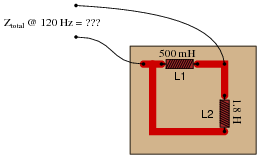
Calculate the total impedance offered by these two inductors to a sinusoidal signal with a frequency of 120 Hz:
Show your work using three different problem-solving strategies:
- Calculating total inductance (Ltotal) first, then total impedance (Ztotal).
- Calculating individual admittances first (YL1 and YL2), then total admittance (Ytotal), then total impedance (Ztotal).
- Using complex numbers: calculating individual impedances first (ZL1 and ZL2), then total impedance (Ztotal).
Do these two strategies yield the same total impedance value? Why or why not?
Reveal answerFirst strategy:
Ltotal = 391.3 mH
Xtotal = 295.0 Ω
Ztotal = 295.0 Ω ∠ 90o or Ztotal = 0 j295.0 Ω
Second strategy:
ZL1 = XL1 = 377.0 Ω
YL1 = [1/(ZL1)] = 2.653 mS
ZL1 = XL2 = 1.357 kΩ
YL2 = [1/(ZL2)] = 736.8 μS
Ytotal = 3.389 mS
Ztotal = [1/(Ytotal)] = 295 Ω
Third strategy: (using complex numbers)
XL1 = 377.0 Ω ZL1 = 377.0 Ω ∠ 90o
XL2 = 1.357 kΩ ZL2 = 1.357 kΩ ∠ 90o
Ztotal = 295.0 Ω ∠ 90o or Ztotal = 0 j295.0 Ω
Follow-up question: draw a phasor diagram showing how the two inductors’ admittance phasors geometrically add to equal the total admittance.
Notes:The purpose of this question is to get students to realize that any way they can calculate total impedance is correct, whether calculating total inductance and then calculating impedance from that, or by calculating the impedance of each inductor and then combining impedances to find a total impedance. This should be reassuring, because it means students have a way to check their work when analyzing circuits such as this!
-
Question 36 of 75
Determine the input frequency necessary to give the output voltage a phase shift of 75o:
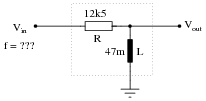
Also, write an equation that solves for frequency (f), given all the other variables (R, L, and phase angle θ).
Reveal answerf = 11.342 kHz
f = R 2 πL tanθNotes:Discuss with your students what a good procedure might be for calculating the unknown values in this problem, and also how they might check their work.
Students often have difficulty formulating a method of solution: determining what steps to take to get from the given conditions to a final answer. While it is helpful at first for you (the instructor) to show them, it is bad for you to show them too often, lest they stop thinking for themselves and merely follow your lead. A teaching technique I have found very helpful is to have students come up to the board (alone or in teams) in front of class to write their problem-solving strategies for all the others to see. They don’t have to actually do the math, but rather outline the steps they would take, in the order they would take them.
By having students outline their problem-solving strategies, everyone gets an opportunity to see multiple methods of solution, and you (the instructor) get to see how (and if!) your students are thinking. An especially good point to emphasize in these “open thinking” activities is how to check your work to see if any mistakes were made.