Facebook
 Google
 GitHub
 Linkedin
AC Electric Circuits
Series and Parallel AC Circuits
75 questions By Tony R. Kuphaldt
-
Question 46 of 75
Suppose you are building a circuit and you need an impedance of 1500 Ω ∠ -41o at a frequency of 600 Hz. What combination of components could you connect together in series to achieve this precise impedance?
Reveal answerA 1132.1 Ω resistor connected in series with a 269.6 nF capacitor would suffice.
Notes:As usual, the most important part of your students’ answers is not the figures themselves, but rather their methods of solution. Students should be very familiar with how to calculate the impedance of a series-connected group of components, but calculating component values from an impedance figure may be a challenge to some.
-
Question 47 of 75
Calculate the impedance of a 145 mH inductor connected in series with 750 Ω resistor at a frequency of 1 kHz, then determine the necessary resistor and inductor values to create the exact same total impedance in a parallel configuration.
Reveal answerZtotal = 1.18 kΩ ∠ 50.54o
If connected in parallel: R = 1.857 kΩ ; L = 243.3 mH.
Hint: if you are having difficulty figuring out where to start in answering this question, consider the fact that these two circuits, if equivalent in total impedance, will draw the exact same amount of current from a common AC source at 1 kHz.
Notes:This is an interesting question, requiring the student to think creatively about how to convert one configuration of circuit into another, while maintaining the same total effect. As usual, the real purpose of a question like this is to develop problem-solving strategies, rather than to simply obtain an answer.
-
Question 48 of 75
Calculate the total impedance of these parallel-connected components, expressing it in polar form (magnitude and phase angle):
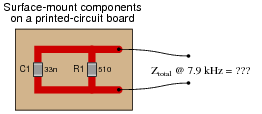
Also, draw an admittance triangle for this circuit.
Reveal answerZtotal = 391.4 Ω ∠ -39.9o

Notes:Some students may wonder why every side of the triangle is represented by a Y term, rather than Y for the hypotenuse, G for the adjacent, and B for the opposite. If students ask about this, remind them that conductance (G) and susceptance (B) are simple two different types of admittances (Y), just as resistance (R) and reactance (X) are simply two different types of impedances (Z).