Facebook
 Google
 GitHub
 Linkedin
AC Electric Circuits
Series and Parallel AC Circuits
75 questions By Tony R. Kuphaldt
-
Question 4 of 75
Determine the input frequency necessary to give the output voltage a phase shift of -38o:
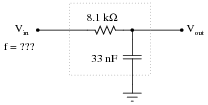
Reveal answerf = 465 Hz
Notes:Phase-shifting circuits are very useful, and important to understand. They are particularly important in some types of oscillator circuits, which rely on RC networks such as this to provide certain phase shifts to sustain oscillation.
-
Question 5 of 75
Write an equation that solves for the impedance of this series circuit. The equation need not solve for the phase angle between voltage and current, but merely provide a scalar figure for impedance (in ohms):

Reveal answerZtotal = √{R2 X2}
Notes:Ask your students if this equation looks similar to any other mathematical equations they’ve seen before. If not, square both sides of the equation so it looks like Z2 = R2 X2 and ask them again.
-
Question 6 of 75
Draw a phasor diagram showing the trigonometric relationship between resistance, reactance, and impedance in this series circuit:

Show mathematically how the resistance and reactance combine in series to produce a total impedance (scalar quantities, all). Then, show how to analyze this same circuit using complex numbers: regarding each of the component as having its own impedance, demonstrating mathematically how these impedances add up to comprise the total impedance (in both polar and rectangular forms).
Reveal answer
Scalar calculations
R = 2.2 kΩ XC = 2.067 kΩ
Zseries = √{R2 XC2}
Zseries = √{22002 20672} = 3019 Ω
Complex number calculations
ZR = 2.2 kΩ ∠ 0o ZC = 2.067 kΩ ∠−90o (Polar form)
ZR = 2.2 kΩ j0 Ω ZC = 0 Ω− j2.067 kΩ (Rectangular form)
Zseries = Z1 Z2 …Zn (General rule of series impedances)
Zseries = ZR ZC (Specific application to this circuit)
Zseries = 2.2 kΩ ∠ 0o 2.067 kΩ ∠−90o = 3.019 kΩ ∠−43.2o
Zseries = (2.2 kΩ j0 Ω) (0 Ω− j2.067 kΩ) = 2.2 kΩ− j2.067 kΩ
Notes:I want students to see that there are two different ways of approaching a problem such as this: with scalar math and with complex number math. If students have access to calculators that can do complex-number arithmetic, the “complex” approach is actually simpler for series-parallel combination circuits, and it yields richer (more informative) results.
Ask your students to determine which of the approaches most resembles DC circuit calculations. Incidentally, this is why I tend to prefer complex-number AC circuit calculations over scalar calculations: because of the conceptual continuity between AC and DC. When you use complex numbers to represent AC voltages, currents, and impedances, almost all the rules of DC circuits still apply. The big exception, of course, is calculations involving power.