Facebook
 Google
 GitHub
 Linkedin
AC Electric Circuits
Series and Parallel AC Circuits
75 questions By Tony R. Kuphaldt
-
Question 7 of 75
Solve for all voltages and currents in this series RC circuit, and also calculate the phase angle of the total impedance:

Reveal answerVC = 47.56 volts peak
VR = 6.508 volts peak
I = 1.972 milliamps peak
ΘZ = −82.21o
Follow-up question: what would we have to do to get these answers in units RMS instead of units “peak”?
Notes:Bring to your students’ attention the fact that total voltage in this circuit is given in “peak” units rather than RMS, and what effect this has on our answers.
Students often have difficulty formulating a method of solution: determining what steps to take to get from the given conditions to a final answer. While it is helpful at first for you (the instructor) to show them, it is bad for you to show them too often, lest they stop thinking for themselves and merely follow your lead. A teaching technique I have found very helpful is to have students come up to the board (alone or in teams) in front of class to write their problem-solving strategies for all the others to see. They don’t have to actually do the math, but rather outline the steps they would take, in the order they would take them. The following is a sample of a written problem-solving strategy for analyzing a series resistive-reactive AC circuit:
Step 1: Calculate all reactances (X).
Step 2: Draw an impedance triangle (Z ; R ; X), solving for Z
Step 3: Calculate circuit current using Ohm’s Law: I = V/Z
Step 4: Calculate series voltage drops using Ohm’s Law: V = I Z
Step 5: Check work by drawing a voltage triangle (Vtotal ; V1 ; V2), solving for Vtotal
By having students outline their problem-solving strategies, everyone gets an opportunity to see multiple methods of solution, and you (the instructor) get to see how (and if!) your students are thinking. An especially good point to emphasize in these “open thinking” activities is how to check your work to see if any mistakes were made.
-
Question 8 of 75
A student is asked to calculate the phase shift for the following circuit’s output voltage, relative to the phase of the source voltage:

He recognizes this as a series circuit, and therefore realizes that a right triangle would be appropriate for representing component impedances and component voltage drops (because both impedance and voltage are quantities that add in series, and the triangle represents phasor addition):
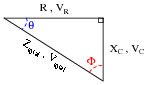
The problem now is, which angle does the student solve for in order to find the phase shift of Vout? The triangle contains two angles besides the 90o angle, Θ and Φ. Which one represents the output phase shift, and more importantly, why?
Reveal answerThe proper angle in this circuit is Θ, and it will be a positive (leading) quantity.
Notes:Too many students blindly use impedance and voltage triangles without really understand what they are and why they work. These same students will have no idea how to approach a problem like this. Work with them to help them understand!
-
Question 9 of 75
Calculate the output voltage of this phase-shifting circuit, expressing it in polar form (magnitude and phase angle relative to the source voltage):

Reveal answerVout = 6.7 V ∠ -47.9o
Notes:This is a very practical application of resistor-capacitor (RC) circuits: to introduce a phase shift to an AC signal. Examples of where a circuit such as this may be used include oscillators (to introduce phase shift into a feedback network for a total phase shift of 360o) and thyristor firing control circuits (phase-shifting the triggering voltage in relation to the source voltage).