Facebook
 Google
 GitHub
 Linkedin
AC Electric Circuits
Series and Parallel AC Circuits
75 questions By Tony R. Kuphaldt
-
Question 10 of 75
Calculate the output voltage of this phase-shifting circuit, expressing it in polar form (magnitude and phase angle relative to the source voltage):

Reveal answerVout = 2.593 V ∠ 61.3o
Notes:This is a very practical application of resistor-capacitor (RC) circuits: to introduce a phase shift to an AC signal. Examples of where a circuit such as this may be used include oscillators (to introduce phase shift into a feedback network for a total phase shift of 360o) and thyristor firing control circuits (phase-shifting the triggering voltage in relation to the source voltage).
-
Question 11 of 75
In this circuit, a series resistor-capacitor network creates a phase-shifted voltage for the “gate” terminal of a power-control device known as a TRIAC. All portions of the circuit except for the RC network are “shaded” for de-emphasis:
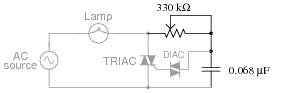
Calculate how many degrees of phase shift the capacitor’s voltage is, compared to the total voltage across the series RC network, assuming a frequency of 60 Hz, and a 50% potentiometer setting.
Reveal answerEC phase shift = -76.7o
Challenge question: what effect will a change in potentiometer setting have on this phase angle? Specifically, will increasing the resistance make the phase shift approach -90o or approach 0o?
Notes:In this question, I purposely omitted any reference to voltage levels, so the students would have to set up part of the problem themselves. The goal here is to build problem-solving skills.
-
Question 12 of 75
Determine the input frequency necessary to give the output voltage a phase shift of 70o:

Reveal answerf = 798 Hz
Notes:Phase-shifting circuits are very useful, and important to understand. They are particularly important in some types of oscillator circuits, which rely on RC networks such as this to provide certain phase shifts to sustain oscillation.