Facebook
 Google
 GitHub
 Linkedin
AC Electric Circuits
Series and Parallel AC Circuits
75 questions By Tony R. Kuphaldt
-
Question 52 of 75
A quantity sometimes used in DC circuits is conductance, symbolized by the letter G. Conductance is the reciprocal of resistance (G = 1/R), and it is measured in the unit of siemens.
Expressing the values of resistors in terms of conductance instead of resistance has certain benefits in parallel circuits. Whereas resistances (R) add in series and “diminish” in parallel (with a somewhat complex equation), conductances (G) add in parallel and “diminish” in series. Thus, doing the math for series circuits is easier using resistance and doing math for parallel circuits is easier using conductance:

In AC circuits, we also have reciprocal quantities to reactance (X) and impedance (Z). The reciprocal of reactance is called susceptance (B = 1/X), and the reciprocal of impedance is called admittance (Y = 1/Z). Like conductance, both these reciprocal quantities are measured in units of siemens.
Write an equation that solves for the admittance (Y) of this parallel circuit. The equation need not solve for the phase angle between voltage and current, but merely provide a scalar figure for admittance (in siemens):

Reveal answerYtotal = √{G2 B2}
Follow-up question #1: draw a phasor diagram showing how Y, G, and B relate.
Follow-up question #2: re-write this equation using quantities of resistance (R), reactance (X), and impedance (Z), instead of conductance (G), susceptance (B), and admittance (Y).
Notes:Ask your students if this equation looks familiar to them. It should!
The answer to the challenge question is a matter of algebraic substitution. Work through this process with your students, and then ask them to compare the resulting equation with other equations they’ve seen before. Does its form look familiar to them in any way?
-
Question 53 of 75
Calculate the total impedance offered by these three resistors to a sinusoidal signal with a frequency of 10 kHz:
- R1 = 3.3 kΩ
- R2 = 10 kΩ
- R3 = 5 kΩ
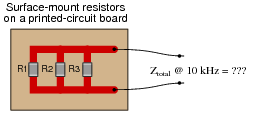
State your answer in the form of a scalar number (not complex), but calculate it using two different strategies:
- Calculate total resistance (Rtotal) first, then total impedance (Ztotal).
- Calculate individual admittances first (YR1, YR2, and YR3), then total impedance (Ztotal).
Reveal answerFirst strategy:
Rtotal = 1.658 kΩ
Ztotal = 1.658 kΩ
Second strategy:
YR1 = 303 μS
YR2 = 100 μS
YR3 = 200 μS
Ytotal = 603 μS
Ztotal = 1.658 kΩ
Notes:This question is set up to be more complex than it has to be. Its purpose is to get students thinking in terms of parallel admittances, in a manner similar to parallel conductances.
-
Question 54 of 75
Calculate the total impedance offered by these three capacitors to a sinusoidal signal with a frequency of 4 kHz:
- C1 = 0.1 μF
- C2 = 0.047 μF
- C3 = 0.033 μF
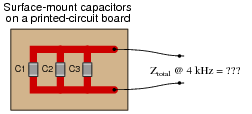
State your answer in the form of a scalar number (not complex), but calculate it using two different strategies:
- Calculate total capacitance (Ctotal) first, then total impedance (Ztotal).
- Calculate individual admittances first (YC1, YC2, and YC3), then total impedance (Ztotal).
Reveal answerFirst strategy:
Ctotal = 0.18 μF
Ztotal = 221 Ω
Second strategy:
YC1 = 2.51 mS
YC2 = 1.18 mS
YC3 = 829 μS
Ytotal = 4.52 mS
Ztotal = 221 Ω
Notes:This question is another example of how multiple means of calculation will give you the same answer (if done correctly!). Make note to your students that this indicates an answer-checking strategy!