Facebook
 Google
 GitHub
 Linkedin
AC Electric Circuits
Series and Parallel AC Circuits
75 questions By Tony R. Kuphaldt
-
Question 61 of 75
Voltage divider circuits may be constructed from reactive components just as easily as they may be constructed from resistors. Take this capacitive voltage divider, for instance:

Calculate the magnitude and phase shift of Vout. Also, describe what advantages a capacitive voltage divider might have over a resistive voltage divider.
Reveal answerVout = 1.754 V ∠ 0o
Follow-up question #1: explain why the division ratio of a capacitive voltage divider remains constant with changes in signal frequency, even though we know that the reactance of the capacitors (XC1 and XC2) will change.
Follow-up question #2: one interesting feature of capacitive voltage dividers is that they harbor the possibility of electric shock after being disconnected from the voltage source, if the source voltage is high enough and if the disconnection happens at just the right time. Explain why a capacitive voltage divider poses this threat whereas a resistive voltage divider does not. Also, identify what the time of disconnection from the AC voltage source has to do with shock hazard.
Notes:Capacitive voltage dividers find use in high-voltage AC instrumentation, due to some of the advantages they exhibit over resistive voltage dividers. Your students should take special note of the phase angle for the capacitor’s voltage drop. Why it is 0 degrees, and not some other angle?
-
Question 62 of 75
Determine the input frequency necessary to give the output voltage a phase shift of 25o:
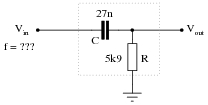
Also, write an equation that solves for frequency (f), given all the other variables (R, C, and phase angle θ).
Reveal answerf = 2.143 kHz
f = 1 2 πR C tanθNotes:Discuss with your students what a good procedure might be for calculating the unknown values in this problem, and also how they might check their work.
Students often have difficulty formulating a method of solution: determining what steps to take to get from the given conditions to a final answer. While it is helpful at first for you (the instructor) to show them, it is bad for you to show them too often, lest they stop thinking for themselves and merely follow your lead. A teaching technique I have found very helpful is to have students come up to the board (alone or in teams) in front of class to write their problem-solving strategies for all the others to see. They don’t have to actually do the math, but rather outline the steps they would take, in the order they would take them.
By having students outline their problem-solving strategies, everyone gets an opportunity to see multiple methods of solution, and you (the instructor) get to see how (and if!) your students are thinking. An especially good point to emphasize in these “open thinking” activities is how to check your work to see if any mistakes were made.
-
Question 63 of 75
Determine the necessary resistor value to give the output voltage a phase shift of 58o:
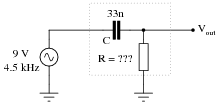
Also, write an equation that solves for this resistance value (R), given all the other variables (f, C, and phase angle θ).
Reveal answerR = 669.7 Ω
R = 1 2 πf C tanθNotes:Discuss with your students what a good procedure might be for calculating the unknown values in this problem, and also how they might check their work.
Students often have difficulty formulating a method of solution: determining what steps to take to get from the given conditions to a final answer. While it is helpful at first for you (the instructor) to show them, it is bad for you to show them too often, lest they stop thinking for themselves and merely follow your lead. A teaching technique I have found very helpful is to have students come up to the board (alone or in teams) in front of class to write their problem-solving strategies for all the others to see. They don’t have to actually do the math, but rather outline the steps they would take, in the order they would take them.
By having students outline their problem-solving strategies, everyone gets an opportunity to see multiple methods of solution, and you (the instructor) get to see how (and if!) your students are thinking. An especially good point to emphasize in these “open thinking” activities is how to check your work to see if any mistakes were made.