
 Facebook
 Google
 GitHub
 Linkedin
Basic Electricity
Soldering
13 questions By Tony R. Kuphaldt
-
Question 10 of 13
Explain what surface-mount devices are, and how the soldering and desoldering processes for them differ from the processes used to solder and de-solder “through-hole” components on printed circuit boards. The following illustration contrasts “through-hole” component construction versus surface-mount construction for a voltage divider circuit (three resistors connected in series):
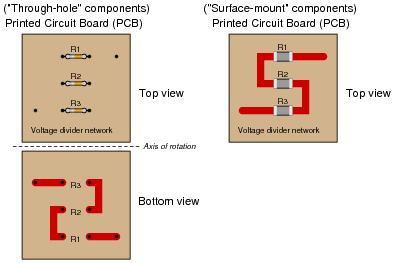
Reveal answer“Surface-mount” components solder to the surface of a printed circuit board, and have no mechanical means of attachment, unlike “through-hole” components. Because of their small size and lack of attachment prior to soldering, special soldering equipment must be used.
Notes:Ask your students to describe some of the special soldering equipment that must be used for surface-mount devices? How does it differ in terms of power from regular soldering irons and guns? Why are surface-mount soldering tools rated at a different power level?
Ask your students to describe how surface-mount components may be held to the board during the soldering process. Are all surface-mount components identical, or are there different types? What special soldering tool attachments are available for working with surface-mount devices?
-
Question 11 of 13
The equation for converting degrees Celsius (oC) to degrees Fahrenheit (oF) is as follows:
TF = 9 5TC + 32 Use this equation to convert the following temperatures from Celsius to Fahrenheit:
- • 0oC =
- • 100oC =
- • -40oC =
- • 250oC =
- • 310oC =
Now, algebraically manipulate the equation so that you may solve for degrees Celsius from a given figure in degrees Fahrenheit. Show all your work, then check your results by working backward through the five calculations above to arrive at the original figures in degrees Celsius.
Reveal answer- • 0oC = 32oF
- • 100oC = 212oF
- • -40oC = -40oF
- • 250oC = 482oF
- • 310oC = 590oF
TC = 5 9(TF − 32) Notes:The last instruction given in the question - working backwards through the five calculations to see if you get the original (given) figures in degrees Celsius - is actually a very useful way for students to check their algebraic work. Be sure to make note of this in class!
-
Question 12 of 13
What is soldering? What is solder?
Reveal answer“Soldering” is a low-temperature form of welding commonly used to join electrical conductors together for permanent connections.
“Solder” is a special alloy of metals designed to melt at a low temperature, to make permanent electrical connections.
Notes:It should be noted that not all forms of soldering are “low temperature.” Silver soldering, for example, takes place at much greater temperatures than regular electrical soldering. However, all soldering is a form of welding.


