Facebook
 Google
 GitHub
 Linkedin
Analog Integrated Circuits
Summer and Subtractor OpAmp Circuits
25 questions By Tony R. Kuphaldt
-
Question 7 of 25
Determine all current magnitudes and directions, as well as voltage drops, in this circuit:

Reveal answer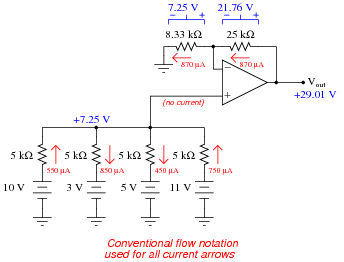
Follow-up question: what would be required to get this circuit to output the exact sum of the four input voltages?
Notes:This question not only provides practice analyzing the behavior of a summer circuit, but also analyzing the behavior of a passive averager circuit. If your students need some refreshing on how to analyze the passive averager, you might want to review Millman’s Theorem with them.
-
Question 8 of 25
Determine the amount of current from point A to point B in this circuit:
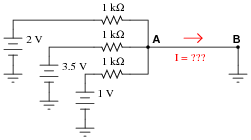
Reveal answerI = 6.5 mA
Notes:This question, while being an application of Kirchhoff’s Current Law, is also a prelude to an inverting summer circuit, where an opamp takes that 6.5 mA (total) current and converts it into an output voltage.
-
Question 9 of 25
Determine the amount of current from point A to point B in this circuit, and also the output voltage of the operational amplifier:
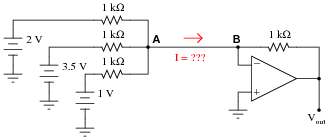
Reveal answerI = 6.5 mA Vout = -6.5 V
Notes:This question is best preceded by #02516, which asks for students to solve for the current between A and B with no opamp in the circuit (simply grounded at point B). When students realize that point B is now a virtual ground instead of a real ground, they see that the same conclusion derived by Kirchhoff’s Current Law in the passive circuit is still valid in this active circuit, and that the result is an output voltage corresponding to that current.