
 Facebook
 Google
 GitHub
 Linkedin
Network Analysis Techniques
Superposition Theorem
17 questions By Tony R. Kuphaldt
-
Question 10 of 17
Calculate the charging current through each battery, using the Superposition Theorem (ignore all wire and connection resistances - only consider the resistance of each fuse):
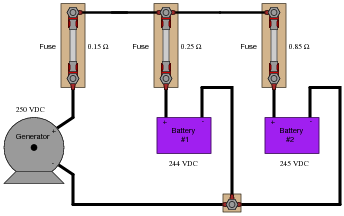
Reveal answerIgenerator = 16.82 A
Ibattery1 = 13.91 A
Ibattery2 = 2.91 A
Follow-up question: identify any safety hazards that could arise as a result of excessive resistance in the fuse holders (e.g., corrosion build-up on the metal tabs where the fuse clips in to the fuse-holder).
Notes:Though there are other methods of analysis for this circuit, it is still a good application of Superposition Theorem.
-
Question 11 of 17
Suppose we have a single resistor powered by two series-connected voltage sources. Each of the voltage sources is “ideal,” possessing no internal resistance:

Calculate the resistor’s voltage drop and current in this circuit.
Now, suppose we were to remove one voltage source from the circuit, replacing it with its internal resistance (0 Ω). Re-calculate the resistor’s voltage drop and current in the resulting circuit:

Now, suppose we were to remove the other voltage source from the circuit, replacing it with its internal resistance (0 Ω). Re-calculate the resistor’s voltage drop and current in the resulting circuit:

One last exercise: “superimpose” (add) the resistor voltages and superimpose (add) the resistor currents in the last two circuit examples, and compare these voltage and current figures with the calculated values of the original circuit. What do you notice?
Reveal answerOriginal circuit: ER = 2 volts ; IR = 2 mA
With 3 volt voltage source only: ER = 3 volts ; IR = 3 mA
With 5 volt voltage source only: ER = 5 volts ; IR = 5 mA
5 volts - 3 volts = 2 volts
5 mA - 3 mA = 2 mA
Notes:This circuit is so simple, students should not even require the use of a calculator to determine the current figures. The point of it is, to get students to see the concept of superposition of voltages and currents.
Ask your students if they think it is important to keep track of voltage polarities and current directions in the superposition process. Why or why not?
-
Question 12 of 17
Suppose we have a single resistor powered by two parallel-connected current sources. Each of the current sources is “ideal,” possessing infinite internal resistance:

Calculate the resistor’s voltage drop and current in this circuit.
Now, suppose we were to remove one current source from the circuit, replacing it with its internal resistance (∞ Ω). Re-calculate the resistor’s voltage drop and current in the resulting circuit:

Now, suppose we were to remove the other current source from the circuit, replacing it with its internal resistance (∞ Ω). Re-calculate the resistor’s voltage drop and current in the resulting circuit:

One last exercise: “superimpose” (add) the resistor voltages and superimpose (add) the resistor currents in the last two circuit examples, and compare these voltage and current figures with the calculated values of the original circuit. What do you notice?
Reveal answerOriginal circuit: ER = 15 volts ; IR = 3 A
With 7 amp current source only: ER = 35 volts ; IR = 7 A
With 4 amp current source only: ER = 20 volts ; IR = 4 A
35 volts - 20 volts = 15 volts
7 A - 4 A = 3 A
Notes:This circuit is so simple, students should not even require the use of a calculator to determine the current figures. If students are not familiar with current sources, this question provides an excellent opportunity to review them. The main point of the question is, however, to get students to see the concept of superposition of voltages and currents.




As a student, it will be better if these worksheets had not only answers but explanations as well so one can see where they went wrong.
Thank you.