
 Facebook
 Google
 GitHub
 Linkedin
Network Analysis Techniques
Superposition Theorem
17 questions By Tony R. Kuphaldt
-
Question 7 of 17
Note that this circuit is impossible to reduce by regular series-parallel analysis:

However, the Superposition Theorem makes it almost trivial to calculate all the voltage drops and currents:
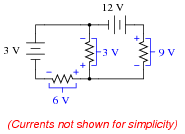
Explain the procedure for applying the Superposition Theorem to this circuit.
Reveal answerThis is easy enough for you to research on your own!
Notes:I really enjoy covering the Superposition Theorem in class with my students. It’s one of those rare analysis techniques that is intuitively obvious and yet powerful at the same time. Because the principle is so easy to learn, I highly recommend you leave this question for your students to research, and let them fully present the answer in class rather than you explain any of it.
-
Question 8 of 17
Use the Superposition Theorem to calculate the amount of current going through the 55 Ω heater element. Ignore all wire and connection resistances, only considering the resistance of each fuse in addition to the heater element resistance:
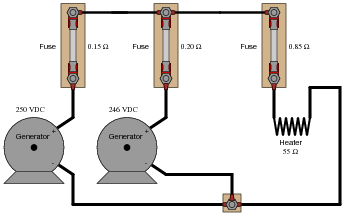
Reveal answerIheater = 4.439 A
Follow-up question: explain how you could use the Superposition Theorem to calculate current going through the short length of wire connecting the two generators together:

Notes:Though there are other methods of analysis for this circuit, it is still a good application of Superposition Theorem.
-
Question 9 of 17
Suppose a DC generator is powering an electric motor, which we model as a 100 Ω resistor:

Calculate the amount of current this generator will supply to the motor and the voltage measured across the motor’s terminals, taking into account all the resistances shown (generator internal resistance rgen, wiring resistances Rwire, and the motor’s equivalent resistance).
Now suppose we connect an identical generator in parallel with the first, using connecting wire so short that we may safely discount its additional resistance:

Use the Superposition Theorem to re-calculate the motor current and motor terminal voltage, commenting on how these figures compare with the first calculation (using only one generator).
Reveal answerWith only one generator connected:
Imotor = 4.726 amps Vmotor = 472.6 volts
With two generators connected:
Imotor = 4.733 amps Vmotor = 473.3 volts
Challenge question: how much current does each generator supply to the circuit when there are two generators connected in parallel?
Notes:Some students will erroneously leap to the conclusion that another generator will send twice the current through the load (with twice the voltage drop across the motor terminals!). Such a conclusion is easy to reach if one does not fully understand the Superposition Theorem.





As a student, it will be better if these worksheets had not only answers but explanations as well so one can see where they went wrong.
Thank you.