
 Facebook
 Google
 GitHub
 Linkedin
Network Analysis Techniques
Superposition Theorem
17 questions By Tony R. Kuphaldt
-
Question 4 of 17
The Superposition Theorem is a very important concept used to analyze both DC and AC circuits. Define this theorem in your own words, and also state the necessary conditions for it to be freely applied to a circuit.
Reveal answerThere are plenty of textbook references to the Superposition Theorem and where it may be applied. I’ll let you do your own research here!
Notes:As the answer states, students have a multitude of resources to consult on this topic. It should not be difficult for them to ascertain what this important theorem is and how it is applied to the analysis of circuits.
Be sure students understand what the terms linear and bilateral mean with reference to circuit components and the necessary conditions for Superposition Theorem to be applied to a circuit. Point out that it is still possible to apply the Superposition Theorem to a circuit containing nonlinear or unilateral components if we do so carefully (i.e. under narrowly defined conditions).
-
Question 5 of 17
Explain in your own words how to apply the Superposition Theorem to calculate the amount of current through the load resistor in this circuit:
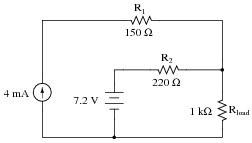
Reveal answerTo apply the Superposition Theorem to the analysis of Rload‘s current, you must consider each source acting alone, then algebraically combine the results of each analysis.
Iload = 6.623 mA
Notes:Here is a circuit students will not be able to analyze by series-parallel analysis, since it is impossible to reduce all the resistors in it to a single equivalent resistance. It is cases like this that really showcase the power of Superposition as an analysis technique.
-
Question 6 of 17
The Superposition Theorem works nicely to calculate voltages and currents in resistor circuits. But can it be used to calculate power dissipations as well? Why or why not? Be specific with your answer.
Reveal answerThe Superposition Theorem cannot be directly used to calculate power.
Notes:In order to answer this question correctly (without just looking up the answer in a book), students will have to perform a few power calculations in simple, multiple-source circuits. It may be worthwhile to work through a couple of example problems during discussion time, to illustrate the answer.
Despite the fact that resistor power dissipations cannot be superimposed to obtain the answer(s), it is still possible to use the Superposition Theorem to calculate resistor power dissipations in a multiple-source circuit. Challenge your students with the task of applying this theorem for solving power dissipations in a circuit.





As a student, it will be better if these worksheets had not only answers but explanations as well so one can see where they went wrong.
Thank you.