
 Facebook
 Google
 GitHub
 Linkedin
Basic Electricity
Switches
18 questions By Tony R. Kuphaldt
-
Question 13 of 18
Examine this schematic diagram:

Now, without moving the following components, show how they may be connected together with wires to form the same circuit depicted in the schematic diagram above:
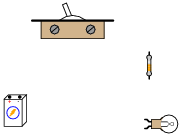
Reveal answer
Notes:One of the more difficult skills for students to develop is the ability to translate a nice, neat schematic diagram into a messy, real-world circuit, and visa-versa. Developing this skill requires lots of practice.
It is very worthwhile for students to discuss how they solve problems such as these with each other. For those students who have trouble visualizing shapes, a simple hint or “trick” to use when translating schematics to illustrations or visa-versa may be invaluable.
-
Question 14 of 18
What does the normal status of an electrical switch refer to? Specifically, what is the difference between a normally-open switch and a normally-closed switch?
Reveal answerThe “normal” status of a switch refers to the open or closed status of the contacts when there is no actuating force applied to the switch.
Notes:An important qualification for an electrical switch to be either “normally-open” or “normally-closed” is that it have a spring to return it to its “normal” state in the absence of an actuating force. Latching switches such as most toggle switches really cannot be defined in terms of “normally-” anything. Discuss this with your students, possibly showing them some examples of momentary contact switches that are either N.O. or N.C.
-
Question 15 of 18
Identify the “normal” status of each switch, whether it is normally-open (N.O.) or normally-closed (N.C.):

Based on the symbols shown, describe what physical condition results in the switch contacts being open, and what condition results in the switch contacts being closed, for each switch.
Reveal answer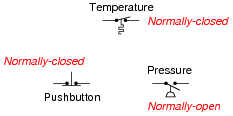
- •
- Temperature switch: cold = contacts closed, hot = contacts open
- •
- Pushbutton switch: unpressed = contacts closed, pressed = contacts open
- •
- Pressure switch: no applied pressure = contacts open, pressure applied = contacts closed
Notes:Discuss with your students the different types of switches shown in this question (not just their normal status, but what physical event actuates each type of switch). There are many, many different types of switches - far more than just the types actuated by a human hand!





Question 3: but there is a difference! Electricity flows in from positive side, the location impacts the light switch