
 Facebook
 Google
 GitHub
 Linkedin
DC Electric Circuits
Time Constant Calculations
52 questions By Tony R. Kuphaldt
-
Question 16 of 52
Determine the capacitor voltage at the specified times (time t = 0 milliseconds being the exact moment the switch contacts close). Assume the capacitor begins in a fully discharged state:

Time VC (volts)
0 ms
30 ms
60 ms
90 ms
120 ms
150 ms
Reveal answer
Time VC (volts)
0 ms 0
30 ms 12.29
60 ms 19.71
90 ms 24.19
120 ms 26.89
150 ms 28.52
Notes:Be sure to have your students share their problem-solving techniques (how they determined which equation to use, etc.) in class.
-
Question 17 of 52
Plot the capacitor voltage and the capacitor current over time after the switch closes in this circuit, for at least 4 time constants’ worth of time:
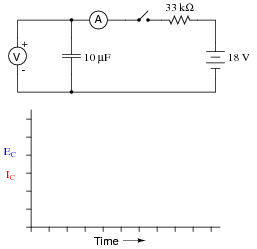
Be sure to label the axes of your graph!
Reveal answer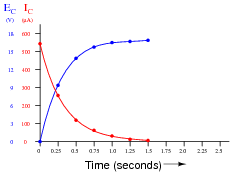
Notes:I intentionally left the graph unscaled in the problem, so that students might determine their own scales to plot the points in. The scaling shown in the answer is obviously not ideal, as the graphs have reached their terminal values (for all practical purposes) well before the horizontal axis is complete.
-
Question 18 of 52
Plot the inductor voltage and the inductor current over time after the switch closes in this circuit, for at least 4 time constants’ worth of time:
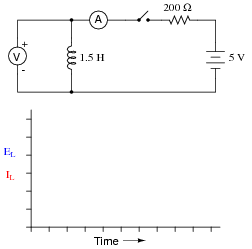
Be sure to label the axes of your graph!
Reveal answer
Notes:I intentionally left the graph unscaled in the problem, so that students might determine their own scales to plot the points in. The scaling shown in the answer is obviously not ideal, as the graphs have reached their terminal values (for all practical purposes) well before the horizontal axis is complete.





Maybe this will help someone else. The general formulas for V(t) and I(t) in question 25 (and the x(t) versions in question s 23 and 14) contain typos (or maybe hypertext coding glitches). They should actually be V(t) = (Vf-Vo)(1-e^(-t/𝛕)) + Vo, I(t) = (If-Io)(1-e^(-t/𝛕)) + Io in question 25. Those are correct in the PDF download version. In questions 23 and 24 the equations are x = xinitial + ( xfinal − xinitial ) ( 1 − e[(−t)/(τ)] ).