
 Facebook
 Google
 GitHub
 Linkedin
DC Electric Circuits
Time Constant Calculations
52 questions By Tony R. Kuphaldt
-
Question 19 of 52
Calculate the amount of time it takes for a 33 μF capacitor to charge from 0 volts to 20 volts, if powered by a 24 volt battery through a 10 kΩ resistor.
Reveal answer0.591 seconds
Notes:In order for students to solve this problem, they must algebraically manipulate the “normal” time-constant formula to solve for time instead of solving for voltage.
-
Question 20 of 52
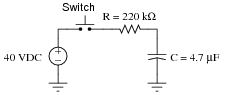
Determine the amount of time needed after switch closure for the capacitor voltage (VC) to reach the specified levels:
VC Time
0 volts
10 volts
20 volts
30 volts
40 volts
Trace the direction of electron flow in the circuit, and also mark all voltage polarities.Reveal answer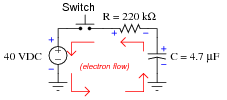
VC Time
0 volts 0 ms
10 volts 297.5 ms
20 volts 716.7 ms
30 volts 1.433 s
40 volts > 5 s
Notes:Some students may write 5.17 seconds as the time required to charge to 40 volts (5 time constants’ worth of time). If so, remind them that the “standard” of 5τ is arbitrary, and that theoretically the capacitor never actually reaches full charge.
-
Question 21 of 52
A simple time-delay relay circuit may be built using a large capacitor connected in parallel with the relay coil, to temporarily supply the relay coil with power after the main power source is disconnected. In the following circuit, pressing the pushbutton switch sounds the horn, which remains on for a brief time after releasing the switch:

To calculate the amount of time the horn will remain on after the pushbutton switch is released, we must know a few things about the relay itself. Since the relay coil acts as a resistive load to the capacitor, we must know the coil’s resistance in ohms. We must also know the voltage at which the relay “drops out” (i.e. the point at which there is too little voltage across the coil to maintain a strong enough magnetic field to hold the relay contacts closed).
Suppose the power supply voltage is 24 volts, the capacitor is 2200 μF, the relay coil resistance is 500 Ω, and the coil drop-out voltage is 6.5 volts. Calculate how long the time delay will last.
Reveal answertdelay = 1.437 seconds
Notes:In order for students to solve this problem, they must algebraically manipulate the “normal” time-constant formula to solve for time instead of solving for voltage.






Maybe this will help someone else. The general formulas for V(t) and I(t) in question 25 (and the x(t) versions in question s 23 and 14) contain typos (or maybe hypertext coding glitches). They should actually be V(t) = (Vf-Vo)(1-e^(-t/𝛕)) + Vo, I(t) = (If-Io)(1-e^(-t/𝛕)) + Io in question 25. Those are correct in the PDF download version. In questions 23 and 24 the equations are x = xinitial + ( xfinal − xinitial ) ( 1 − e[(−t)/(τ)] ).