Facebook
 Google
 GitHub
 Linkedin
Digital Circuits
Time-Delay Electromechanical Relays
19 questions By Tony R. Kuphaldt
-
Question 7 of 19
An electric motor is used to power a large conveyor belt. Before the motor actually starts, a warning siren activates to alert workers of the conveyor’s forthcoming action. The following relay circuit accomplishes both tasks (motor control plus siren alert):

Study this ladder logic diagram, then explain how the system works.
Reveal answerThis is an exercise for you and your classmates to analyze!
Notes:This circuit provides students an opportunity to analyze the workings of a delayed-start motor control circuit, where some other action (a siren in this case) takes place during the motor’s delay. Have your students present both their analyses and the methods behind the analyses as you work through this question with them.
-
Question 8 of 19
Large electric motors are often equipped with some form of soft-start control, which applies power gradually instead of all at once (as in “across the line” starting). Here is an example of a simple “soft start” control system:
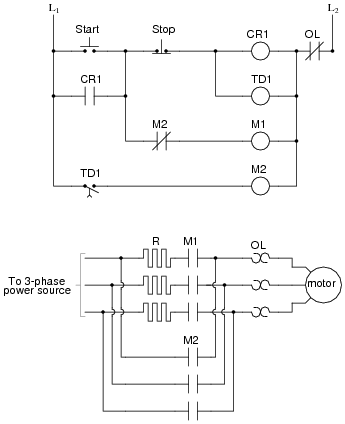
Analyze this ladder logic diagram, and explain how it starts up the electric motor more gently than an “across-the-line” starter would.
Reveal answerIn this system, resistors limit the motor’s line current during the initial start-up period, and then are bypassed after the time delay relay times out.
Notes:After being accustomed to seeing resistors drawn as zig-zag symbols, it may take some students a few moments to realize the “square wave” components in the motor power diagram are actually resistors. Confusing? Yes, but this is the standard symbolism for ladder-logic diagrams!
-
Question 9 of 19
The following ladder logic diagram is for a reversing motor control circuit:
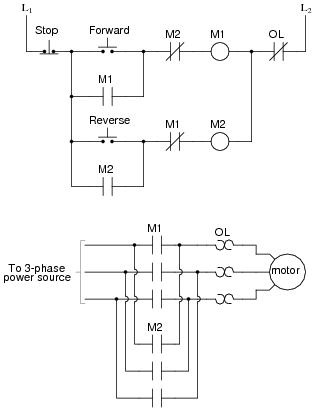
Study this diagram, then explain how motor reversal is accomplished. Also, identify the function of each “M” contact in the control circuit, especially those normally-closed contacts in series with the motor starter coils.
Now consider the following modification made to the reversing motor control circuit (motor and power contacts not shown here):

What extra functionality do the time-delay relays contribute to this motor control circuit?
Reveal answerThe normally-open and normally-closed “M” contacts provide seal-in and interlock functions, respectively. The time-delay relays prevent the motor from being immediately reversed.
Follow-up question: figure out how to simplify the time-delay relay circuit. Hint: integrate the time-delay and interlocking functions into a single contact (per rung).
Notes:This circuit provides students an opportunity to analyze the workings of a delayed-start, reversing motor control circuit. Have your students present both their analyses and the methods behind the analyses as you work through this question with them.