Facebook
 Google
 GitHub
 Linkedin
Digital Circuits
Time-Delay Electromechanical Relays
19 questions By Tony R. Kuphaldt
-
Question 4 of 19
Match the following time-delay relay contact type symbols and labels:

- Normally-open, on-delay
- Normally-open, off-delay
- Normally-closed, on-delay
- Normally-closed, off-delay
Reveal answer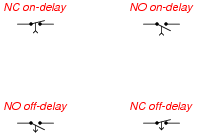
Follow-up question: how do you make sense of the arrow in each contact symbol, with regard to whether the contact is an “on-delay” or an “off-delay”?
Notes:Ask your students to present their personal explanations of how to make sense of the arrow directions, in relation to whether the relay is an “on-delay” or an “off-delay.” The correlation is really not that complex, but it is a good thing to clearly elaborate on it for the benefit of the whole class. You may want to re-phrase the question like this: Ïs it possible to determine whether each contact is on- or off-delay merely by looking at the arrow, or must one also consider the “normal” status?”
If some students believe this may be determined by arrow direction alone, show them these symbols:

-
Question 5 of 19
Time-delay relays are important circuit elements in many applications. Determine what each of the lamps will do in the following circuit when pushbutton “A” is pressed for 10 seconds and then released:

Timing diagram:

Reveal answer
Follow-up question: identify each relay contact by name:
- Normally-closed, timed-open
- Normally-open, timed-open
- Normally-closed, timed-close
- Normally-open, timed-close
Notes:Time-delay relays are not the easiest for some students to understand. The purpose of this question is to introduce students to the four basic types of time-delay relay contacts and their respective behaviors. Discuss with your students how the contact symbols make sense (arrows on the switch actuators describing direction of delay).
Note to your students how it is possible to have different types of time-delay contacts actuated by the same relay coil.
-
Question 6 of 19
A simple time-delay relay may be constructed by connecting a large capacitor in parallel with the relay coil, like this:

Explain how this circuit works, and also determine what type of time-delay relay function is provided by it (NOTO, NOTC, NCTO, or NCTC).
Reveal answerNormally-open, timed-open (NOTO).
Follow-up question: what purpose does the diode serve in this circuit?
Notes:For substantial time delays (many seconds) on large relays (high-current coils), the capacitor must be huge, making this a somewhat impractical circuit for all but miniature relays.