Facebook
 Google
 GitHub
 Linkedin
Security and Upgradeability: Key for Moving From Proof-of-Concept to Product
We examine the software used in a 2025 object detection demo and the lessons it holds for developing new edge AI products.
The 2025 Things Conference in Amsterdam, The Netherlands, was typical of the IoT and embedded computing events that punctuate the electronics industry's calendar. Exhibitors competed with each other to attract attention to their technology demonstrations, and it was near-impossible to find demos that did not deploy some form of artificial intelligence (AI).
I have to plead guilty here: Foundries.io was one of those demonstrating an AI application. Developed in collaboration with fellow Qualcomm company Edge Impulse, ours was a camera-based system for object detection which could track people moving on the walkway in front of the camera.
Not an unusual or innovative use case for AI, you might think. In fact, there was something different and important about this demo: because of the Linux-based software underpinning the demo system, the AI application could be trained and updated on the fly with training data acquired on the show floor.
Also, the security platform software used to develop and update the system wasn't only meant for one demo at one show. It is easily scalable to a fleet of thousands or millions of production units in the field. The story of this scalable demo exemplifies the difference between a proof-of-concept and a product.
The Common Way to Create an AI Proof-of-Concept
Today, AI and machine learning are at the center of the action in embedded computing. While the discipline of embedded AI is in many ways in its infancy, the software tools and frameworks for implementing AI at the edge already allow developers to create new product concepts and implement prototype designs remarkably quickly.
Many of the new AI applications on display at The Things Conference and similar exhibitions are trained and compiled on sophisticated edge AI platforms such as Edge Impulse. An advantage of Edge Impulse is that it enables rapid iteration of an AI model based on frequently refreshed training data. This is crucial for embedded devices, in which AI implementations are typically highly application-specific. Unlike the large language models behind applications such as Gemini or ChatGPT, they are also based on specialized, painstakingly curated training data sets.
Many edge AI implementations benefit from frequent updating, as the accumulation of training data enables refinement of the model. The availability of platforms such as Edge Impulse has contributed to the flourishing of new AI demonstrations and proofs-of-concept on view at The Things Conference and elsewhere.
In proof-of-concept development, there is intense pressure on developers to get quickly from idea to hardware. This pressure originates both internally, from product managers and other executives, and externally, from the industry and competitors. As a result, developers tend to use software components which come readily to hand.
The computer world's best-known commercial Linux distributions are the natural choice for developers in a hurry, familiar as they are from the user's personal computer. Viewed purely as a Linux OS, these distributions provide a sound basis for demonstrating the capabilities of edge AI software.
However, an AI design needs more when it becomes a product. It needs to achieve relevant certifications and comply with regulations. These include meeting certain cybersecurity protection requirements for its lifetime in the field. And the commercial Linux OS which runs on the developer's PC, which is quite suitable for the limited purpose of demonstrating an AI design at an exhibition, is not ideal for a security-focused embedded product intended for release to the market.
Demonstrating the Requirements for Keeping an AI Product Secure
The AI algorithm in the Foundries.io Object Detection demo at The Things Conference was developed on the Edge Impulse platform. The algorithm was compiled to run on the Qualcomm Dragonwing Robotics RB3 Platform (Figure 1).
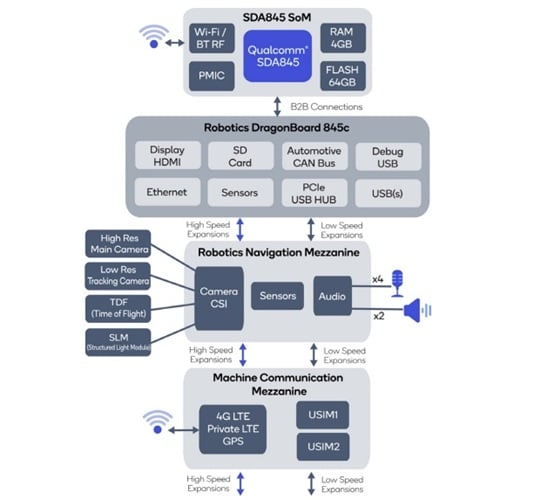
Figure 1. The Dragonwing Robotics RB3 platform provides a platform for advanced AI video processing at the edge. Image used courtesy of Qualcomm [pdf]
The demo system's OS was the Linux microPlatform (LmP). This application-customizable Linux distribution was created in the Yocto Project framework. The LmP was chosen as the basis for this proof-of-concept because the Foundries.io design was not primarily intended to demonstrate what is possible with AI at the edge. Instead, its purpose was to demonstrate the elements required to scale an AI-based product up for volume production. In particular, it showcased the capabilities required to deploy and maintain such a product in regions like Europe.

Figure 2. The European Commission: the first authority globally to introduce comprehensive cybersecurity requirements for embedded computing devices. Image used courtesy of publicdomainpictures.net
In Europe, cybersecurity regulations and competitive pressure require a superior security framework for developing, delivering, and installing over-the-air (OTA) software updates to a fleet of devices in the field. A product, in contrast to a proof-of-concept or a demo at an exhibition, needs security features for life—under the terms of the European Union's Cybersecurity Resilience Act (CRA), lifetime security capabilities are mandatory. Measures in the CRA require a product's manufacturer to:
- Address vulnerabilities identified in applicable Common Vulnerabilities and Exposures (CVE) notices after shipment.
- Maintain a software bill-of-materials (SBOM) for each production unit, to enable effective CVE tracking.
- Fix vulnerabilities without delay.
- Regularly test and review product security.
- Have a policy for vulnerability disclosure.
- Securely distribute fixes/updates in a timely manner and free of charge to the end user.
On top of these legally required security capabilities, most AI products also need software updates to improve the performance of the AI algorithm. The Foundries.io Object Detection design demonstrated this function by using images captured at the exhibition to expand the training data set.
In Edge Impulse, these new images were used to train the model and repeatedly produce new, improved versions of the people-detection algorithm. The new algorithm was flashed over-the-air multiple times per day to the Dragonwing Robotics RB3 Platform. By the end of the two-day event, the system was performing inferences faster and more accurately than at the beginning.
Capabilities of the FoundriesFactory Platform
To provide for security-focused distribution of updates to the Linux OS and the application software, some basic security functionality is essential:
- Public key infrastructure (PKI) management.
- SBOM generation and maintenance.
- Fleet management.
- A continuous integration/continuous development (CI/CD) flow to support the rapid development and deployment of fixes and patches.
- Update development, delivery, and deployment backed by strong security features.
These capabilities are provided off-the-shelf in the FoundriesFactory software-as-a-service platform (Figure 3) from Foundries.io. The platform provides the LmP, which is customizable via the Yocto Project framework, and maintains it via OTA updates.
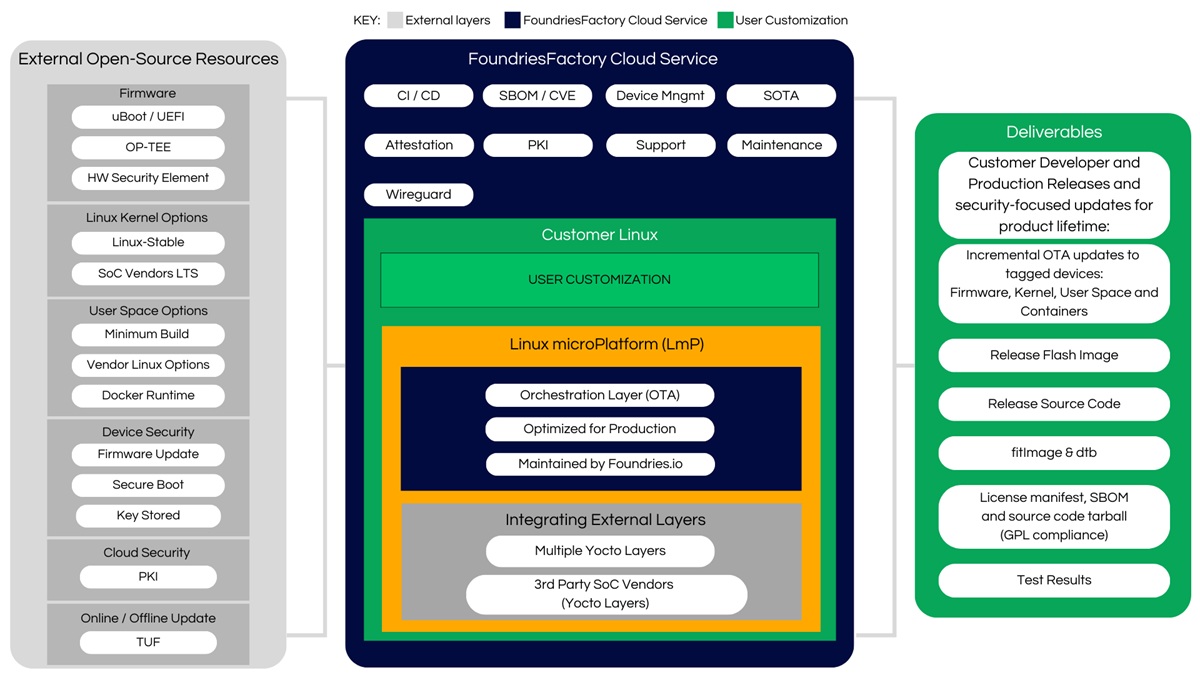
Figure 3. [click to enlarge] The FoundriesFactory platform integrates external open-source resources to provide development, security, and operational functions. Image used courtesy of Foundries.io
Alongside the LmP, the FoundriesFactory platform orchestrates a suite of open-source tools, including Docker for container development and The Update Framework (TUF) for OTA updating, around a comprehensive and granular database for code and device identities. This enables a CI/CD process backed by rollback capabilities and automatic generation of SBOMs unique to each production unit.
At every step of the way—from proof-of-concept development through production, to deployment and eventually decommissioning—the product's codebase, security, and update status are automatically recorded. The information is readily available to support the automation of processes such as firmware flashing, exposure checking, and OTA updating.
This infrastructure for developing, deploying, and maintaining a Linux OS and application software is what's missing in the commercial Linux distributions which are so convenient for proof-of-concept development. Of course, it is possible to build a production version of a proof-of-concept on such a commercial Linux OS, but then the OEM will have to create for itself the full suite of security, key management, fleet management, and updating capabilities that are already available in the FoundriesFactory platform. The CRA requires these capabilities—and so does the ability to more securely update AI applications.
Security Infrastructure: Unflashy But Essential
The Foundries.io demonstration at The Things Conference wasn't exciting, but it wasn't meant to be. The features it showcased are like the seat belts in a premium car: not the first thing that a potential customer pays attention to in the showroom or on a test drive—but no customer would buy the car if it didn't have them.
The fundamental security capabilities that enable productization of a proof-of-concept or demonstration design tend not to attract the attention of the YouTube stars of the embedded world. However, they're absolutely essential to the success of a product deployed to any industry where security capabilities are mandatory.
Featured image used courtesy of Adobe Stock