Facebook
 Google
 GitHub
 Linkedin
Software-Defined Systems: Reshaping the Future of Modern Cars
This article explores how digital twins can help to reshape the design methodology of automotive semiconductors and systems, enabling truly software-defined vehicles.
Today's vehicles are no longer defined by horsepower or torque. Instead, they are now characterized by the intelligence and adaptability of the software that runs them, along with consumer expectations of continuously evolving driving experiences.
To meet these expectations, automakers are now realizing that they need to adopt a software-first mindset rather than designing fixed hardware architectures and layering software on top. In this way, the rise of the software-defined vehicle (SDV) represents a paradigm shift in automotive engineering.
Limitations of Vehicle Development
Traditionally, the automotive industry has followed a hardware-first development model. In this model, vehicle architecture is finalized long before software development begins. This is inefficient and prone to delays.
For example, when new safety or infotainment features emerge mid-development, manufacturers struggle to integrate them because the vehicle's electronic architecture and electronic control units (ECUs) are already locked down. This often leads to delays to vehicle launch or the postponement of innovative next-generation features, damaging brand competitiveness and consumer perception.
As cars evolve into connected, intelligent systems, the complexity of integrating hundreds of sensors, ECUs, and AI-driven functions is exposing the inflexibility of hardware-first design. A simple software change, like adding a new driver-assistance function, can cascade into months of revalidation and hardware retesting. Consumer electronics and mobility services iterate every few months, making the slow, siloed model of development no longer sustainable.
These issues, coupled with the need to accelerate time-to-market and to offer differentiation that excites consumers, mean that software development can no longer just be an afterthought. It needs to be embedded into the hardware design process from the beginning.
Using a shift-left approach, engineers/architects can start with software workloads and validate them on a digital twin of the vehicle and its electronics much earlier in the development cycle. System architects can now continuously develop and test AI-driven applications, such as:
- Autonomous driving perception stacks.
- Decision-making capabilities.
- Advanced driver assistance systems (ADAS).
- Connectivity.
- Infotainment systems.
Development using virtual ECUs and semiconductor models allows the hardware to be optimized around actual software demands.
Early Digital Twin Deployment Saves Time and Money
The traditional flow for development is shown in the top half of Figure 1. The bottom half shows a digital development flow where co-development can be started much earlier. Using this approach, software development can be started at least six months earlier and tested with the hardware without affecting the delivery schedule.
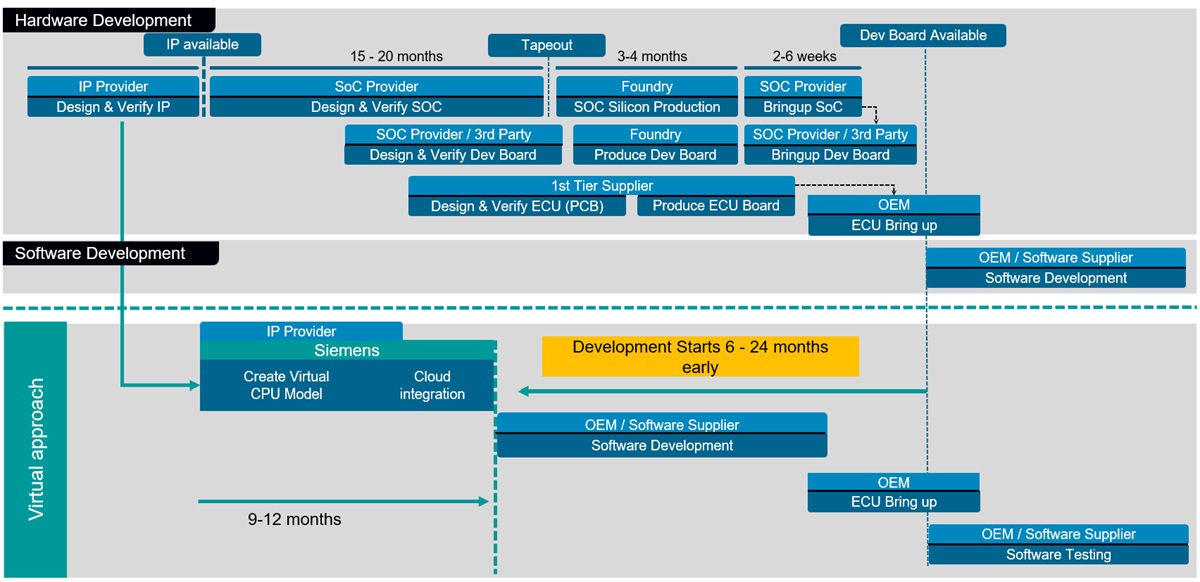
Figure 1. [click to enlarge] Top: conventional hardware and software development cycle. Bottom: a more efficient approach using virtual hardware.
Tier 1s and OEMs want to move away from the conventional hardware and software development cycle. By deploying digital twins early in the design process, engineers can test how different hardware architectures respond to software workloads, such as AI-based perception or real-time navigation. This reduces the risk of costly redesigns. It can also ensure timely delivery or even accelerate time-to-market.
AI Workloads are Significantly Influencing Chipset Feature Optimization
Artificial intelligence is now an integral part of today's cars. Many features are fueled by AI models, including:
- Advanced driver assistance systems.
- Lane-keeping.
- Adaptive cruise control.
- Highway pilot.
- Collision avoidance.
These features require massive data processing capabilities, fast calculations, and continued learning from real-world driving scenarios.
Unlike traditional automotive control units designed for deterministic tasks (for example, engine control or braking), AI-driven workloads demand specialized semiconductor hardware with immense computational throughput, low-latency data transfer, and high energy efficiency. Examples include:
- High-performance systems-on-chips (SoCs) such as NVIDIA Drive or Qualcomm Snapdragon Ride that integrate CPUs, GPUs, and neural processing units (NPUs) for perception and decision-making.
- Memory subsystems like LPDDR5 and high-bandwidth memory that enable faster data movement between sensors and processors.
- Networks-on-chips (NoCs) that handle parallel AI inference and communication among distributed ECUs.
The next generation of autonomous vehicle features will be even more complex, requiring more dynamic, high-bandwidth computational resources. Once this occurs, digital twins will be used to quickly evaluate multiple potential chipset configurations that would be far too expensive and time-consuming to achieve using real SoCs.
For even more realistic results, semiconductor suppliers should be able to simulate the workloads taken from current real-world driving data. By validating silicon architectures in virtual car environments, chipmakers can anticipate bottlenecks early, optimize performance, and deliver AI-ready semiconductors that enable better and more adaptive vehicles.
SDV Development Cannot Happen in Silos
One of the significant issues in current vehicle design methodology is that much of the development happens in silos. After the definition phase, parallel teams develop their systems in isolation with little to no interaction until the full system integration.
Efficient code cannot be developed in isolation from the rest of the system, but that's not the only problem. More significantly, when full system validation is only possible after hardware is delivered, any significant issues can cause immediate and potentially catastrophic schedule delays.
To address these issues, a digital twin platform can be used to simulate full systems-of-systems. For the results to be as accurate as possible, real-world inputs and hardware should also be integrated.
SDV Feature Set Evolution Needs Continuous Validation and Testing
Software-defined vehicles are not static products that become obsolete after a few years. Rather, they are evolving platforms. These cars can receive continuous updates, unlocking new features long after purchase.
For owners, this means enhanced safety, an improved driving experience, and a longer vehicle lifespan. For automakers, software-defined vehicles create new revenue streams through subscriptions and feature-on-demand services.
In this scenario, a system designer can't simply choose a chipset without a futuristic outlook, nor can they write efficient code in isolation. A stable, adaptable simulation environment capable of evaluating full systems throughout the entire SDV development flow is also required.
Ultimately, realizing a full software-defined vehicle concept is not possible without using digital-twin technology. Even then, it can't be achieved using a piecemeal approach. Instead, it needs a holistic environment that integrates all the models, tools, and hardware into one platform with synchronized communication. It should also be scalable, growing with designs to cover each phase of the development cycle.
Figure 2 illustrates how an integrated development workflow for SDVs enables an end-to-end digital twin approach. It's an open solution based on automotive standards that can be used to build a platform that provides a 360-degree view of how chips, ECUs, software stacks, and vehicle networks interact.
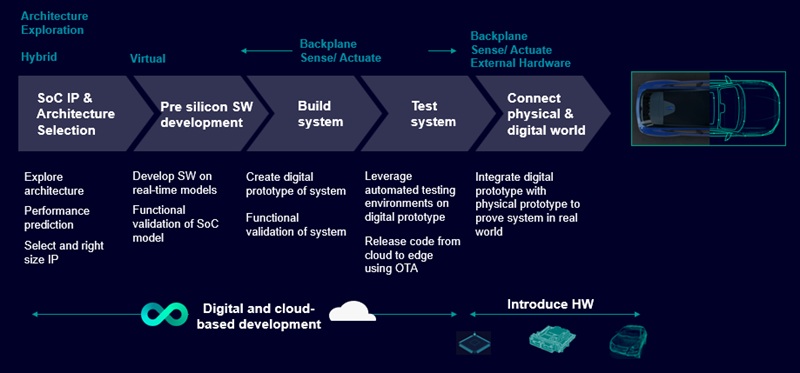
Figure 2. The end-to-end digital approach using Siemens PAVE360 integrated development workflow for software-defined vehicles.
How to Use a Digital-Twin Platform to Design and Test SDVs
A multi-fidelity digital twin should be able to scale across vehicle design, creating a sole source of truth within an organization.
A digital twin environment can be used by system architects for architecture selection to test multiple SoCs in the same loop by deploying similar software architecture onto various models of the SoC and analyzing their performance for the given scenario. Then they can select the best SoC for their use cases using simulation, rather than relying completely on the datasheets provided by the chip makers.
By using native acceleration in the cloud, pre-silicon software development is now also possible. For example, Innexis Architecture Native Acceleration (ANA) offers near real-time performance, thus overcoming the issues commonly associated with slow virtual models. It is available for leading next-generation automotive IP such as Arm Zena-CSS.
Now, OEMs can develop their software early and IP partners can create software ecosystems before the hardware becomes available. System architects can then use the digital-twin platform to build a simulation of their full system through the VSI tool, test the developed software, and validate the system performance under multiple scenarios using inputs from both the real and virtual world.
Tools such as CARLA allow system engineers to run and validate using multiple real-world scenarios. This ensures that the hardware and the software perform under millions of kilometers of simulated scenarios. These efforts also ease subsequent certification to technical, safety, and legal standards.
Similarly, system architects can assess their mechanical models by integrating the Amesim/PyBamm/FMU3.0 models into their simulation or the network. System testing can always be traced back to the requirements in the same loop, and design iterations can be done in a timely manner to achieve the required maturity. Once the system architects are confident enough with their design, they can start bringing the actual hardware in the loop.
One of the hallmarks of SDVs is the ability to evolve via over-the-air updates. Using digital twin technology, system architects can develop software upgrades while the cars are running on the road. Architects can simulate any software releases against the digital twin of the hardware and ensure that updates won't compromise safety or performance. After rigorous testing, the software can be deployed to millions of vehicles on the road without endangering any human lives in the real world.
Wrapping Up
The rise of software-defined systems is transforming the automotive industry from a manufacturing-driven business into a technology- and innovation-driven ecosystem. SDVs redefine how automakers deliver value in a rapidly changing market.
With comprehensive digital-twin environments, system architects can safely simulate faults, test new algorithms, and validate updates in a fully virtual environment before deployment. This not only provides assurance for reliability and safety but also dramatically shortens the development cycle. Automakers can now reduce time-to-market, lower warranty costs, and extend the lifecycle value of each model by continuously delivering software-driven enhancements.
In essence, SDVs empower automakers to behave more like software companies: agile, data-driven, and customer-focused. They can personalize driving experiences, monetize digital services, and build stronger brand loyalty, all while reducing the risks and costs associated with traditional vehicle development. The result is a smarter, safer, and more sustainable automotive future—one where innovation travels as fast as the software that drives it.
All images used courtesy of Siemens