Facebook
 Google
 GitHub
 Linkedin
5 Light-Based Technologies Reshaping Computing and Sensing
Researchers push the boundaries of photonic devices, opening new frontiers in AR, structural monitoring, and quantum applications.
Light-based engineering is advancing rapidly. In the past month alone, five major optoelectronics research milestones have demonstrated that photonic devices are moving from laboratory curiosities into practical, scalable implementations.
Whether programmable everyday objects, tunable polarization controls, AI-optimized sensors, or free-space beam steering, these projects reveal a common theme: researchers are racing to control light at smaller scales, at higher speeds, and at lower power costs than ever before. Each breakthrough opens distinct applications, and collectively suggests that optoelectronics is ready for mainstream adoption.
1. MIT Reprograms Objects With Light
MIT researchers led by Yunyi Zhu and senior author Stefanie Mueller have developed ChromoLCD, a handheld stamping device that "reprograms" the appearance of everyday objects on demand. The tool combines a monochromatic LCD with custom LED backlighting (RGB and UV channels) and a Raspberry Pi 5 controller.
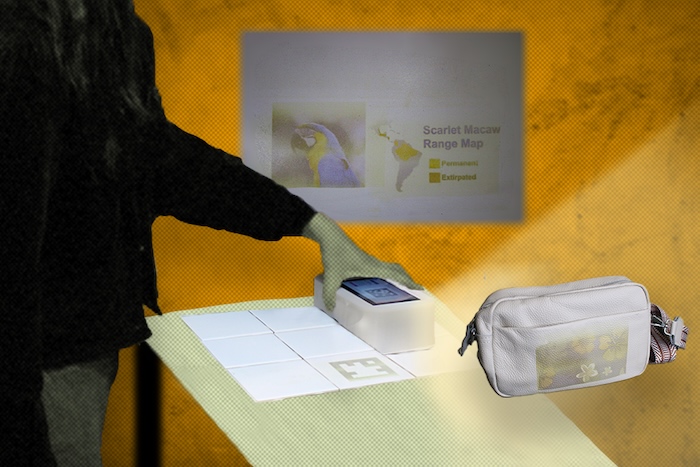
ChromoLCD programs clear pictures onto t-shirts, tables, and whiteboards. Image used courtesy of MIT
When pressed against a surface coated with photochromic dyes, the device uses UV light to activate the dyes and visible light to desaturate individual color channels in real time. This results in 25 pixels per inch, which is eight times the resolution of prior art. Reprogramming takes between 7 and 20 minutes. The work, published at the ACM TEI conference this month, sidesteps the need for electronic displays embedded in materials; instead, it treats any dyed surface as a reconfigurable canvas.
2. Duke Devises Tunable Polarization Controls
In parallel, Harvard researchers under Eric Mazur, led by Fan Du, have tackled a different light-manipulation challenge: dynamically controlling circular polarization. Their chip-scale device stacks silicon nitride membranes with MEMS actuators to create a twisted bilayer photonic crystal.

Schematic illustration of MEMS-integrated twisted bilayer photonic crystals illuminated by right-handed circularly polarized and left-handed circularly polarized beams. Image used courtesy of Harvard
By mechanically tuning the twist, the device exerts real-time control over how light spirals, or its "handedness." Published in Optica in early March, this advance opens doors to polarization-sensitive displays, optical switches, and quantum information systems that depend on handedness control.
3. UCLA Invents AI-Optimized Sensing Without Power
UCLA's Aydogan Ozcan has pioneered diffractive optical processors, AI-designed diffractive surfaces that encode information directly into light's phase and amplitude without power consumption.
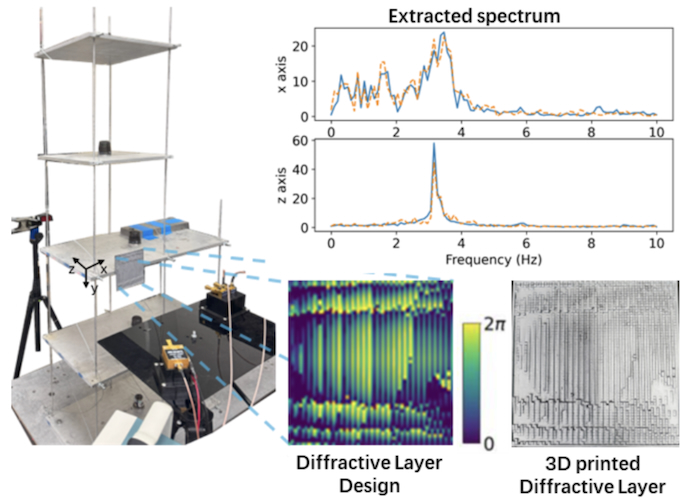
Structural vibration monitoring with diffractive optical processors. Image used courtesy of UCLA's Ozcan Lab
On March 4, his team published results in Science Advances showing how millimeter-wave illumination interacts with the diffractive structure to create optical signatures of vibrations. A shallow neural network decoder then translates these signatures into structural health data. The team successfully tested the approach on seismic waveforms using lab building models. Because diffraction is passive, the sensor requires no external power, a major advantage for distributed monitoring across infrastructure.
4. Duke Pushes Thermal Photodetectors to Gigahertz Speeds
Meanwhile, Duke University's Maiken Mikkelsen and PhD student Eunso Shin have pushed the speed of thermal photodetectors into the gigahertz range. Their metasurface design places 10-nanometer silver nanocubes just above a gold layer, trapping light through plasmonics to achieve 2.8-GHz operation and 125-picosecond response times—100 to 1,000 times faster than conventional pyroelectric detectors.
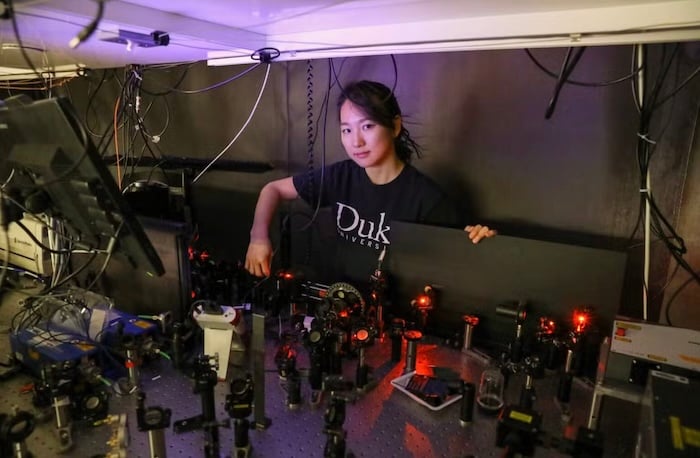
PhD student Eunso Shin with the metasurface device. Image used courtesy of Duke University
Critically, the device operates at room temperature with no external power and responds across the full electromagnetic spectrum. Published in Advanced Functional Materials, this work enables imaging and sensing applications previously impossible with thermal detectors.
5. MIT Steers Light Into Free Space
Finally, MIT's photonic free-space device, published in Nature on March 11, solves a perennial challenge of efficiently steering light from on-chip waveguides into free space.
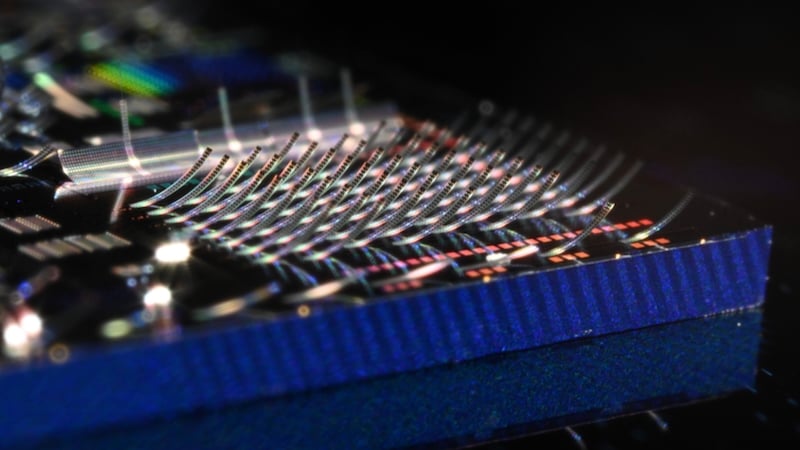
MIT's photonic chips leverage light rather than electricity to process data, using microscopic structures that curve upward like ski jumps. Image used courtesy of MIT
The team—Henry Wen, Matt Saha, Andrew Greenspon, and senior author Dirk Englund—used "ski jump" structures made from silicon nitride and aluminum nitride, which exploit different thermal expansion coefficients to bend beams upward. The result is an extraordinary density of 30,000 pixels in the footprint of two smartphone pixels, with applications spanning AR and VR, LiDAR, 3D printing, and quantum computing.
A Bright Future for Optoelectronics
These five projects underscore a shift in optoelectronics, in which light is becoming programmable, efficient, and dense. Programmable surfaces blur the boundary between display and material; dynamic polarization control enables polarization-dependent quantum systems; passive diffractive sensors reduce power budgets for distributed monitoring; ultra-fast thermal detectors open new imaging modalities; and free-space photonic devices unlock practical AR, sensing, and quantum systems.