Facebook
 Google
 GitHub
 Linkedin
Menlo Micro Announces Configurable Switch for Semiconductor Testing
The company claims the MEMS switch is in a league of its own, replacing mechanical and solid-state relays in high-speed semiconductor test equipment.
At DesignCon 2026, Menlo Micro introduced a new DC-coupled, 80-Gbps high-speed differential loopback switch. The new MM5627 switch—housed in an 8.2-mm x 8.2-mm, 227-lead LGA (land grid array) package—supports DP3T switching in 128 possible switching states at speeds from DC to 20 GHz.
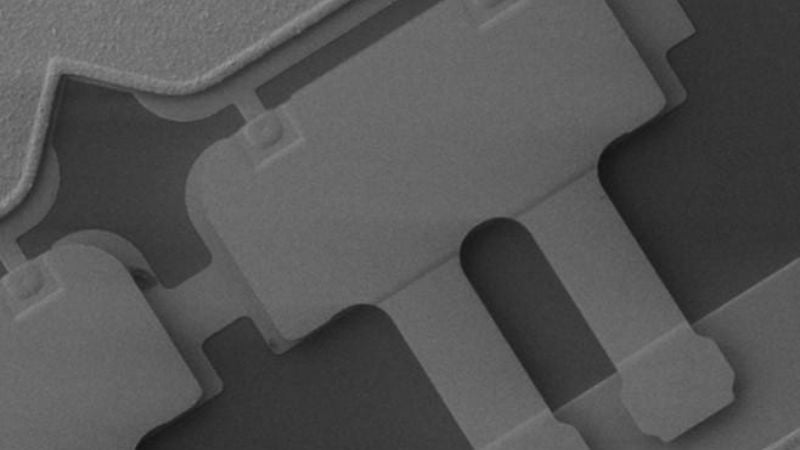
Photomicrograph of Menlo Micro’s MEMS switch technology.
Menlo Micro says the switch is the first in its category to fully integrate on-chip components for DP3T logic, high configurability, and 80-Gbps performance. The company designed the chip to test and validate AI GPUs, CPUs, and advanced semiconductor ICs. The switch is used for routing, switching, and looping back signals at higher speeds and with greater versatility than previously possible.
The switches are microelectromechanical systems (MEMS) produced with semiconductor-like fab processing. As mechanical switches, they provide linearity and low-loss characteristics that semiconductors can’t match. The small size and weight mean they can offer switching speeds that far exceed those of any conventional mechanical relay. The MM5627 is arc-free up to hundreds of volts. It also operates at temperatures above 300ºC and switches in less than 10 μs. The small size makes them relatively immune to shock and vibration.
A Highly Configurable Switching Topology
This device offers a DC-to-20 GHz signal-through range and features a differential dual DP3T switch with loopback capability. It uses a normally open, reflective actuator design and delivers a low insertion loss of –2.3 dB at 20 GHz.
An integrated charge pump and driver eliminate the need for external biasing and driver circuitry, simplifying system design. The fully controllable ports support low-, medium-, and high-data-rate signal routing, providing flexible configuration options.
Designed for high reliability, the switch supports greater than three billion switching operations. It operates at 3.3 V DC with a 5 V DC I/O maximum. It also requires a 5-V DC charge-pump supply and supports a switch-cycle frequency of up to 100 Hz.
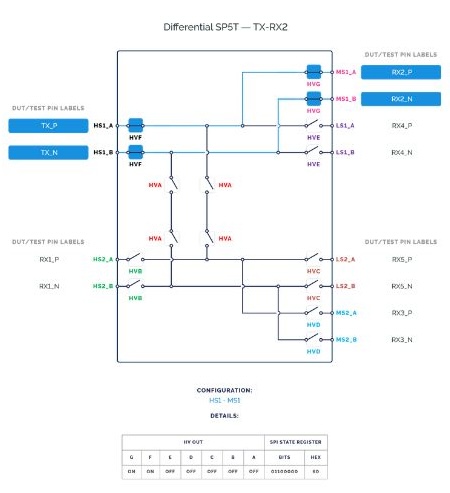
Online configurator for MM5627 switch options.
The MM5627 can be configured in up to 128 different switching states. Users can access the settings through an SPI interface or GPIO. Menlo Micro offers an online configurator to help define the settings and accompanying configuration codes. It can further be ganged into large switch arrays for even greater flexibility.
Relays You Never Hear About
The growth in AI data centers is dramatically increasing the need for support and ancillary technologies that accompany AI GPUs, AI accelerators, and high-bandwidth architectures. These devices call for easier and faster test systems.
Test equipment for high-speed protocols, such as the latest PCIe or SerDes, and modern processors, such as AI accelerators and CPUs, requires multiple configuration arrangements. In lab settings, engineers regularly rearrange test cables, but doing so is impractical in large-scale validation or production environments. Such settings require large banks of mechanical or solid-state relays to automate test signal routing.
Mechanical relays have significant limitations in size, power consumption, noise (direct and settling time), and speed. Solid-state relays provide some improvement but come with semiconductor switching losses and many of the same limitations of mechanical relays. Both technologies seem anachronistic compared to the jobs they are tasked with.
Menlo Micro's Ideal Switch
Menlo Micro's alternative to mechanical and solid-state relays, the micro-mechanical MM5627, is built on the company's “ideal switch” technology. The switch takes mechanical switching well beyond the capabilities of either technology it replaces. The MM5627 switches at high-speed semiconductor speeds and power draw, allowing it to operate at a level comparable to the components under test.
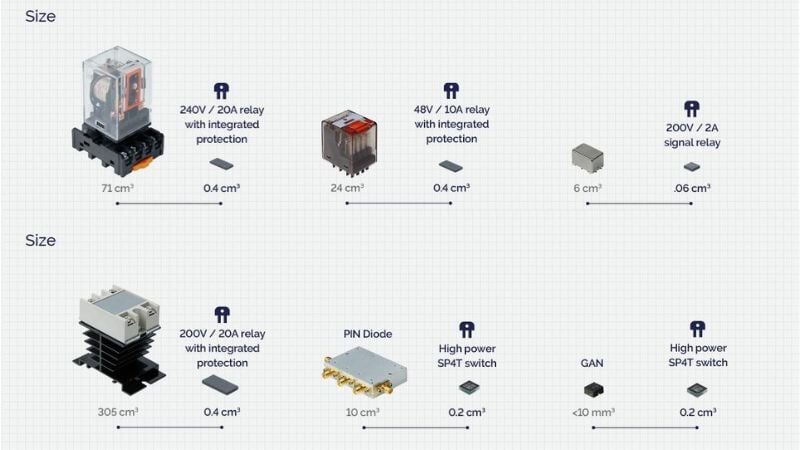
Size comparison of Menlo Micro switches and mechanical relays.
Compared with typical mechanical and solid-state relays, the MM5627 and its related devices deliver significant performance advantages. They offer 100x better linearity, enabling higher bandwidth and data rates. Power consumption is reduced by a factor of 100, thereby extending battery life, minimizing heat generation, and enabling smaller form factors.
With 85x lower resistance, the device eliminates the need for heat sinks while reducing overall size, weight, and cost. An additional 0.5-dB reduction in loss further improves battery efficiency and removes heat sink requirements.
Menlo Micro claims the device provides 1,000x longer operational life than mechanical relays for enhanced reliability, along with switching speeds that are 1,000x faster, enabling entirely new application possibilities.
All images used courtesy of Menlo Micro.