Facebook
 Google
 GitHub
 Linkedin
AI Chip Race Heats Up With Intel, Nvidia, and AMD’s CES Debuts
The industry's biggest chipmakers came to CES with processors that will shape the future of AI PCs, data center computing, and embedded AI.
Artificial intelligence is dominating CES 2026, with AI chips and compute platforms front and center. While Nvidia is advancing new architectures, AMD is talking yotta-scale AI computing for very large models and workloads. Meanwhile, mobile and PC chipmakers like Intel are highlighting AI-ready silicon across devices—signifying that hardware is being redesigned around AI first.

Nvidia CEO and founder Jensen Huang took the CES stage in Las Vegas, opening the show with Rubin, the company's first extreme-codesigned AI platform. Image (modified) used courtesy of Nvidia
In this roundup, All About Circuits looks at these big-silicon announcements from Intel, Nvidia, and AMD, covering chips for AI PCs, next-gen AI data centers, and embedded AI.
Intel Announces AI PC Processors on 18A Process
Intel’s AI PC processor announcement covers the new Core Ultra Series 3, designed for use in AI PCs. The Series 3 promises to deliver high performance in processing and graphics, along with long battery life.
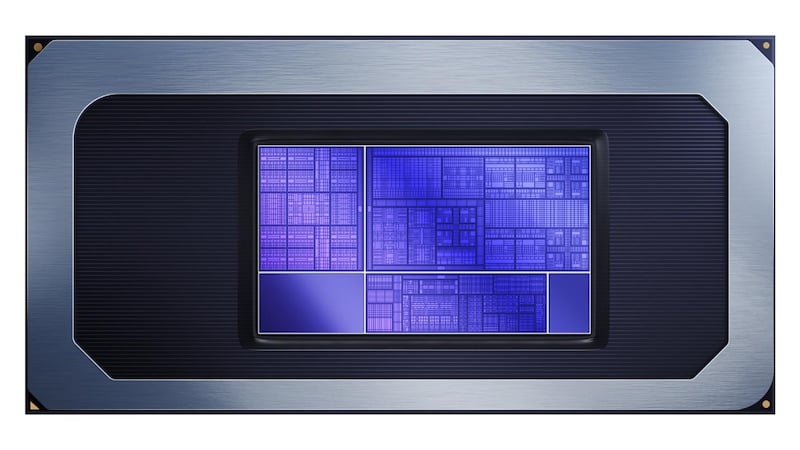
Intel Core Ultra Series 3 processor. Image used courtesy of Intel
The Core Ultra Series 3 CPUs are sold in 14 models branded as Core Ultra 5, Core Ultra 7, and Core Ultra 9. The chips feature up to 16 cores and threads, with a performance core (P-core) frequency of up to 5.1 GHz. Intel's Graphics GPU or the higher-performing Intel Arc GPU provides graphics. The top-of-the-line model has 12 Arc cores at 2.5 GHz, delivering 122 TOPs. AI processing is powered by the Intel NPU core, delivering 50 TOPs for AI tasks.
The Series 3 is the first AI PC processor built on Intel’s 18A process node in North America. It improves chip density by 30% over Intel’s prior best process node, Intel 3. It utilizes Intel’s RibbonFET transistor architecture, which delivers up to 15% better performance per watt. 18A also uses backside power delivery across the chip to increase density, improve cell utilization, and enhance power delivery.
Nvidia Launches Six AI Chips and AI Supercomputer Architecture
Nvidia dominated CES headlines with its new Rubin platform, consisting of six new chips and an AI supercomputer architecture. The anchors of the set are the Vera CPU and Rubin GPU. The platform's tight integration and co-design, along with software stack improvements, are intended to reduce the resources required for AI while increasing performance.
Nvidia claims up to 10x lower inference token costs while requiring 4x fewer GPUs to train mixture-of-experts (MoE) models than its earlier Blackwell platform.
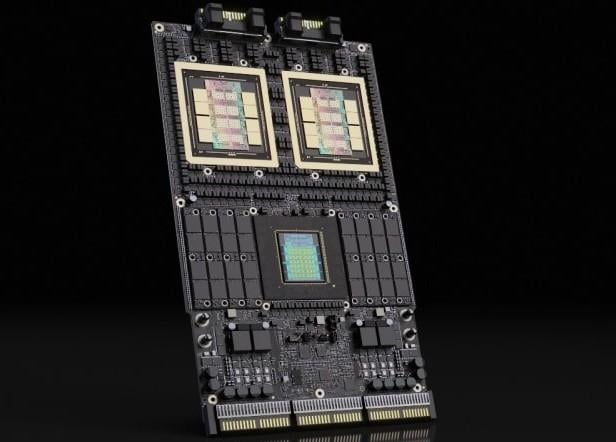
Nvidia Rubin platform. Image used courtesy of Nvidia
The additional four members of the chipset are:
- Nvidia NVLink 6 Switch: High-throughput GPU-to-GPU communications for low latency across the server rack
- Nvidia ConnectX-9 SuperNIC: Networking for massively parallel computing and transfers across the data center
- Nvidia BlueField-4 DPU: Data processing unit drives inference context memory and AI-native storage
- Nvidia Spectrum-6 Ethernet Switch: Fully standards-compliant Ethernet
AI supercomputing is as much about moving data fast as it is about processing, which is why four of the six new chips are directly related to data movement. The supported high-bandwidth memory 4 (HBM4), along with NVLink 6 chip-to-chip transfer architecture, reduces bottlenecks with GPU scaling. The communications switch, NIC, and Ethernet switch all cover different parts of the processor-to-processor and system-to-outside-world communication workload. The DPU handles cache like memory and memory security
Nvidia’s philosophy looks at the entire rack system rather than the processing units as the core computing device. The Vera CPU features 88 cores and up to 1.2 TB/s of LBDDR5X memory bandwidth. By improving the CPU for system management, the GPU for AI processing, and the system's internal and system-wide data paths, Nvidia believes it has created the most advanced AI supercomputer at the lowest cost.
AMD Targets Embedded AI With New Ryzen Processors
AMD came to CES with its new Ryzen AI Embedded P100 and X100 series CPUs targeted at embedded AI systems. The P100 processors are based on Zen 5 CPU cores with 4 or 6 cores and 8 or 12 threads, depending on the model. The X100 will have up to 16 cores when released. Both chips are x86 instruction-set-based and include an integrated AMD RDNA 3.5 GPU for graphics and an AMD XDNA 2 NPU for low-power AI acceleration.
AMD designed the 4- to 6-core P100 models for digital vehicle cockpits and human-to-machine interfaces (HMI). The integrated NPU and GPU enable higher-performance AI processing with lower power consumption and a smaller physical footprint. This makes the devices better able to bring AI into the high-performance embedded universe.
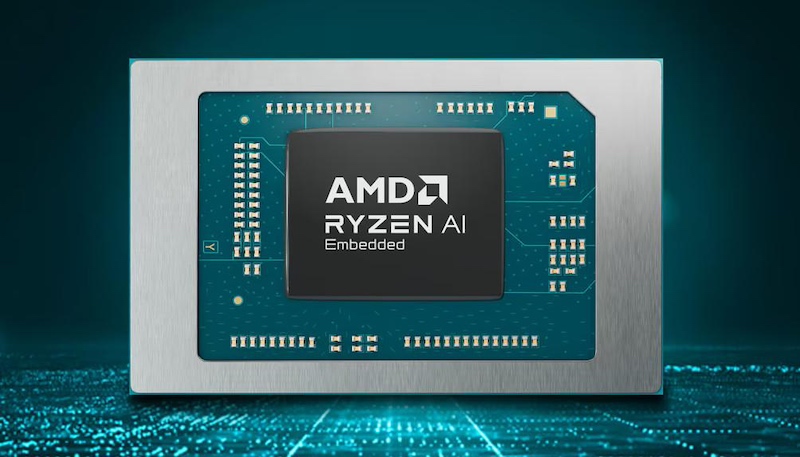
AMD’s new Ryzen AI Embedded, introduced at CES 2026. Image used courtesy of AMD
AMD’s new CPU delivers up to a 2.2× boost in both multi-threaded and single-threaded performance over the previous generation, along with up to 50 TOPS, enabling 3x higher AI inference performance than earlier versions. It also offers 35% faster graphics performance, while operating across a 15–54 W power range. It also supports extreme temperatures from -40°C to +105°C in its industrial and automotive variants.
AMD sees the chips enhancing infotainment, real-time graphics, and adding AI-driven interactivity across multiple interface domains. Other targeted applications include smart healthcare, autonomous physical AI, and advanced AI-supported industrial control systems.
AMD is now sampling the P100 series processors with 4 to 6 cores to early-access customers, with full availability coming in Q2 2026. The industrial P100 variant with 8 to 12 cores is slated for sampling in the first quarter. The processors are available in standard, industrial-temperature, and automotive-grade classes.
AMD plans to roll out the X100 processors for sampling by mid-year. As of this writing, AMD has not yet published a product information page covering the X100 processors.