Facebook
 Google
 GitHub
 Linkedin
Cadence Adds Digital Twin for Nvidia’s AI Data Center Compute Platform
A new addition to Cadence's Reality Digital Twin platform library aims to speed the design and deployment of large AI data centers.
Cadence recently announced an AI data center digital twin for Nvidia's high-performance accelerated computing platform. This addition brings Nvidia’s DGX Superpod with DGX GB200 systems to the Cadence Reality Digital Twin Platform library. The updated Reality Digital Twin Platform can be used to design and simulate the most powerful AI data centers built to date. It allows drag-and-drop design, reconfiguration, and operational simulation of incredibly complex AI data centers.

Cadence data center simulation.
The Cadence Reality Digital Twin Platform is a modeling system designed specifically for the build-out and deployment of large AI data centers. Cadence calls the software “the industry's only physics-based digital twin platform for data centers.” The software is the result of an ongoing collaboration between Nvidia and Cadence. It already includes support for the Nvidia Omniverse blueprint for AI factory design and operations. The new addition supports Nvidia’s latest turnkey AI data center infrastructure solution, the Nvidia DGX Superpod with DGX GB200.
The DGX GB200 Superpod
The DGX Superpod is Nvidia’s highest performing purpose-built rack-scale system for training and inferencing trillion-parameter generative AI models. The rack is liquid-cooled and comes with 36 Nvidia Grace Blackwell Superchips. The Superchips consists of a Grace CPU and two Blackwell GPUs on a common substrate. The rack systems can be combined to create computing modules with hundreds of thousands of CB200s. The Superpod is a turnkey data center solution built around DGX GB200s with all of the necessary support infrastructure.
Nvidia has also developed a reference design and blueprint for AI data centers. The reference describes how to design an AI factory. It includes all the major systems and the physics parameters attached to those components. Nvidia plans to make the reference design an open system. The Superpod is a part of the blueprint, so designers can make use of it as their base.
Keeping Up With Data Center Growth
AI data center growth continues at an astounding pace. Along with that growth comes the need for optimization for efficiency. Two of the biggest challenges facing designers of the latest, largest AI data centers are power distribution and cooling performance. AI installations, as of this writing, reach up to around 200 megawatts. Multiple companies are already building or planning facilities that reach into the low-gigawatt range.
Researcher Dean Nelson, chairman and founder of Infrastructure Masons, estimates that currently, there are seven million smaller data centers worldwide totaling 105 gigawatts of capacity. Due to design inefficiency, however, 37 GW of that is unused either due to cooling or power limitations. The wasted 37 GW, for reference, could power nearly 30 million typical homes in the U.S. Cadence's platform and Nvidia's reference design target improvements in the design process and those power inefficiencies.
Data Center Simulation and Digital Twins
Simulation doesn’t stop at the schematic level. Designing complex systems today includes simulation, and that testing extends to data centers. The “digital twin” is a model that allows designers to accurately account for all significant parameters, including space, energy, cooling, environmental impact, and cost. Cadence refers to its digital twins as “physics accurate” for their model accuracy and the breadth and depth of the simulation system.

Digital twin-level simulation of an AI data center showing heating and cooling patterns.
Digital twin simulation is a proven and entrenched practice in the semiconductor industry, with 99% of all semiconductors undergoing simulation prior to fabrication. Other industries lag behind. Systems, such as data centers, robotics, drones, and aerospace, currently only simulate 20% of devices. Now, the Cadence Reality Digital Twin Platform is bringing digital twin-level simulation to large-scale AI data center design.
Early data centers were little more than warehouses filled with rows of server racks. The latest centers, however, use astronomical amounts of power and require precision cooling and power distribution. Today’s data centers are complex systems with multiple critical variables needing careful coordination.
Drag-and-Drop Data Center Modeling
The Cadence Reality Digital Twin Platform comes with a library of more than 14,000 data center components and related items from more than 750 vendors. Cadence includes every known component of an AI data center to enable 100% simulation coverage. If a designer needs a library model that is not included, Cadence will create and add it to the customer’s library as part of its software support.
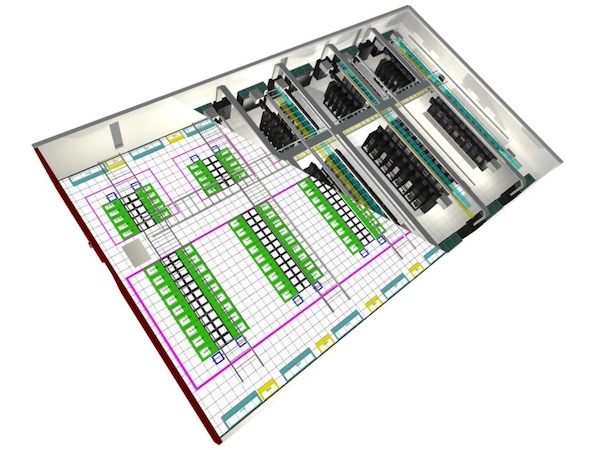
Work-in-progress drag-and-drop AI data center design.
The platform software uses a drag-and-drop metaphor during the design phase. Each physical property of the component and subsystem is tracked and computed based on layout and surrounding equipment. The end result is an accurate simulation of the space requirements, physical capacity, cooling, and electrical parameters. By adding, subtracting, or moving, designers can optimize the entire data center system prior to architectural design and buildout.
Simplifying the Complex
AI datacenters are growing in complexity as they are growing in size. A GW-scale AI data center needs just about as much optimization and care as a complex integrated circuit. Cadence is offering the Reality Digital Twin Platform to provide facility designers with the tools to keep pushing AI data center capability while reducing design time and improving efficiency.
All images used courtesy of Cadence.