
 Facebook
 Google
 GitHub
 Linkedin
Can You Power a Circuit With a UV Sensor?
During a recent visit to KMITL’s new KAISEM institute in Bangkok, Thailand, All About Circuits spoke with researchers exploring whether a UV sensor could do more than detect light: could it power part of a circuit, too?
What if your UV sensor could do more than detect light? In a lab in Bangkok, a group of researchers has been quietly flipping assumptions about what a UV sensor can be.
During a recent visit to the KMITL Academy of Innovative Semiconductors (KAISEM), a newly formed R&D center based at King Mongkut’s Institute of Technology, Ladkrabang (KMITL Ladkrabang), I had the opportunity to speak to the researchers about their work and learn more about what, beyond light detection, UV sensors can do.

Assistant Professor Kamol Wasapinyokul, Ph.D., discusses his research paper, ‘Impressive Response of Spin-Coated ZnO Nanparticle UV-Sensitive Devices with Various Thicknesses under Different UV Intensities’.
While UV sensors are traditionally seen as passive detectors that require external circuitry for reading, the researchers' devices, which are based on spin-coated zinc oxide (ZnO) nanoparticles, have shown an unexpected twist. Under the right conditions, they generate photocurrents in the milliamp range—enough, potentially, to trigger circuits, wake microcontrollers, or even trickle-charge capacitors.
"These current levels are sufficient to charge a small capacitor or trigger a low-power switching element," said Assistant Professor Dr. Kamol Wasapinyokul of KAISEM, while speaking to All About Circuits. “What we have been thinking is that our device could act as a UV-activated switch, enabling other circuits when UV is detected, with no need for a microcontroller.”
The idea of a sensor serving as both a signal source and an energy switch is what makes this project so compelling for embedded designers.
Spin-Coating Simplicity, Surprising Results
The sensors themselves are fabricated in open lab conditions using a basic spin-coating process and off-the-shelf ZnO nanoparticles. There’s no cleanroom required. Instead, ZnO is dispersed in chloroform, spin-coated onto pre-patterned glass substrates with gold electrodes, and annealed at 250°C to improve film quality.
Despite this low-cost, approachable fabrication method, the devices deliver impressive results. When exposed to UV light at 375 nm (the peak absorption wavelength for ZnO), the sensors generate photocurrents in the range of hundreds of microamperes, even up to a few milliamps after natural aging in air.
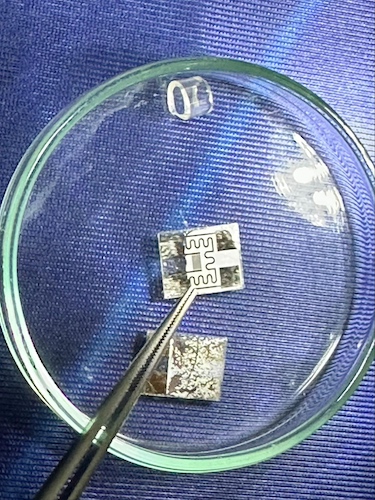
The ZnO UV sensor device. The sensor contains a glass substrate with interdigitated gold electrodes.
The team’s long-term tests, conducted over 56 days in ambient air, revealed that the devices improve over time. Responsivity values jumped from 78 A/W to nearly 700 A/W in some cases, a change attributed to increasing surface oxygen adsorption, which enhances the photoconductive effect.
From Detector to Energy-Aware Switch
Here’s where this becomes interesting from a circuit design standpoint: Those current levels, under UV illumination, are high enough to trigger low-power circuits or even charge a storage element. While the team hasn’t yet implemented capacitor charging or energy harvesting in a formal setup, they confirmed that it’s firmly on the radar.
"Especially for IoT or remote sensing scenarios,” Dr. Wasapinyokul said, “this could allow a device to wake or trigger based on UV exposure, without relying on a microcontroller.”
The concept aligns neatly with embedded designers’ growing interest in energy-aware sensing—components that only become active when their input environment changes. Here, UV serves not just as an input signal, but as the power cue itself.
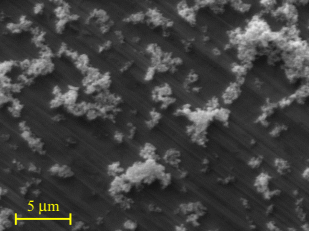
SEM image of ZnO nanoparticles used in the researcher’s original experiments. Image used courtesy of Assistant Professor Dr. Kamol Wasapinyokul/KAISEM
One tradeoff is that while responsivity improves with aging, response and recovery times slow down. In one case, response time grew from four seconds on day one to over 180 seconds by day 56. But for many use cases, such as threshold-based event detection or gradual environmental monitoring, speed isn't the priority.
“Even though the response and recovery times were longer, this may not be a drawback in energy-harvesting or threshold-triggering devices,” Dr. Wasapinyokul pointed out. “In those cases, sensitivity is more critical than speed.”
This suggests that aged ZnO sensors may be better suited to slow-reacting roles, such as UV dosimeters, UV-activated wake switches, or environmental sensors, where continuous low-power operation is more important than instantaneous data logging.
Circuitry and Next Steps
The researchers used a straightforward test setup: a 5-V bias was applied using a Keithley source and measure unit, which also served as an ammeter. They also confirmed that the sensor responds reliably to a simple 5-V battery—no lab-grade equipment required.
Integration with PCBs and microcontrollers is on the horizon, with the team planning to prototype a compact device including signal conditioning and basic logic. They’re also experimenting with introducing asymmetry into the MSM structure to encourage self-powered operation, something that’s currently limited by the device’s symmetric gold contacts.
"We plan to intentionally introduce asymmetry in future experiments," said Dr. Wasapinyokul, hinting at a future where these ZnO layers could act more like photovoltaic elements.
Ultimately, this project isn’t just about ZnO or UV sensing. It’s about rethinking the roles that simple, low-cost materials can play in embedded systems. What starts as a UV detector might also become a switch, a sensor, and part of a power-management strategy, all in the same thin film. For engineers designing the next generation of solar-aware or energy-autonomous systems, such versatility could be transformative.














Fun read, and well timed as I just uploaded a video on energy harvesting using a photodiode and transmitting data over BLE, just with 100uF of nergy storage and no batteries.
So I’m very confident this can be done with UV cells : )
https://www.youtube.com/watch?v=TGbtzlWb-Kc