Facebook
 Google
 GitHub
 Linkedin
Design Wins: Four Designs Rethink Compute, Power, and Integration
This four-product roundup highlights new hardware platforms for spaceborne AI, EV power, wireless sensing, and private 5G.
Computing demands are rising across manifold industries, from space systems and electric vehicles to wireless sensors and private cellular networks. These demands tighten power budgets while maintaining high reliability expectations. Recent product announcements from Spacechips, Wolfspeed, Sensor Maestros, Gigalane, and their respective partners show how designers are responding, not with incremental tweaks, but by rethinking where processing happens, how power is delivered, and how systems are integrated.
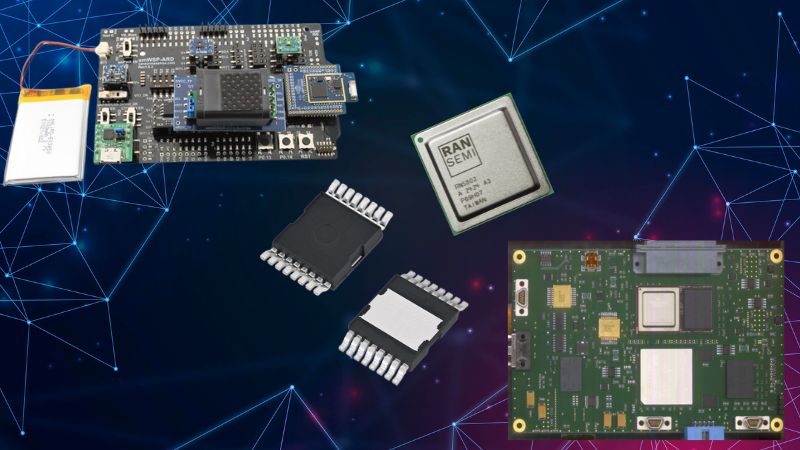
Taken together, these four developments point to a common direction in hardware design. Technological intelligence is moving ever closer to the source of data, power electronics are being optimized for efficiency and longevity rather than peak numbers alone, and modular platforms are replacing custom one-off designs. Each product reflects a deliberate set of trade-offs shaped by its operating environment, whether that’s in orbit, on an EV platform, in an indoor sensor network, or in a private 5G deployment.
Spacechips' Transponder Brings AI Into Orbit
Spacechips’ AI1 transponder starts from a simple premise that most satellite data doesn’t need to make the trip back to Earth. As sensors push for higher resolutions, downlink capacity quickly becomes the limiting factor. The AI1 transponder can mitigate that problem with an onboard Adaptive Compute Acceleration Platform. This platform delivers up to 133 TOPS, so imagery and signals can be processed, filtered, or flagged while still in orbit.
That computing capability brings an immediate power challenge. High-current, low-voltage rails must operate reliably for missions lasting 5 to 10 years under radiation and thermal extremes. Spacechips partnered with Vicor to use radiation-tolerant modules based on its Factorized Power Architecture.
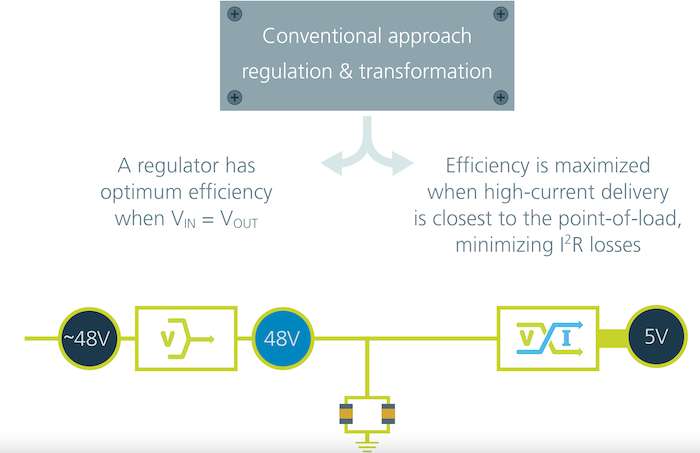
Vicor's point-of-load power system. Image used courtesy of Vicor
This architecture separates isolation, regulation, and current multiplication into discrete stages to deliver dense, redundant power while keeping size and losses under control. The result is a compact, rugged processor card that supports applications ranging from Earth observation and SIGINT to in-space servicing and autonomous satellite operation.
Wolfspeed's SiC in Toyota EV Platforms
Toyota’s selection of Wolfspeed silicon carbide MOSFETs for onboard chargers highlights how SiC has moved beyond flagship traction inverters into everyday vehicle subsystems. Onboard chargers run frequently, manage high voltages, and directly affect charging time and efficiency over the vehicle’s life. That makes long-term reliability and predictable performance just as important as raw switching speed.

Wolfspeed’s silicon carbide MOSFETs will now be used in Toyota’s onboard chargers. Image used courtesy of Wolfspeed
Wolfspeed’s devices were chosen to meet Toyota’s quality and durability requirements while improving conversion efficiency and reducing losses. Higher efficiency means shorter charging times, less heat to worry about, and better overall energy use. The announcement also reflects a broader trend toward vertically integrated, regionally anchored supply chains, as OEMs place more emphasis on manufacturing continuity and long-term availability for electrified platforms.
Nordic-Based Rapid Prototyping for Indoor Air Quality
At the other end of the scale, Sensor Maestros’ smSENSR-LOGR platform focuses on speed of development rather than volume production. Built to mate with Nordic Semiconductor’s nRF52 development kits, the platform gives developers a modular way to assemble Bluetooth LE sensor systems using standardized plug-in blocks for sensing, storage, and connectivity.

Sensor Maestros’ smSENSR-LOGR uses Nordic’s nRF52 SoCs and a modular plug-in architecture to let developers quickly build and test Bluetooth LE sensor nodes. Image used courtesy of Nordic Semiconductor
Sensor Maestro’s platform is built around a controller that lets developers spend time on sensing rather than power tuning or radio edge cases. Nordic’s nRF52 SoCs can provide a predictable Bluetooth LE link and enough headroom to manage periodic sampling and local storage. The initial firmware ties those pieces together by logging air-quality parameters and exposing them wirelessly for configuration and data retrieval.
Gigalane and RANsemi Target Private 5G
Gigalane has announced a new O-RAN radio unit built around RANsemi’s RNS805 baseband SoC. By combining Gigalane’s RF design experience with RANsemi’s software-defined baseband platform, the partners produced a Band n79 radio optimized for enterprise and industrial deployments in Korea.
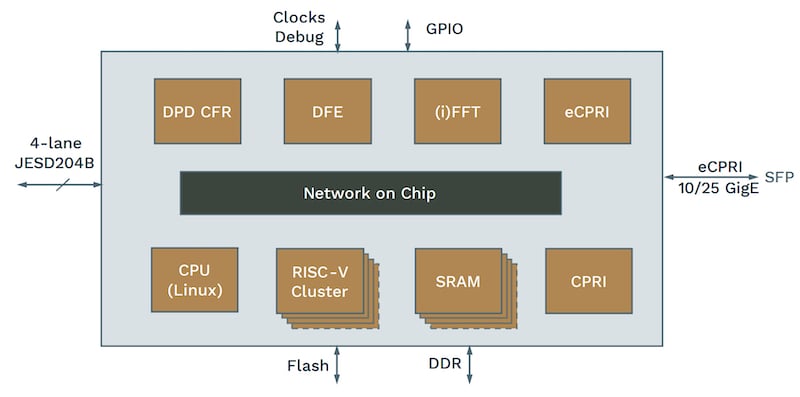
Block diagram of RANsemi's RNS805 silicon architecture. Image used courtesy of RANsemi
The RNS805 enables Open RAN compliance while allowing features and performance to be adapted through software rather than hardware redesigns. That flexibility is central to private networks, where use cases vary widely and evolve quickly. The collaboration also signals growing momentum behind Open RAN architectures beyond traditional carrier infrastructure, extending into localized, enterprise-focused wireless systems.
Although the use cases range from satellites to factory floors, each announcement reflects the same design reality. Bandwidth, power, and physical limits are treated as fixed inputs, not problems to be solved later. Processing moves closer to where data is generated, power devices are chosen for endurance, platforms are reused to shorten development cycles, and radios are designed to adapt in software instead of hardware.