Facebook
 Google
 GitHub
 Linkedin
EDA Companies Rally Support for Arm’s New Compute Subsystem Platform
Following Arm's announcement of its new AI-defined automotive platform, several key EDA players have upgraded their toolsets with support.
Arm's processor architecture appears in more than 94% of automobiles. Now, the company is solidly positioning itself in the AI automobile market with the Arm Zena Compute Subsystems (CSS) platform for AI-supported vehicle design. Arm Zena is an Armv9-based pre-integrated and pre-validated, standardized AI silicon platform. Vehicles based on the Arm Zena will use AI to create a customized, safe, and efficient driving experience—all with minimal intervention from the occupants.

Block diagram of Arm Zena CSS. Image used courtesy of Arm
All About Circuits recently covered Arm’s Zena CSS news in more detail. In this roundup, however, we spotlight announcements from industry EDA vendors Siemens, Cadence, and Synopsys on added support for the Zena platform to their popular toolchains. By providing a standardized solution, Arm hopes to significantly reduce time to market for vehicle manufacturers aiming to introduce advanced AI capabilities. EDA vendor support is also crucial to the quick adoption of the Zena platform.
Siemens' Pave360 SDV Framework
Siemens, a long-time supporter of Arm, has just announced support for Arm Zena CSS in its Pave360 software-defined vehicle (SDV) framework. Pave360 is built around Siemens' Innexis software environment. It includes Veloce hardware-assisted verification and validation system, Teamcenter software for product lifecycle, Polarion for application lifecycle management (ALM), and Simcenter Prescan and Simcenter Amesim software for simulation. The collection applies an integrated approach to software-defined and AI-defined vehicle development.
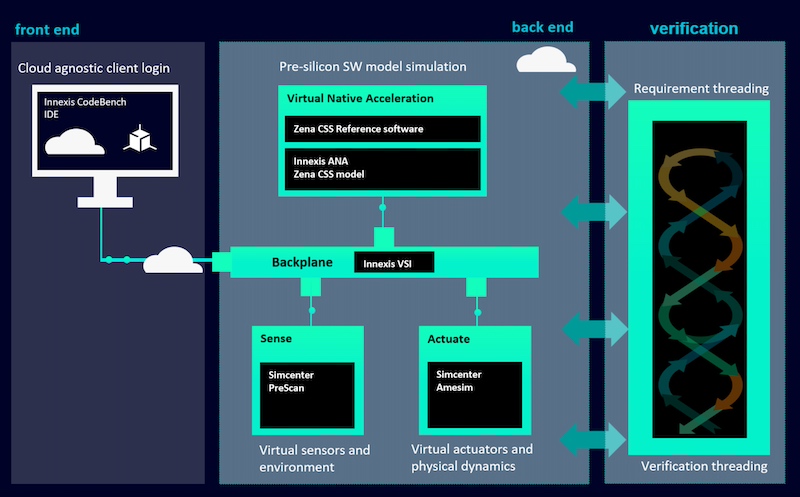
Pave360's digital twin and Arm Zena CSS virtual reference solution. Image used courtesy of Siemens
Siemens bases its initial support for Zena CSS on its Innexis architecture native acceleration (ANA). This allows software developers to begin work before hard silicon is available. The company's digital twin systems further allow simulation with or without silicon to duplicate real-world performance.
Cadence's Helium Virtual and Hybrid Studio
Cadence and Arm started collaborating on AI-defined vehicle design back in 2024. Now, Cadence has added Zena CSS support to its Helium Virtual and Hybrid Studio. The Cadence additions cover IP, design solutions, and design services for software and system-on-chips (SoCs) based on the Zena CSS.
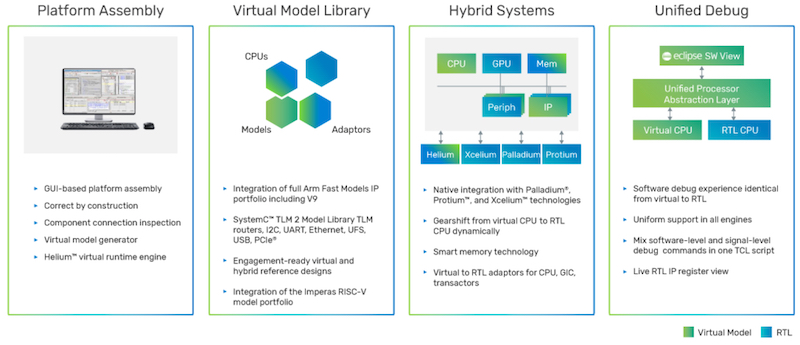
Features of Helium Virtual and Hybrid Studio. Image used courtesy of Cadence
Cadence tools offer a “shift-left” capability that creates a digital twin for virtual prototyping. The tools allow Arm Zena CSS developers to test and validate their solutions prior to creating physical silicon. The collaborative environment is tailored for team-based embedded software engineering and includes advanced modeling services for virtual system-on-chip (SoC) and virtual system of systems (SoS).
Synopsys' Platform Architect and Virtualizer Dev Kit
Synopsys also announced support for Arm Zena CSS in its Platform Architect and Virtualizer Development Kit (VDK). The virtualizer goes beyond simulation and connects developers to hard Arm silicon processors hosted in the cloud. By providing live CPUs in the cloud, software runs up to 100x faster than instruction set simulators.
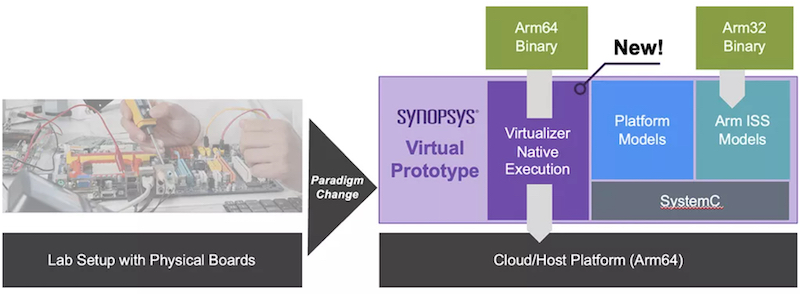
Synopsys virtualizer runs code on cloud-based Arm CPUs. Image used courtesy of Synopsys
To ensure compliance and security, Synopsys software allows the development of in-compliance solutions for functional safety (FuSa) and cybersecurity standards. Zena CSS can take advantage of automatic safety integrity level (ASIL) compliant development systems. Developers can create products that are ISO 26262 and ISO/SAE 21434 compliant.
Bringing AI-Defined Automobiles to Life
The new era of AI-defined vehicles stands to change the automotive experience more than any other innovation. By partnering with key industry EDA vendors, Arm is enabling virtually any automobile manufacturer to join this arena. The three EDA systems covered here have a track record of automotive silicon and software development; their partnership with Arm will now add AI to their users’ tool set.
Featured image used under Adobe Stock license.