Facebook
 Google
 GitHub
 Linkedin
Efinix Expands Titanium Line with High-Speed, AI-Focused FPGAs
Efinix has doubled its Titanium FPGA family, adding devices with transceivers up to 25.8 Gbps to support AI, edge, and industrial applications.
Efinix has doubled its Titanium FPGA family, introducing a set of devices designed for AI-centric applications.
Programmable logic has long been central to industries that need flexibility and high performance. However, as machine vision, robotics, and edge computing workloads become increasingly demanding, older FPGA designs struggle to keep pace with modern data requirements. Legacy devices often require complex workarounds, consume more power than is acceptable in mobile platforms, and occupy too much board space in systems where every millimeter counts.
Efinix FPGAs may support AI acceleration, data analysis, real-time decision making, and other compute-intensive workloads.
Efinix may have a solution. Built on TSMC’s 16/12-nm process technology, the company's newest FPGAs scale logic capacity up to two million logic elements and integrate transceivers that can hit 25.8 Gbps. These additions target industries under pressure to process enormous data streams at the edge, without compromising power budgets or footprint.
Key Features and Specifications
The expanded Titanium range introduces several technical milestones that will catch the eye of system architects. At the heart of these devices is Efinix’s Quantum compute fabric, a design that prioritizes performance per watt. Logic densities now span from 35,000 to 2 million elements, giving designers more headroom for AI acceleration and embedded compute systems.
High-speed connectivity is another highlight. The transceivers, scaled up to 25.8 Gbps, open doors for applications requiring rapid data movement, whether between cameras and processors in a factory inspection line or across communication backplanes in networking equipment. Paired with hardened MIPI D-PHY blocks and LPDDR4/4x controllers, the devices simplify integration with modern imaging sensors and memory. This hardened IP reduces reliance on soft logic, saving resources for the workloads that matter.
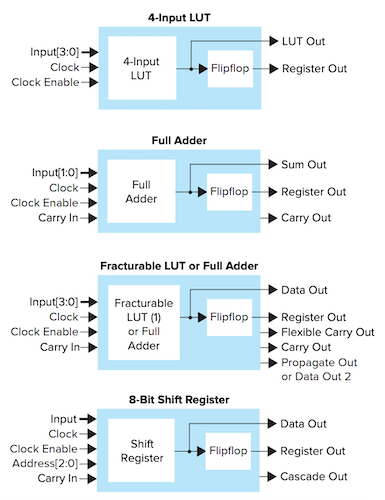
The logic functions in a Titanium FPGA XLR cell.
Security and reliability also receive attention. Built-in single-event upset (SEU) detection enables continuous monitoring of device integrity, while bitstream authentication and encryption guard against tampering. These features are important in critical environments where data integrity is non-negotiable, such as automotive or medical settings.
30 MHz to 1 GHz in One Step
The ability to measure across 30 MHz to 1 GHz in a single step marks a practical shift from earlier designs that needed three passes to cover the same spectrum. Consolidating this task results in faster validation, reduced complexity in test workflows, and fewer opportunities for errors to occur, ultimately leading to shorter development cycles and more reliable performance in the field.
This advancement is particularly valuable in AI-driven sensor aggregation systems. With imaging and sensor data streaming in at diverse frequencies, the devices' ability to handle wide ranges in fewer steps directly accelerates time to market. It also frees engineering resources, reducing the need for additional external components or lengthy debug sessions.
Regulatory Compliance Capabilities
In fields such as communications, automotive, and healthcare, meeting regulatory standards is just as important as performance. Titanium FPGAs help in this area with built-in error detection and strengthened security features that make certification easier to achieve. When devices can demonstrate resilience to interference and secure data handling out of the box, the burden on integrators is considerably lightened.
Efinix has pledged support through at least 2045, adding another layer of assurance. Industries with lengthy product life cycles, such as aerospace or medical, need confidence that components will remain available and consistent across decades of deployment. Titanium’s lifecycle support positions the family as a safe bet for designs that must meet stringent certification and stability requirements.
TSMC Partnership and Broader Impact
TSMC’s 16/12-nm process is central to the new devices. The smaller node allows Efinix to raise logic density and cut power use without increasing size. Some models are packaged at just 3.5 mm x 3.4 mm, making them suitable for handheld systems while still delivering the computing performance usually tied to much larger boards. For industries racing toward real-time AI at the edge, the significance is straightforward: more compute in less space, using less energy. From automated assembly lines to handheld diagnostic equipment, the new Titanium FPGAs give designers the building blocks to create systems that can process, analyze, and act on data the moment it arrives.
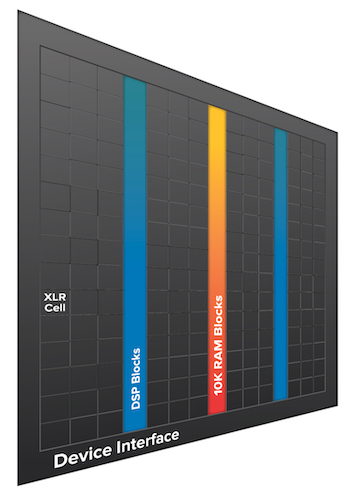
Titanium FPGAs use Efinix's Quantum compute fabric and a 16-nm process node, giving them a small footprint and low power consumption.
Conventional FPGAs are struggling to handle today’s data loads, which can slow development and drive up power use. The new Titanium devices tackle these challenges with faster transceivers, broad frequency support, and integrated compliance features. Built on TSMC’s advanced process technology and supported with a long product lifecycle, they give industries a dependable option that balances performance, efficiency, and long-term stability.
All images used courtesy of Efinix.