Facebook
 Google
 GitHub
 Linkedin
Embedded World NA Showcases the Next Chapter of Embedded Intelligence
From neuromorphic edge silicon to formal Rust verification, this year’s show revealed how embedded design is evolving at every level.
At Embedded World North America 2025, innovation felt less about incremental upgrades and more about integration of hardware with software, of AI with the edge, and of safety with speed.
Across the show floor in Anaheim, CA, companies unveiled new tools and architectures aimed at solving the same underlying challenge: how to make complex embedded systems smarter, safer, and easier to deploy. The five announcements below capture that transition in motion, spanning from neuromorphic processors to formal Rust verification.
BrainChip Brings Neuromorphic Compute to the Edge
At the show, BrainChip launched the AKD1500 edge AI co-processor, a neuromorphic accelerator designed to deliver 800 giga operations per second at under 300 mW, a power-to-performance ratio that targets constrained embedded environments. Built on GlobalFoundries’ 22FDX platform, the device (product brief linked) operates as a co-processor via PCIe or serial interfaces, integrating with x86, Arm, and RISC-V systems without requiring a full SoC redesign.
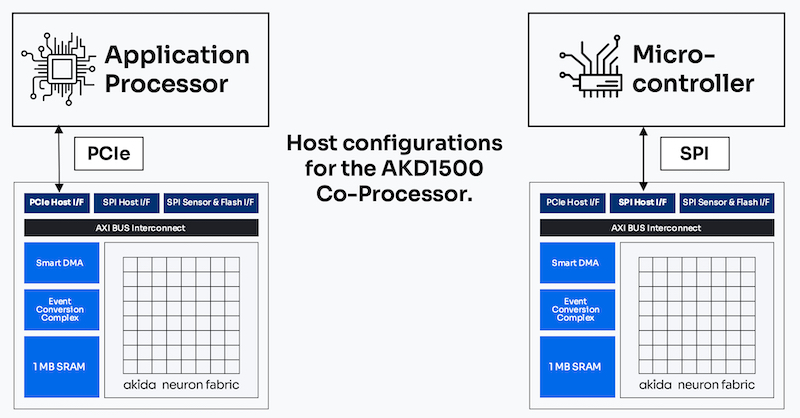
Host configurations for the AKD1500 co-processor. Image used courtesy of BrainChip
Its architecture uses BrainChip’s Akida event-based neural model, which enables on-chip learning instead of cloud retraining. That’s particularly relevant for defense, medical sensing, and wearable applications, where low-latency and data privacy are essential. The AKD1500 also ties into BrainChip’s MetaTF toolchain, allowing engineers to port models from TensorFlow/Keras directly into neuromorphic workflows.
This release marks a practical step toward deployable neuromorphic compute, moving adaptive AI closer to the sensor in both industrial and consumer form factors.
Seco Expands Edge AI With Pre-Trained Applications
Among the new releases, Seco highlighted an object detection system for smart vending, designed to recognize products and user interactions in real time to optimize inventory and automate restocking.
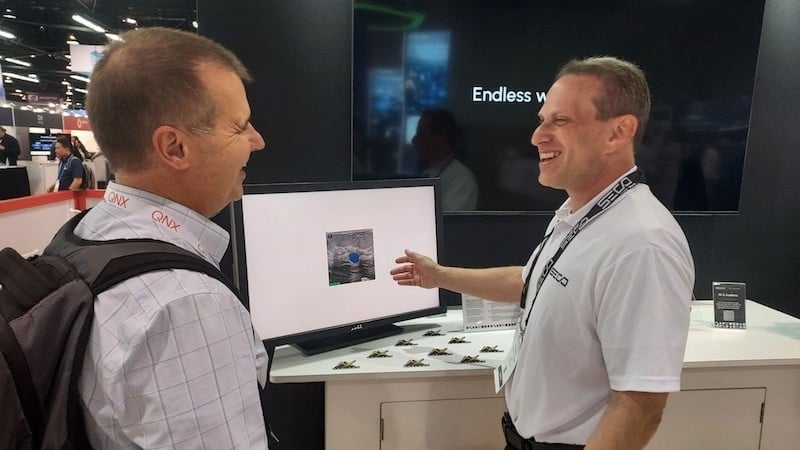
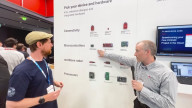
EETech's VP of engineering and content, Dale Wilson, with Seco's VP of products, innovation, and marketing, Rodney Feldman, at Embedded World North America 2025.
Alongside it, emotion recognition and facial attribute detection models demonstrated how on-device deep learning can personalize vending and HMI experiences while maintaining full data privacy at the edge. For industrial environments, Seco’s audio classification for complex noise profiles applies acoustic analytics to distinguish normal operational sounds from anomalies, enabling predictive maintenance and earlier fault detection.
Each model is distributed through the Seco Application Hub and built for seamless deployment within the company’s Clea Framework, supported by enterprise-grade, long-term updates and a retraining workflow through Seco’s Developer Center. Together, these tools advance Seco’s goal of making edge AI a configurable, production-ready component that industrial OEMs can integrate directly into their existing systems without a full redesign.
LDRA and Tasking Target eVTOL Certification Bottlenecks
LDRA, now part of Tasking, announced an all-in-one productivity package aimed at aerospace and defense software certification, particularly for electric vertical take-off and landing (eVTOL) systems. The package consolidates requirements traceability, static/dynamic analysis, compliance reporting, and unit testing into a single toolchain that integrates with modern DevSecOps pipelines.
Dale Wilson with Jim McElroy, LDRA VP of sales and marketing, at Embedded World North America 2025.
By combining LDRA’s test automation suite with Tasking's compiler and debug/trace tools, the package addresses DO-178C, DO-330, and DO-326B compliance as well as multi-core WCET analysis for Arm and RISC-V processors. The approach replaces a patchwork of tools with a unified flow that reduces both certification cost and development time, which is a key challenge for the urban air mobility sector as it scales toward safety-critical autonomy.
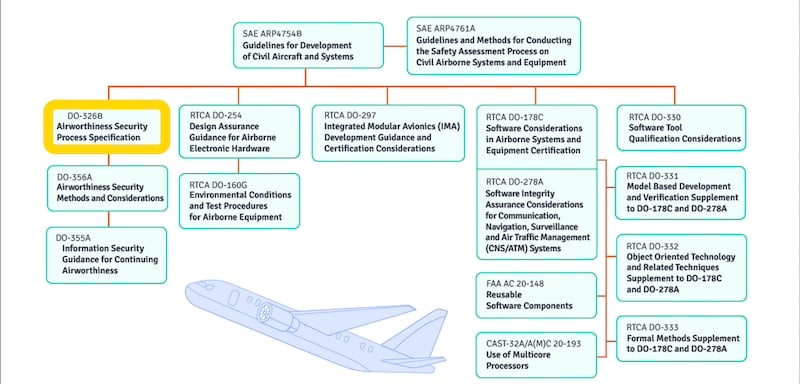
Key air mobility standards. Image used courtesy of LDRA
Grinn’s GenioBoard Accelerates Edge AI Development
Grinn unveiled the GenioBoard, an edge AI single-board computer (SBC) designed around its GenioSOM-700 module. The board targets rapid prototyping and direct transition to production, providing hardware security features and industrial-grade reliability out of the box.

Dale Wilson with Robert Otręba, CEO of Grinn, at Embedded World North America 2025.
The platform supports a wide range of industrial, medical, and smart city applications and includes comprehensive SDK support aligned with MediaTek’s Genio ecosystem. By focusing on design-to-production continuity, Grinn aims to bridge the gap between evaluation boards and deployable hardware, giving engineers a traceable upgrade path as projects mature from proof-of-concept to field deployment.
TrustInSoft Brings Formal Verification to Rust and Real-Time Code
TrustInSoft expanded its TIS Analyzer toolchain with formal verification for Rust, extending its existing C/C++ analysis to cover mixed-language and real-time systems. The update integrates with Ferrous Systems’ Ferrocene compiler toolchain, providing mathematical proof guarantees of memory safety, concurrency correctness, and race-condition detection.
Unlike conventional static analyzers, TIS explores all execution paths, exposing non-deterministic behaviors in multi-threaded and interrupt-driven firmware. For teams migrating critical code to Rust or maintaining mixed environments, the ability to apply formal reasoning across boundaries offers a level of assurance that conventional testing cannot match, particularly in automotive, telecom, and industrial IoT applications.
Related Content