Facebook
 Google
 GitHub
 Linkedin
For the Netherlands, Photonics Initiatives Secure Global Leadership—Part 3
The Netherlands' €1.1B integrated photonics initiative, led by PhotonDelta, is driving global leadership by financing startups and strengthening the supply chain.
For years, one of the Dutch government’s primary objectives has been to accelerate the development of new companies. In order to stimulate company formation and company growth, PhotonDelta has two complementary financing instruments at its disposal. The Startup Fund, worth €60M and supported by the National Growth Fund, focuses on the earliest phase and offers pre-seed loans and innovation vouchers to help young teams move from research to their first steps in the market.
For companies reaching the next stage of growth, there is PhotonVentures, a fund of approximately €100M that was established in 2022 and has already attracted international investors. This fund provides venture capital to startups and scale-ups that want to industrialize and scale up their technology. Together, the Startup Fund and PhotonVentures ensure a continuous pipeline of new companies, attract private investment, and enable the supply chain to renew and strengthen itself.
PhotonDelta: a Photontics Growth Accelerator
PhotonDelta is a non-profit organization that acts as a growth accelerator for the integrated photonics industry. It supports an ecosystem of companies, knowledge institutions, and investors who work together to develop new technologies and solutions based on photonic chips (Photonic Integrated Circuits, PICs).
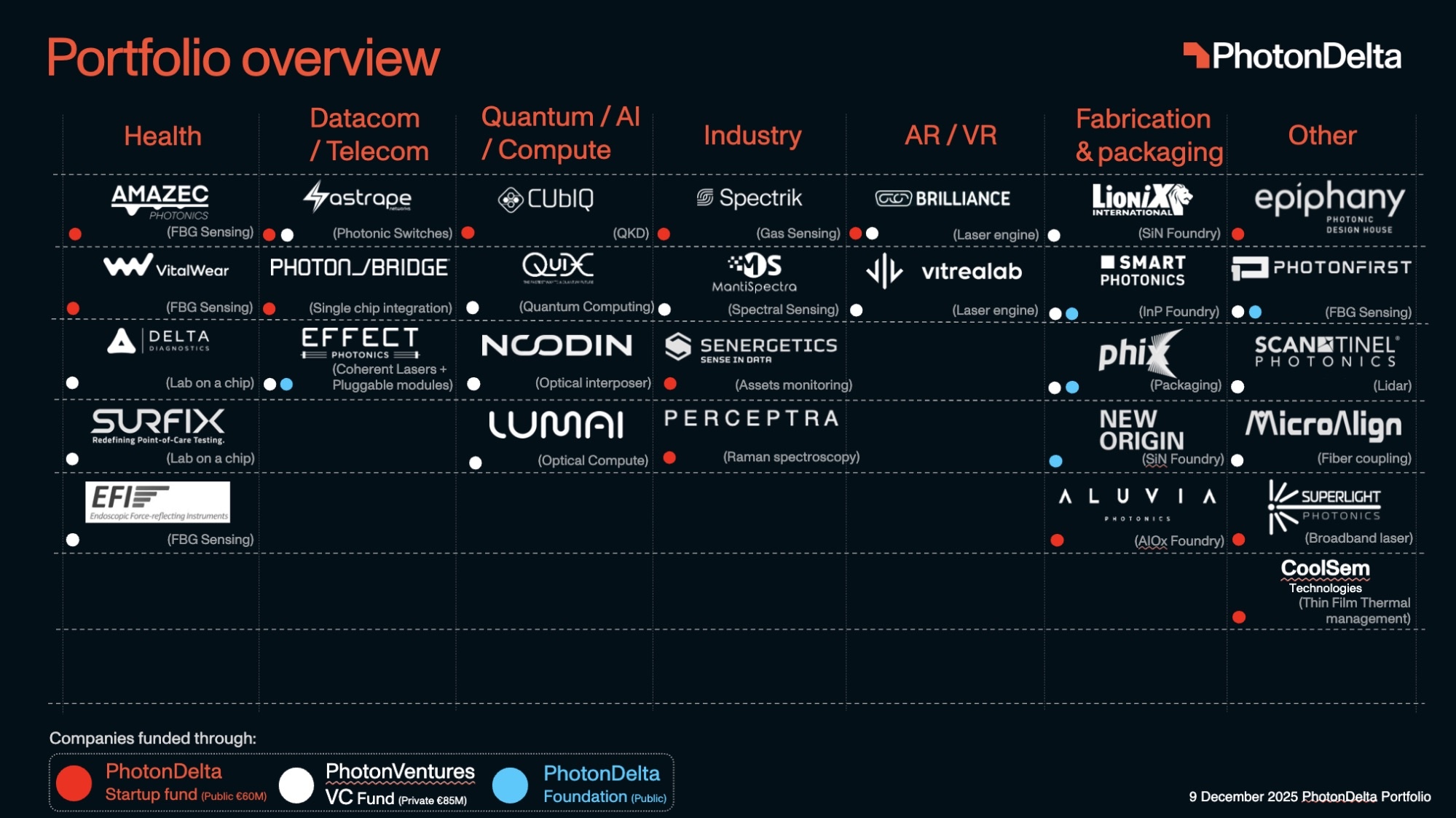
PhotonDelta’s portfolio overview. Image used courtesy of PhotonDelta. (Click on image to enlarge).
PhotonDelta helps this ecosystem move forward by stimulating collaboration, financing start-ups and scale-ups, developing shared innovation infrastructure, and strengthening connections with international markets. PhotonDelta now has offices in the Netherlands and the US and plays a central role in the global development of the integrated photonics industry.
Early in its’ development, PhotonDelta recognized that the US is a leader in the application of integrated photonics, with strong market adoption in data centers, telecommunications, defense, and medical technology, and with an unparalleled investment base and industrial scale. The Netherlands, on the other hand, has a technological advantage with InP and SiN platforms—and a complete ecosystem of design, packaging, and pilot production.
It is precisely the combination of US market and investment power with Dutch technology that presents a strategic opportunity. For this reason, PhotonDelta is preparing a Strategic Market Mission together with partners, the preparation of which is being financed through the Pre-PPS program Photonics USA until early 2026. This program includes market studies, networking receptions, and workshops with US experts.
The PhotonDelta office in Silicon Valley serves as a local anchor point, working closely with the Dutch embassy and foreign posts in the US. This will enable validated input to be gathered for the SMM application and strategic partnerships to be established, thereby securing the Netherlands structural access to US end markets and laying a solid foundation for a multi-year Public-Private Partnership program starting in 2026.
An Agreement Signed With Dutch Companies
In December of 2018 a covenant was signed in which Dutch companies, knowledge institutions, and governments pledged a total of €236M in cash and in-kind resources. The initial aim of this collaboration was to exploit the leading knowledge position in the field of integrated photonics—thereby building a stronger economic position in the world.
The partners of PhotonDelta together form a coherent and cooperative industrial cluster, with design, development, and production taking place within the supply chain. The ambitions and strategy for 2019-2026 are laid down in the “National PhotonDelta Plan”, which is structured around four strategic pillars. The PhotonDelta Foundation is the implementing organization for this plan and commenced its activities on January 1, 2019.
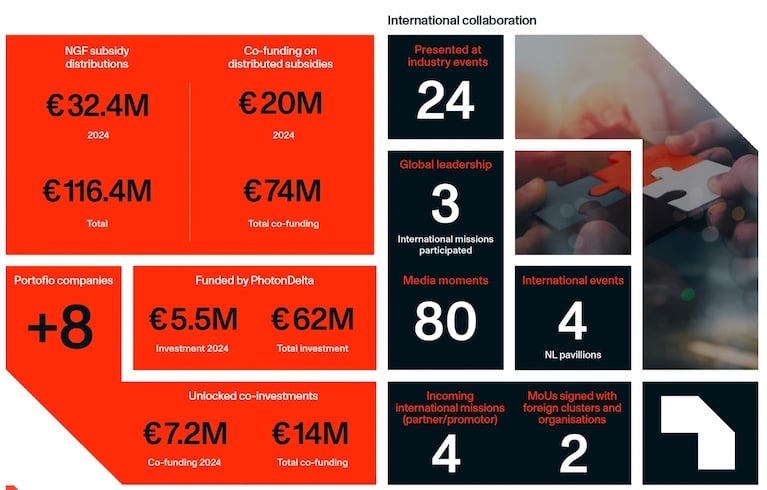
A snapshot of PhotonDelta’s ecosystem in 2024. Image used courtesy of PhotonDelta.
In April of 2022 the Growth Fund Program for integrated photonics was awarded to PhotonDelta. The total size of the program is €1.1B, of which €470M comes from the National Growth Fund, while the rest is co-invested by various partners and stakeholders. It’s a part of the Dutch government's national plan to strengthen and expand the country's position as a world leader in integrated photonics.
SIDEBAR
Here are just a few of the most interesting companies working closely with PhotonDelta:
- Smart Photonics: a pure-play Indium Phosphide (InP) foundry, headquartered in Eindhoven, the Netherlands. Established in 2012, the company builds on a strong industrial heritage rooted in Philips and JDSU, bringing decades of III-V semiconductor manufacturing expertise into the photonics era. Leveraging a generic integration technology initially developed at the Technical University of Eindhoven (TU/e), SMART has successfully industrialized this platform to offer scalable, high-quality production of InP-based PICs.
- EFFECT Photonics: specializes in the development and commercialization of advanced optical transceivers for fiber optic communications. These transceivers are built using EFFECT’s proprietary full optical integration on InP chips, an approach that delivers superior performance and significantly reduces production costs. Additionally, photonics innovation, EFFECT also develops its own proprietary Digital Signal Processor (DSP) technology. This technology is integrated into EFFECT’s transceivers and is also offered separately as stand-alone modules for broader market adoption.
- PHIX Photonics Assembly: PhiX is an independent packaging foundry founded in 2018 as a spin-off from LioniX, born out of a clear vision to complete the Dutch photonics ecosystem. Situated at the High-Tech Factory in Enschede, PhiX has rapidly grown into a vital enabler of the photonics industry, specializing in the assembly and packaging of PICs. The company serves as a bridge between innovative photonic design and scalable manufacturing, offering both engineering support and high-quality volume production.
- LioniX International: designs and manufactures custom PICs and related microsystem solutions, with services spanning from initial design through scalable volume production. It specializes in silicon nitride-based PIC technology (known as TriPleX) and delivers vertically integrated solutions—including fabrication, assembly, and packaging—for OEMs and system integrators across markets such as telecom/datacom, sensing, metrology, life sciences, and space.
- New Origin: an independent pure-play foundry for silicon nitride PICs. The company emerged from the photonics ecosystem around the University of Twente’s MESA+ NanoLab and regional partners, with the aim of providing high-volume production for silicon nitride photonic chips that leverage light for data transmission at high speed and low energy.
- Astrape Networks: spin-off from TU Eindhoven with the mission to improve the efficiency of short-distance data networks. The company is developing EFFINITI, a hybrid networking solution for data centers that optimizes data traffic and energy use. By doing this, Astrape’s technology reduces energy consumption by up to 60% and significantly improves the utilization of existing high-capex data center infrastructure. Its goal is to build networks that combine the flexibility and low latency of electronic systems with the scalability and efficiency of optical networks requiring heavy data traffic typical of contemporary AI workloads.
- Photon Bridge: develops advanced integrated photonics technology to enable high-performance optical engines for next-generation AI datacenter and telecom applications. The company’s core innovation is a proprietary cantilever waveguide coupling platform that unifies the speed of III-V semiconductor materials (for active functions like lasers and detectors) with the scalability of silicon photonics, creating high-density, low-power optical interconnects and modules.
- MantiSpectra: spin-off from Eindhoven University of Technology that develops ultra-compact near-infrared spectral sensing chips for real-time material analysis. Its core technology, ChipSense, condenses laboratory-grade spectroscopy into a small, affordable photonic chip that can identify and quantify materials instantly. MantiSpectra’s solutions enable fast, on-site sensing for applications such as agriculture, industrial process control, and quality inspection—without the need for bulky instrumentation.
- Quix Quantum: develops an integrated photonic processor for optical quantum computing. They developed a plug-and-play integrated and reconfigurable light-based quantum processor that accelerates progress toward a quantum future. QuiX has a working 20 Qu-mode processor with low propagation losses and low coupling losses (a world record) and is currently testing a 56 Qu-mode processor. Their solution is significantly less expensive in both development costs and application pricing, compared to gate-based quantum computing. In late 2022, QuiX won a € 14M contract with the German Aerospace Centre (DLR) to deliver a universal quantum computer.
Notably, PhotonDelta recently concluded their first Global Photonics Engineering Contest, where Perceptra (an MIT startup) won €50k in services to make their first PIC-based prototype.
Related Content