Facebook
 Google
 GitHub
 Linkedin
Four New Tools Tackle the Challenges of the Modern Test Bench
A new digitizer, VNA, spectrum analyzer, and Python SDK address speed, frequency, transient capture, and scope control obstacles.
Engineers aren’t just measuring signals anymore; they’re chasing higher data rates, shorter response times, and more complex test scenarios. The usual equipment still works, but it doesn’t always work fast enough or flexibly enough to keep pace.
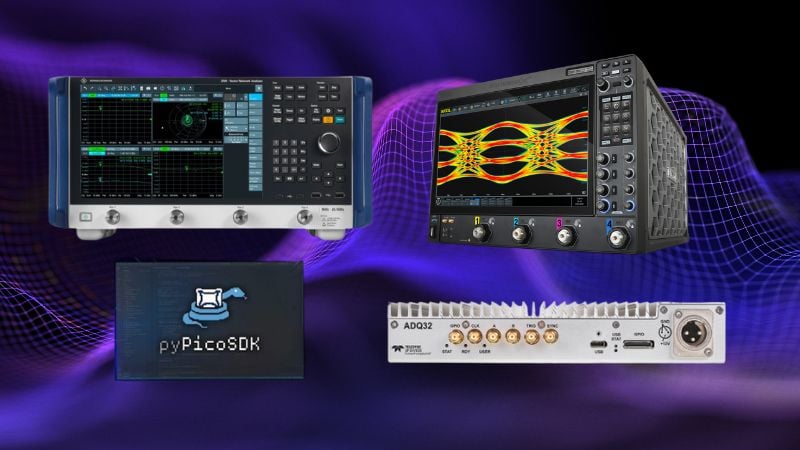
Four new releases aim to chip away at the everyday bottlenecks engineers commonly run into. Teledyne SP Devices, Rohde & Schwarz, Rigol Technologies, and Pico Technology have each introduced tools targeting very specific pain points, from high-speed digitization and extended RF coverage to real-time spectrum capture and simpler scope automation. Together, they highlight how vendors are adjusting their portfolios to match the frustrations engineers face on the bench today.
Teledyne SP Supports High-Speed Data in a Compact Package
High-speed digitization is critical in fields like mass spectrometry and LiDAR. Gigabytes of information must be captured and processed every second. The challenge is not only throughput, but also preserving signal integrity in compact, often noisy environments.
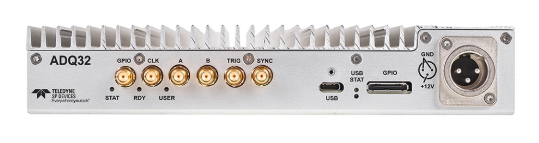
ADQ3-USB stand-alone digitizer with USB 3.2 interface and onboard FPGA. Image used courtesy of Teledyne SP Devices
The ADQ3-USB digitizer addresses that issue with sampling rates up to 10 GSPS and sustained USB 3.2 transfers of 2 GB/s. An onboard FPGA reduces raw data streams as high as 20 GB/s, minimizing bottlenecks and enabling real-time decisions. By removing the need for PCIe slots, the digitizer fits easily into mobile or embedded setups.
For Teledyne, the new USB-based form (datasheet linked) adds flexibility to the ADQ3 series. Firmware options for averaging, pulse detection, and custom FPGA development expand its reach, making it a versatile platform for OEM integration and specialized laboratory work.
Rohde & Schwarz Extends the Frequency Frontier
Data center links and new communication standards are moving into frequency ranges that older instruments weren’t built to handle. PCIe 7.0, for example, pushes data rates to 128 GT/s, requiring test coverage well past 50 GHz. At these higher frequencies, even small amounts of noise or drift can distort results.
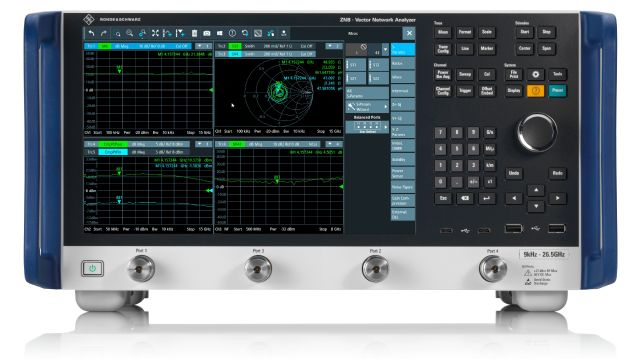
The R&S ZNB3000 vector network analyzer. Image used courtesy of Rohde & Schwarz
The R&S ZNB3000 vector network analyzer can reach frequencies up to 54 GHz, covering applications from AI-driven Ethernet and PCIe to satellite communications in the Ka and V bands. It maintains a 150-dB dynamic range, low trace noise, and fast sweep cycles, all in a scalable platform that lets customers upgrade frequency ranges over time.
For Rohde & Schwarz, these new models reinforce the ZNB3000 family as a long-term, adaptable solution. Engineers can start with lower ranges and expand later, giving the instrument longevity across evolving test requirements.
Rigol Catches Signals Before They Disappear
Catching fast, unpredictable signals has always been tough in spectrum analysis. Frequency hops, short bursts, and interference can slip past conventional analyzers. Rigol’s RSA6000 tackles that head-on with 200 MHz of real-time bandwidth and intercept speeds down to 3.83 microseconds, fast enough to capture fleeting events. A 4-THz/s scan rate supports wideband monitoring, while low phase noise and a low noise floor give engineers a clear view of both strong and weak signals.
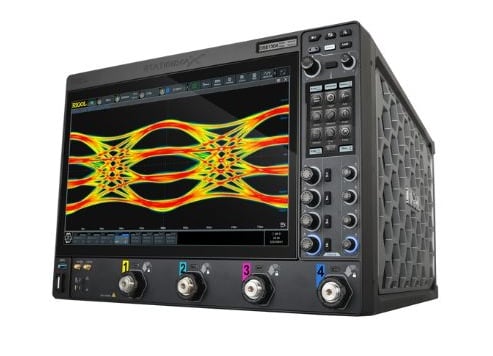
Spectrum analyzer displaying signal strength and frequency content for advanced RF testing. Image used courtesy of Rigol
The RSA6000 expands Rigol’s UltraReal platform by combining five analysis modes, traditional swept spectrum, real-time, vector, analog demodulation, and EMI pre-compliance, into one portable unit. This consolidation makes it not only a new product but also a multipurpose core tool in Rigol’s lineup.
Pico Technology Simplifies Scope Control
Automated test development with an SDK typically requires direct, detailed driver calls. This creates a learning curve that can slow implementation, particularly for users without prior experience in low-level programming. The pyPicoSDK now incorporates these functions into a single library while also adding higher-level routines for simple end-user control.
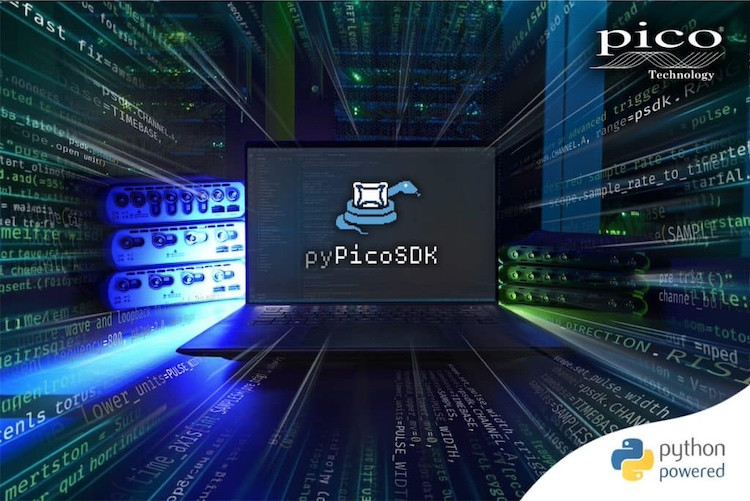
Python-based control interface for Pico oscilloscopes using pyPicoSDK. Image used courtesy of Pico Technology
Pico has introduced the pyPicoSDK Python package as an additional interface for its oscilloscopes. The package consolidates driver functions into a single module, removing the need to work across multiple files. It also includes higher-level routines that reduce the number of explicit calls into low-level drivers. With these changes, scope control can be scripted in Python using fewer commands. Because it integrates with the broader Python ecosystem, including libraries such as NumPy, it can be applied to both automation tasks and basic data analysis.
The first release supports the 6000E and 3000E series scopes. Support for additional devices will be added in later versions. The package is intended as an add-on to Pico’s existing PC-based oscilloscope approach rather than a replacement. It lowers the initial barrier for automation and custom control while keeping compatibility with existing development methods. This ensures the oscilloscopes remain usable across a range of applications, from straightforward lab measurements to more complex automated testing.
Facing Everyday Test Challenges
Each of these new tools answers a specific challenge engineers face daily. Teledyne reduces the complexity of high-speed data capture, Rohde & Schwarz pushes VNAs into higher frequencies, Rigol ensures transient signals don’t go unnoticed, and Pico makes scope automation accessible to more users. Collectively, they mark a steady shift in test and measurement: tools are becoming more specialized, more adaptable, and ultimately more supportive of the complex systems they’re meant to validate.
Related Content