Facebook
 Google
 GitHub
 Linkedin
Gigadevice Unveils Pair of MCUs Tailored Specifically for Optical Modules
The 120 MHz GD32E512 is optimized for high-speed optical modules and the 72 MHz GD32E252 takes on low-speed optical modules.
Gigadevice recently announced two new members of its optical communications MCU portfolio. The GD32E512 and GD32E252 32-bit Arm processors come equipped with a peripheral mix optimized for optical communications applications. The GD32E512 powers up with a 120 MHz Arm Cortex-M33 equipped with up to 512 KB of dual-bank flash, up to 128 KB of SRAM, and up to 65 GPIO. The GD32E252 features an Arm Cortex-M23 with up to 64 KB of flash, up to 8 KB SRAM, and up to 28 GPIO.

The GD32E512 and GD32E252 MCUs are designed for high- and low-speed optical comms, respectively.
Optical Module Specialization
Optical modules plug into datacenter and enterprise computer systems and convert electrical signals to fiberoptic and back. They include serializer/deserializer (Ser/Des) chips, optical transceivers, and diagnostic and control electronics. An MCU coordinates and controls the various sections of the device. The GD32E series MCUs come with a generous I/O and peripheral set as is needed for reliable optical module designs.
Both chips come with 2 x U(S)ART, 3 x I2C, and 2 x SPI (4 x in the E512), 7 DMA (8 in the E512), and SWD debug. The high-speed communications targeted GD32E512 also includes I3C, MDIO, and JTAG. The GD32E252, optimized for slower speed devices, adds an I2S interface. Both include a generous set of ADCs, timers, and a variety of system clocks.
The MCUs include additional flexibility in the form of configurable logic arrays (CLAs), The GD32E512 is equipped with 8 and the GD32E 252 with four. The CLAs are processor independent and real-time.
The chips start out with 1.8 V to 3.6 V operation in a 3 mm x 3 mm package well suited for the small physical size of many plug-in optical modules. Safety and security features include ECC for the Flash and SRAM, power on reset (POR), power down reset (PDR), and low voltage detection (LVD). Code is protected with a 32-bit CRC calculator, code protect settings, and a unique device ID. Operation safety includes both an independent watchdog timer (IWDG) and a window watchdog (WWDG) timer.
Two MCUs for Two Performance Tiers
The GD32E512 is targeted at high-speed optical modules utilized in enterprise and datacenter deployments. It includes two new high-bandwidth, low-latency protocols, I3C and MDIO, which the GD32E252 does not. I3C is the higher performing successor to I2C with speeds that range from a baseline 12.5 Mbps (up from I2C baseline of 100 kbps) up to 100 Mbps in high-bandwidth bulk transport mode (up from I2C 5 Mbps maximum).
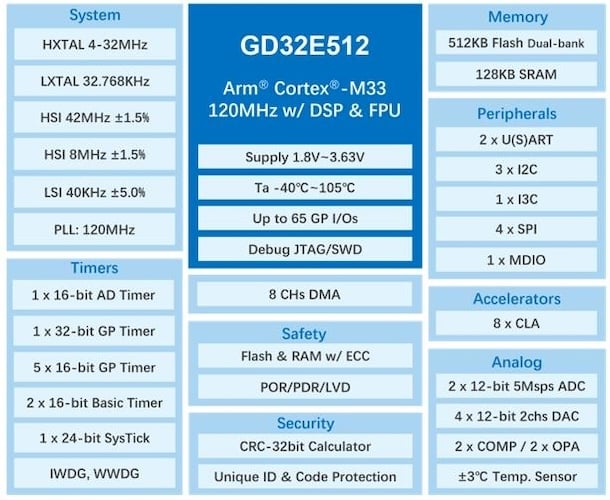
GD32E512 feature set
Higher speeds allow the MCU to monitor and respond at rates needed by high-speed optical communications chips. The E512 also includes a management data input/output (MDIO) interface port. MDIO is a bidirectional command and data protocol for communications over Ethernet protocol within the optical module and to external devices.
The E252 is optimized for lower power and low-cost optical module applications that don’t require maximum performance. Devices like passive optical network (PON) and optical network terminal (ONT) modules show up in residential and non-critical commercial installations where cost is of more concern than performance.
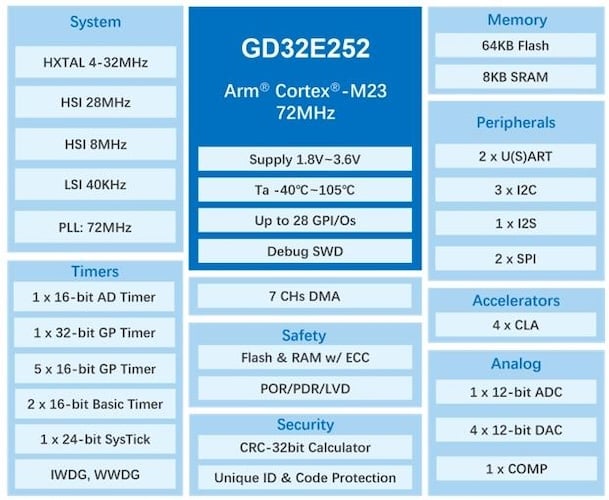
GD32E252 feature set
Rounding Out the Gigadevice Optical Portfolio
The GD32E512 joins the GD32E501 which has a 100 MHz clock and leaves out the I3C and MDIO, and the GD32E511 which shares most features with the 512 but has fewer maximum GPIO and a larger IC package.
The DG32E252 tops out the earlier GD32E251 and GD32E232 variants with greater package and options flexibility. Gigadevice MCUs are supported by both IAR and Keil development toolchains. Both the GD32E512 and GD32E252 are available through distribution now. Accessing data sheets for the two devices requires registration.
All images used courtesy of Gigadevice.
Related Content