
 Facebook
 Google
 GitHub
 Linkedin
Happy 40th Birthday to the Arm Architecture
Celebrating 40 years of innovation, Arm's architecture has evolved from a simple processor in a British lab to a cornerstone of modern computing.
April 2025 marked an important milestone in the computing world: the 40th anniversary of the Arm architecture. From its humble beginnings in a small British lab, Arm has evolved into one of the most influential computing architectures in history. Today, it powers everything from smartphones to supercomputers, impacting industries from mobile to AI, automotive, and beyond.
The Birth of Arm
In the early 1980s, Acorn Computers, a small British company, found itself at a crossroads. As the company set out to develop BBC Micro, an educational computer for schools, they found that the performance of existing processors was inadequate for the job. Sophie Wilson and Steve Furber, engineers at Acorn, were tasked with solving this problem. They sought a more efficient processor design that could handle demanding tasks without the complexity and high power consumption of existing processors.
By 1983, the team had embarked on creating a revolutionary new processor. The result was the ARM1, a 32-bit RISC processor built using only 25,000 transistors.
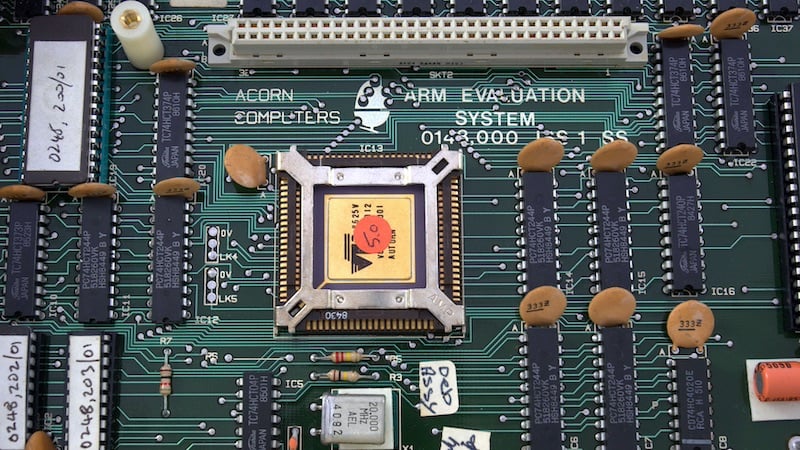
The ARM1 CPU in an Acorn ARM Evaluation System. Image used courtesy of Peter Howkins via Wikimedia Commons (CC BY-SA 3.0)
Unlike contemporary designs, which were based on complex instruction sets, the ARM1 utilized a reduced instruction set computing (RISC) approach, focusing on simpler operations to achieve higher performance with lower power consumption. In 1985, the ARM1 was completed and quickly demonstrated its efficiency, delivering performance that rivaled some of the most advanced processors of its time.
Early Commercial Success with the ARM2
While the ARM1 was never commercially sold, it paved the way for Arm’s first commercial success: the ARM2. Released in 1986, the ARM2 powered the Acorn Archimedes, the first RISC-based personal computer. With its improved clock speed and hardware multiplication capabilities, the ARM2 quickly outperformed competitors like Intel’s 80386, despite its minimalist design. This was a significant step forward in demonstrating the potential of Arm’s architecture. However, the real turning point came in 1990 when Acorn spun off Arm into a separate company.
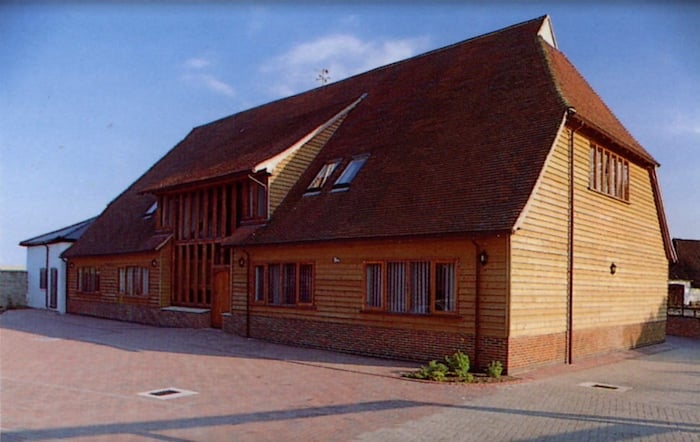
Advanced RISC Machines Ltd (Arm) was founded in 1990, with its first headquarters in an outfitted barn in Cambridge. Image used courtesy of Arm
By licensing its architecture, Arm opened the door for widespread adoption across various industries. The ARM7TDMI, introduced in 1994, became the first widely adopted ARM processor, powering mobile devices like the Nokia 6110, which sold over 100 million units. This move to licensing allowed Arm’s architecture to be customized by companies like Texas Instruments, Qualcomm, and Samsung, leading to the rapid expansion of Arm’s influence in the mobile sector.
The Rise of ARM in Mobile
As the 2000s progressed, Arm’s architecture found its place at the heart of the mobile revolution. The introduction of ARMv7 in 2005 brought multimedia and security features that were crucial for the next generation of smartphones. It was in 2007, with the launch of the iPhone, that Arm truly cemented its role in the mobile industry. Apple’s A-series chips, based on Arm’s design, offered a perfect balance of power efficiency and performance, making them a natural fit for mobile devices.
Arm’s ability to balance performance with energy efficiency became a defining feature of its architecture. The low power consumption allowed for longer battery life in mobile devices, a crucial factor that helped Arm dominate the smartphone market. By 2014, more than 99% of smartphones were powered by ARM-based processors, solidifying its position as the architecture of choice for mobile devices.
Arm quickly expanded its architecture into new markets. The introduction of ARMv8 in 2011, which added 64-bit computing support and scalable vector extensions, opened the door for Arm processors to power not just smartphones, but also data centers and high-performance computing environments.
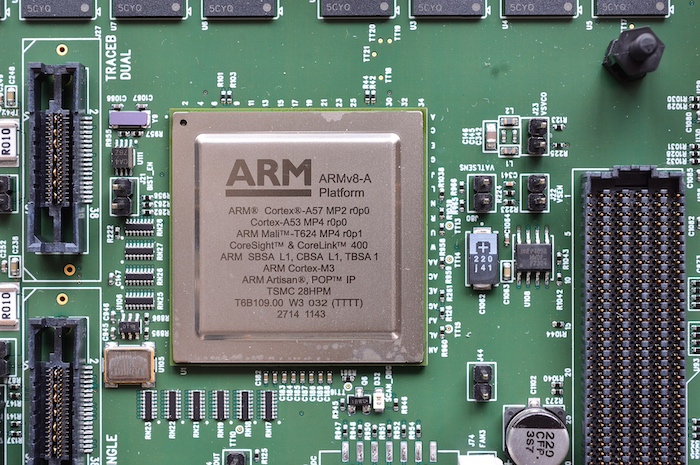
The ARMv8-A platform. Image used courtesy of Wikimedia Commons (CC0 1.0)
In recent years, Arm has further adapted its architecture to meet the growing demands of artificial intelligence (AI) and machine learning. The introduction of ARMv9 in 2021 brought significant advancements, including SVE2 and the confidential compute architecture. These features optimized Arm’s architecture for AI workloads, making it more powerful than ever before in data centers, cloud computing, and AI-driven systems.
Making Waves in Sustainable AI Growth
Today, the Arm architecture isn’t just a key player in mobile but is also shaping the future of AI and sustainability. Arm’s Neoverse N2, based on the ARMv9 architecture, delivers superior performance in AI and machine learning tasks, all while maintaining the power efficiency that Arm is known for. Arm-based systems are now being used in data centers around the world, delivering up to 50% less power consumption than traditional x86 processors, saving billions of kilowatt-hours annually.
Arm predicts that it will ship over 500 billion chips by 2030. As the company continues to innovate, its focus on sustainability is just as critical. With global energy consumption increasing due to the rise of AI, Arm's power-efficient designs will play a significant role in reducing the environmental impact of modern computing.
Related Content










The ARM7500 was the first standard SOC from VLSI Tech and used in various NC (Network Computer) and WebTV products in the mid 90’s. That was they real inflection point for arm. Cirrus logic then added the FPU and EDO RAM support and we built a significant business out of that MCU in the late 90’s. Fun times and great history!