Facebook
 Google
 GitHub
 Linkedin
IDTechEx Forecasts 8.6x Boom in the Photonic Integrated Circuit Market
Photonic integrated circuits (PICs) may be the way to expand beyond Moore’s law over the next decade.
IDTechEx’s latest report on photonic integrated circuits (PICs) forecasts how the market, technology, materials, and applications are expected to expand over the next decade (2025–2035). Despite the looming limitations of Moore’s law, PIC technology is still advancing in miniaturization.
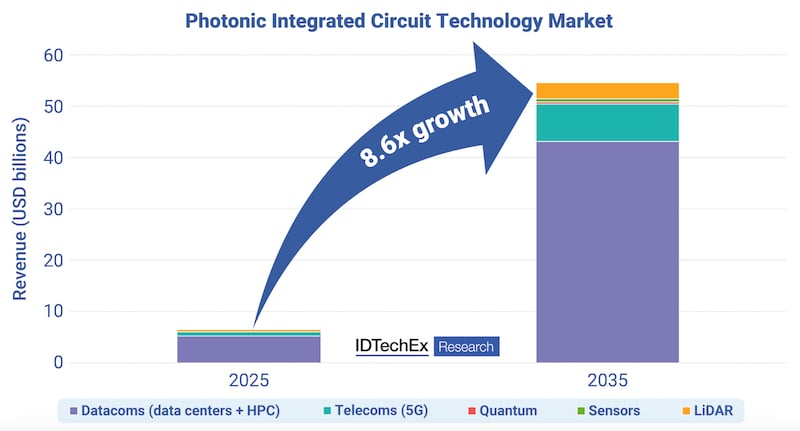
IDTechEx expects an 8.6x industry growth in PICs over the next decade.
Ultimately, IDTechEx expects this market to grow 8.6x, becoming a $54 billion market by 2035.
What Are Photonic Integrated Circuits (PICs)?
Photonic integrated circuits (PICs) are optical systems embedded in semiconductor materials. PICs are known for high-speed data transmission, with speeds at 1.6 Tbps currently, anticipated speeds of 3.2 Tbps by 2026, and much higher rates over the next decade.
As optical systems, PICs can grow beyond Moore’s law, which states that the transistor capacity of a silicon chip will double every eighteen months. However, transistors can only be manufactured so small, and heat dissipation looms as a major roadblock to future development. Because PICs use photons as data carriers instead of electrons, the chip generates (and therefore dissipates) less heat. By reducing the thermal load, PICs may break Moore’s law barriers.
Materials in PIC Technology
PIC chips are largely made from silicon-based materials. Silicon and silica (silicon dioxide) are the key players in this market. Still, due to their indirect band gaps, III-IV semiconductors (such as indium phosphide, InP) are added to the silicon to serve as the light sources and photodetectors. This process combines a set of mature technologies and manufacturing techniques with modular PIC technologies.

As shown here, opportunities for PICs are expected to grow in the next 10 years.
New developments are bringing other materials into the market. Thin-film lithium niobate (TFLN) is making strides in high-performance modulation for quantum computing. Barium titanate (BTO) is likewise under development for these applications. Silicon nitride (SiN), organic polymers on silicon, and several other technologies are expected to enter the market over the next decade.
Applications and Market Players
One of the most lucrative markets for PICs is artificial intelligence (AI). As AI algorithms become more advanced, they require high-speed data transmission. PICs used as high-performance transceivers will drive part of this AI market, with their use extending to AI data centers and accelerators. AI and its use in data centers will be the largest growth opportunities for PICs.
PICs' high-speed data rates will also impact the telecom market sector. With a spike in 5G technology, telecom operators need higher data rates to handle the exponential increase in data.
PICs can be used to build the next generation of sensors as well. Artificial chemical “noses” that mimic a dog’s keen sense of smell can detect leaks and explosives. PICs' high data transmission rates and miniaturization capabilities may enable new biosensors and wearables over the next decade. One of the most important sensor growth markets is in Light Detection and Ranging (LiDAR). LiDAR sensors use light signals to map areas in three dimensions. With the expansion of Autonomous Mobile Robots (AMRs) and self-driving vehicles in the next decade, the demand for next-generation LiDAR will increase.
Report Now Available
Included in this report are 10-year forecasts for markets broken down into different categories and technologies. This gives the tech investor a way to discern where the largest growth opportunities are hidden, and it gives the tech manufacturers and integrators a way to plan for their next designs. For more information, or to purchase a copy of the report, please visit IDTechEx.
All images used courtesy of IDTechEx. Featured image used under Adobe Stock license.
Related Content