Facebook
 Google
 GitHub
 Linkedin
Indie Semiconductor Unwraps Laser Boasting Ultra-Low Noise Performance
Indie is aiming the stable, narrow-linewidth laser at scalable quantum computing and secure communications applications.
Indie Semiconductor recently announced its new LXM-U Narrow-Linewidth DFB Laser Module. The ultra-low-noise LXM-U laser expands Indie’s photonics portfolio beyond automotive applications and into quantum computing and secure communications.

LXM-U narrow-linewidth laser module.
The module is based on Indie’s proprietary laser diode technology, which is reportedly highly stable in multiple regions. The LXM-U lasers hold to tight frequency and phase tolerances, narrow linewidths, and low noise artifact levels. The module promises to deliver 10x lower ultra-low-frequency noise than competitive offerings. This level of stability makes the lasers well-suited for quantum applications where any noise or instability puts quantum operations at risk.
LXM-U Laser Module Details
The LXM-U laser modules use distributed-feedback (DFB) laser diodes. DFB laser diodes contain an integrated one-dimensional diffraction grating structure. The diffraction grating element provides optical feedback to the laser. The result is a highly coherent laser that can travel tens of kilometers while remaining frequency and phase coherent.
The DFB laser is combined with a low-noise current source and a high-stability temperature controller. It comes with a frequency noise cancellation feedback system that reduces noise without compromising laser stability. At a glance, some other key features of the LXM-U laser modules include:
- Power from 40 mW to 70 mW
- Selection of a single wavelength around 1545 nm and 1550 nm
- 15 kHz typical instantaneous linewidth with standard module
- 0.08 kHz typical instantaneous with ultra-narrow module
- 3 GHz typical frequency modulation amplitude at 100-kHz modulation rate
- Relative intensity noise less than -155 dB at greater than 1 MHz
- 90 mm x 56 mm x 18 mm (3.5” x 2.2” x .7”)
- Operating temperature range from -20°C to 65°C
Key Attributes of Narrow-Linewidth Lasers
Narrow-linewidth lasers are known for low noise levels and high temporal coherence. Temporal coherence is one measure of laser stability. It refers to the phase consistency of a laser wave over time, meaning the wave peaks will remain in the same place over time.
High coherence means that knowing what a laser is doing enables accurate predictions of what the wave will be doing at the same spatial point in the future. The high coherence of the Indie LXM-U delivers the spatial predictability necessary for precise quantum operations. The LXM-U can remain stability locked for days at a time.
A narrow linewidth is important for any laser operation that returns data, such as strain gages and interferometers, or produces or controls data, such as quantum communications and other quantum operations. Quantum operations depend on the ability to influence individual quantum particles. Thus, the narrower the linewidth and the greater the stability, the better the laser.
Power Spectral Density of Frequency Noise
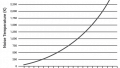
While Indie LXM-U comes with a solid set of narrow-linewidth performance specifications, Indie points out that the conventional specifications and measuring systems don’t tell the whole story. Linewidth as a specification is not sufficient at performance levels associated with the LXM-U.
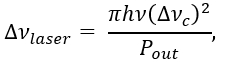
Linewidth formula.
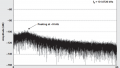
Instead, Indie also provides results of a measuring system called power spectral density of frequency noise (PSDFN). Linewidth alone delivers a basic representation of laser behavior, focusing primarily on the spectral width. PSDFN ups the information level by quantifying noise across a wide range of frequencies. The result is a better insight into the laser’s stability and coherence. PSDFN enables the spectral shape of a laser to be reconstructed, which is important at the quantum level.
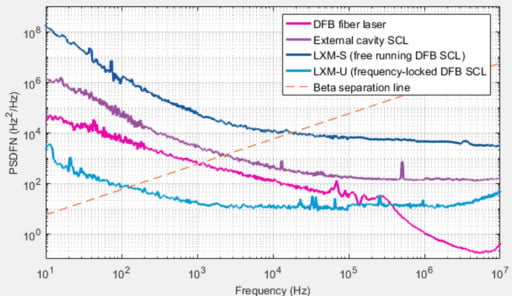
PSDFN representations of different narrow linewidth lasers.
Lasers in Secure Communications and Quantum Computing
Indie optimized the LXM-U for quantum-level applications, such as quantum key distribution (QKD) cryptography. QKD utilizes polarized photons as the cryptographic key and key basis carrier. As quantum particles, individual photons can exist in a superposition state, meaning that they are effectively in both horizontal and vertical polarizations at the same time.
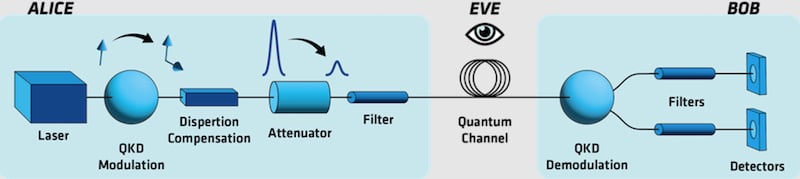
Block diagram of a secure QKD communications system.
Such quantum encoded information is a “read once” message. The act of reading the photon state collapses the quantum wave function into a non-quantum value and destroys the information. This means that the information can only be read once. If a bad actor intercepts and reads the key, the key will be destroyed, and the intended receiver will be made aware of the compromise.
Quantum computers also use coherent lasers. When light-frequency photons are used as qubits, ultra-stable lasers can act as a qubit source—configuring superposition and entanglement and reading the qubit state. Ultra-stable lasers can also be used to cool qubits in non-photon quantum computers.
Specific frequency photons are shot at particles that are cold, but not quite cold enough for quantum operations. The particle absorbs and emits the energy from the photon, which, when tuned properly, will take some of the particle’s vibration with it. Reducing vibration is one of the ways qubits are cooled to within a 10th of a degree Kelvin of absolute zero.
Other Applications for the LXM-U
The mechanical characteristics of the LXM-U laser chip allow it to be co-packaged along with other lasers and photonic integrated circuit chips (PICs). This flexibility is unique to the LXM-U and allows customer-specified integration with their proprietary technologies. System integrators can independently operate the module.
In addition to quantum applications, LXM-U modules are well suited for devices such as LiDAR, fiber optic communications, spectroscopy, and other uses that benefit from low noise and high stability.
All images used courtesy of Indie Semiconductor.
Related Content