Facebook
 Google
 GitHub
 Linkedin
Innodisk Serves Up DDR5 and LPDDR5X Memory for Industrial Designs
The memory modules combine high-speed performance, compact layouts, and tool-free modularity for reliable edge AI operation in tough environments.
With the momentum of edge AI and embedded systems moving into tighter and tougher environments, memory has to offer more than just speed. Innodisk designed its new DDR5 and LPDDR5X CAMM2 modules for these conditions, combining high bandwidth, compact layouts, and rugged mounting to ensure performance, durability, and easy servicing in space-constrained designs.
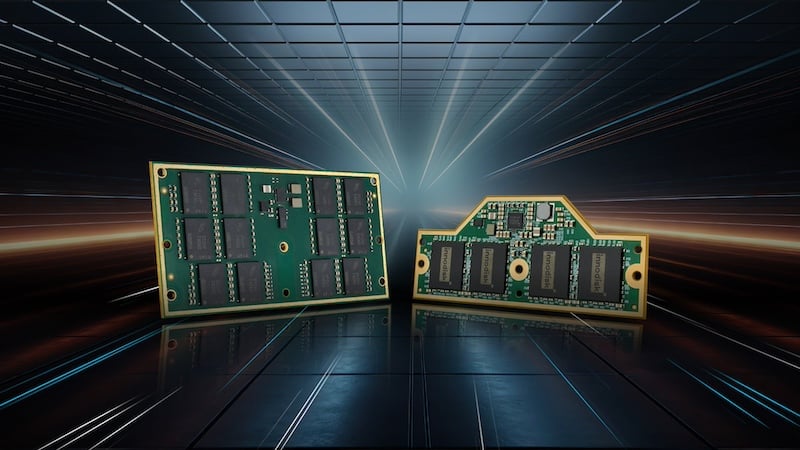
Innodisk’s CAMM2 modules combine high-speed memory with a rugged, space-saving form factor for compact industrial systems.
The DDR5 CAMM2 and LPDDR5X CAMM2 (LPCAMM2) modules aren’t just about raw bandwidth. These modules combine two memory channels into a single, small package, which makes them more useful for size-conscious designs such as in fanless edge computers, ruggedized notebooks, and embedded industrial systems. With peak data rates up to 8,533 MT/s, a secure screw-lock mounting system for vibration resistance, and a modular form factor that supports straightforward upgrades, the devices are positioned as a cleaner, more maintainable alternative to both SODIMM sockets and permanently soldered memory.
DDR5 CAMM2: One Slim Module for Durable Performance
Innodisk’s DDR5 CAMM2 module packs serious bandwidth into a space-saving format. Featuring a 128-bit dual-channel design, it delivers up to 6,400 MT/s data rates, which matches or exceeds two traditional SODIMM modules while also cutting mounting space by up to 60%.
This enables tighter integration in small boards and opens room for customized cooling solutions, which is especially important in fanless or thermally limited designs. A stub-free layout also helps reduce signal reflection issues by eliminating unused DIMM slot traces.
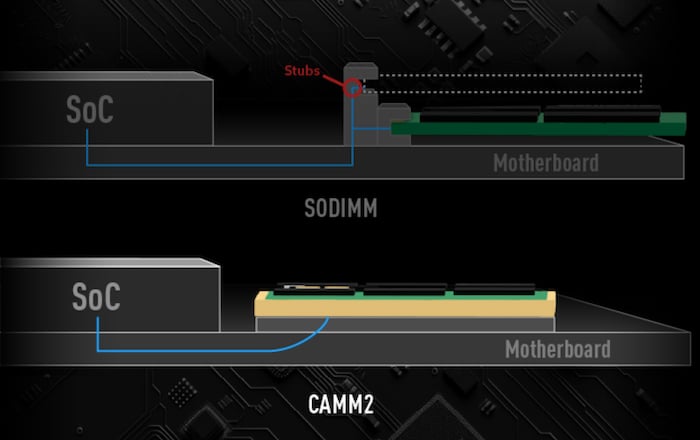
DDR5 CAMM2 bypasses the stub issues of unused DIMM slots in conventional system design by simplifying PCB routing.
In rugged environments, vibration and shock can wreak havoc on memory retention. The DDR5 CAMM2 addresses these conditions with a screw-lock retention system, offering mechanical stability that traditional edge connectors can’t match. This makes it a good fit for platforms like CompactPCI, rugged industrial PCs, and mission-critical telecom systems, where uptime and reliability are paramount.
LPCAMM2: A Low-Power Solution for Mobile and Edge
While DDR5 CAMM2 handles general embedded needs, the LPDDR5X CAMM2 (LPCAMM2) version is tailored for power-sensitive applications that still demand top-tier performance. With blazing speeds up to 8,533 MT/s and a reduced operating voltage of just 1.05 V, LPCAMM2 is built for platforms like humanoid robots, AMRs, and fanless edge devices.
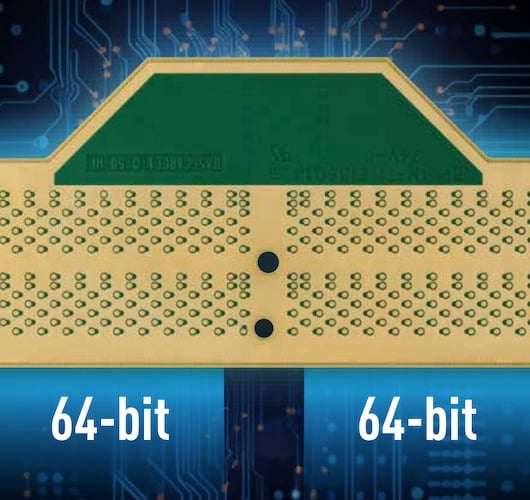
LPCAMM2 merges two SODIMM channels into a single module, delivering 128-bit bandwidth.
Its single-sided, ultra-slim form factor means it takes up minimal vertical space, making it easier to integrate into low-profile enclosures or sealed chassis. Like its DDR5 counterpart, LPCAMM2 uses a 128-bit dual-channel design and a stub-free PCB layout to optimize signal clarity even under high-speed data transmission loads.
LPCAMM2 is field-replaceable, reducing maintenance complexity and avoiding full motherboard swaps. Its screw-lock retention withstands vibration, and the low 1.05-V operating voltage helps conserve power in mobile or autonomous systems. These combined features give LPCAMM2 a unique blend of performance, flexibility, and durability.
Flexible Options for Industrial Memory Needs
By offering both DDR5 and LPDDR5X variants in the CAMM2 form factor, Innodisk gives system designers flexibility to align memory configuration with specific application constraints. The DDR5 CAMM2 module was designed for high throughput and thermal design in dense industrial computing environments, while the LPDDR5X CAMM2 provides enhanced energy efficiency and reduced physical profile for mobile or fanless systems. This new format simplifies servicing compared to soldered memory and supports signal routing.
Sampling begins in Q4 2025, targeting embedded applications with strict thermal and mechanical constraints such as industrial automation, edge AI, and transportation systems.
All images used courtesy of Innodisk.