Facebook
 Google
 GitHub
 Linkedin
Intel Outfits New Xeon Processors, Networking, and GPUs for Agentic AI
At Computex, Intel described the CPU as the control plane for agentic workloads, pairing new processors and network controllers with fresh details on its inference GPU.
Intel took the opportunity this week at Computex 2026 in Taipei to lay out how it wants the processor to anchor agentic AI, launching its Xeon 6+ server chips, introducing the Intel Ethernet E835 controllers, and disclosing more about the Crescent Island data center GPU.
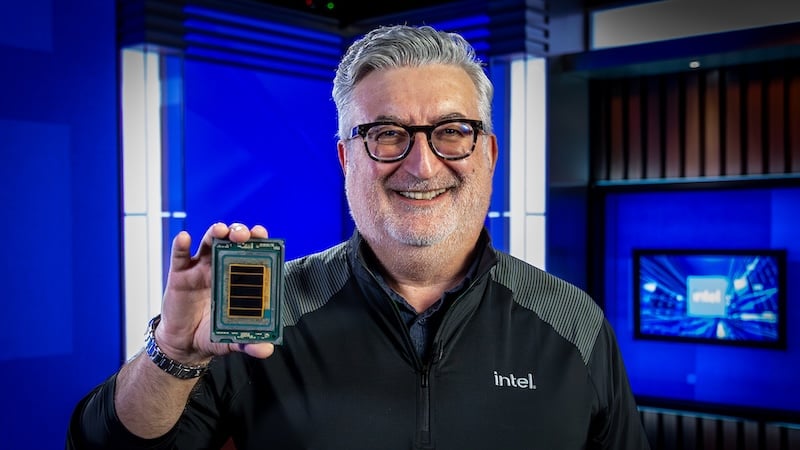
Kevork Kechichian, Intel’s executive vice president and general manager of the Data Center Group (DCG) with an Xeon 6+ processor
The company argues that as AI systems shift from single models toward fleets of autonomous agents, the hard problems move to orchestration, concurrency, and moving data between components, work that lands on the CPU and the network rather than the accelerator alone.
Intel says that AI doesn't scale as a collection of parts, but rather as it scales as a coordinated system. The CPU remains the control plane for the modern AI infrastructure, says the company. With Xeon 6+ and Ethernet E835, Intel intends to tightly coupling compute and networking to reduce bottlenecks.
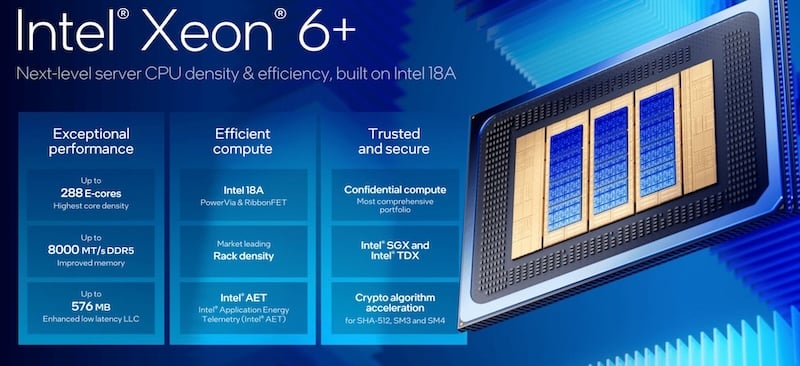
Key specs of Intel’s Xeon 6+ data server CPU
Xeon 6+ Moves 18A to the Data Center
Xeon 6+ (Clearwater Forest) is the first Intel data center CPU built on the Intel 18A process, offered with up to 288 Efficient-cores. The high core count is aimed directly at the dense, highly concurrent workloads that agentic systems generate, where many lightweight tasks run in parallel and need to be scheduled and fed quickly.
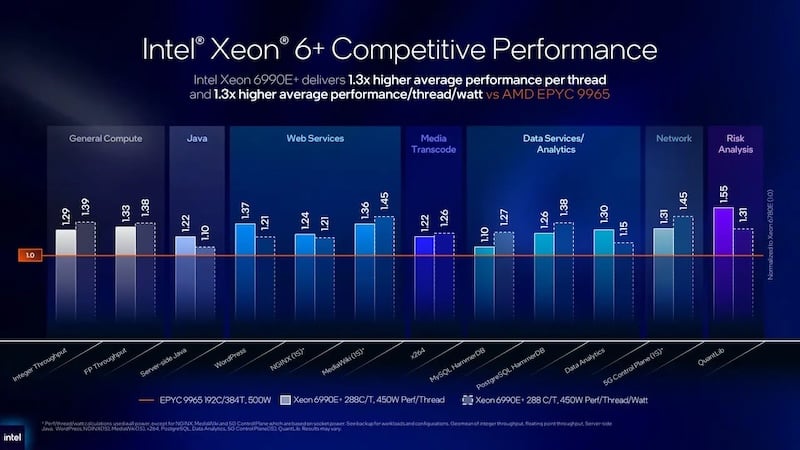
Competitive performance of Intel’s Xeon 6+
Intel claims up to 2.5 times more performance than the previous generation and up to 45% better performance per thread per watt than competing parts, along with up to 9:1 server consolidation against 2nd Gen Intel Xeon. The platform carries 12-channel DDR5, 96 lanes of PCIe Gen5 with CXL support, and Intel's SGX and TDX security extensions.
A new feature, Intel Application Energy Telemetry (AET), exposes per-application power data so operators can tune efficiency. Intel says AET will be available on Xeon processors going forward and that it specifically targets data center providers. More information is available in the Xeon 6+ Solution Brief.
At the opposite end of the range, Intel added a 12-core Xeon 6300, an entry-level server SKU for lighter deployments. The high-core-count chips are available now in systems from ASUS, Dell, Ericsson, GIGABYTE, HPE, Lenovo, and Supermicro, and Intel says they’re already in telecom network trials.
E835 Controllers Prioritize Performance Per Watt
Meanwhile, Intel’s Ethernet E835 controllers and adapters scale from 10GbE to 200GbE, with port options spanning 2x25GbE, 4x25GbE, 2x100GbE, and a single 200GbE configuration set through Intel's port configuration tool. Intel is making some big claims with regard to efficiency here, saying that the E835-CQDA2 adapter delivers up to 1.9 times higher performance per watt than Nvidia's ConnectX-6 DX and up to 1.4 times the performance per watt of Broadcom's comparable adapter.
In dense, virtualized deployments, where a rack may hold hundreds of network ports running continuously, that gap in efficiency can easily compound into meaningful operating cost and thermal headroom. The E835 supports RDMA over RoCEv2 and iWARP, Dynamic Device Personalization, and a hardware root of trust with signed firmware attestation, and runs on Linux, ESXi, and Windows. Cisco, Dell, HPE, Lenovo, and Supermicro are listed as platform partners. More information is available in the Ethernet E835 Solution Brief.
Crescent Island
Intel gave only a brief update on Crescent Island, its next data center GPU, but from what we’ve heard, it’s focused on inference over training. The GPU uses Intel’s Xe3P architecture and pairs it with LPDDR5x memory in capacities up to 480 GB, no doubt a deliberate choice for the large working sets that agentic inference and long-context models require.
It’s designed as a 350 W air-cooled PCIe card, which keeps it deployable in conventional servers without liquid cooling, and it supports datatypes ranging from native FP4 and MXFP4 up to FP64.
Intel didn’t give any details regarding its release date, though it’s expected that customer sampling will begin in the second half of 2026, with broader availability following in 2027. The memory-heavy, air-cooled framing makes Crescent Island an obvious candidate for targeting large AI inference fleets rather than a direct challenger to the largest training accelerators.
Value in Agentic AI
Across the three announcements, Intel is making one clear argument: the value in agentic AI infrastructure isn’t concentrated in any single chip but in how compute, memory, and networking are balanced, and that it’s the CPU and the fabric around it that’ll set the ceiling on how well an agentic system runs.
All images used courtesy of Intel.