Facebook
 Google
 GitHub
 Linkedin
From BMW to Data Centers: Brands Tap 3 Known Chips in New Ways
Companies across industries are leveraging tech from NXP, MaxLinear and Nordic Semiconductor on automotive UWB, accelerated OpenZFS storage, and low-power Bluetooth Mesh sensing.
NXP, MaxLinear and Nordic Semiconductor have introduced new designs aimed at three very different applications: automotive access and presence detection, accelerated data-center storage, and commercial Bluetooth Mesh lighting. The NXP Trimension NCJ29D6 combines UWB ranging and radar, MaxLinear’s Panther platform moves OpenZFS data processing into dedicated hardware, and Nordic’s nRF54L15 provides the wireless processing behind Sunricher’s latest occupancy sensor.
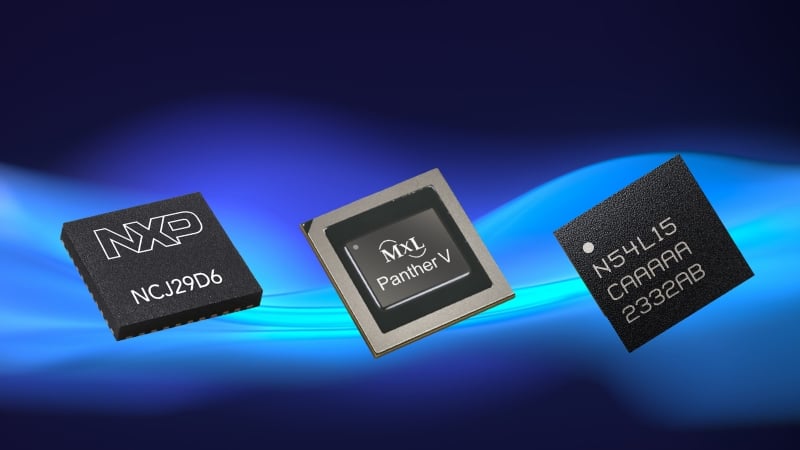
Across the three designs, the focus is on getting more functionality from the underlying hardware. NXP uses a single UWB device for both secure ranging and radar; MaxLinear offloads storage workloads that would otherwise consume CPU resources; and Nordic combines low-power wireless operation with sufficient processing and protocol support for large commercial Bluetooth Mesh networks.
NXP Uses UWB for Access and Presence Detection
BMW Group will deploy NXP’s Trimension NCJ29D6 family beginning with selected 2026 vehicle programs. The automotive UWB device combines secure fine-ranging with short-range radar, enabling the same hardware platform to support applications such as Digital Key Plus, in-cabin presence detection, and kick sensing.
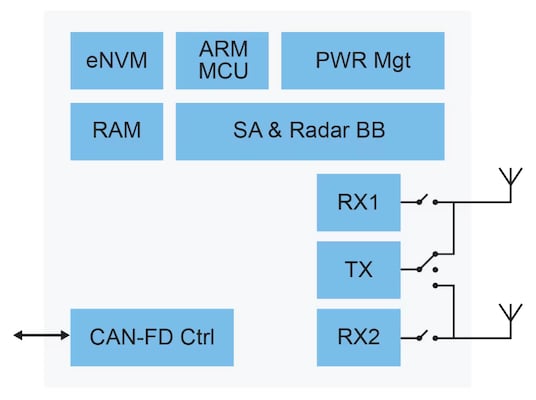
NXP’s NCJ29D6 brings UWB ranging and presence detection to BMW vehicles while giving OEMs a platform for multiple automotive sensing functions. Image used courtesy of NXP
With Digital Key Plus, UWB ranging allows a compatible smartphone or smartwatch to serve as a hands-free vehicle key. The same hardware can also be used for in-cabin presence detection. Using its radar capability, the NCJ29D6 looks for small movements that indicate a person or animal may still be inside a parked vehicle and can trigger a warning when presence is detected. This gives automakers another way to address developing presence-detection requirements and future NCAP protocols in Europe and China without adding a separate sensing system.
The NCJ29D6 is a single-chip impulse-radio UWB transceiver compliant with IEEE 802.15.4 and 802.15.4z. It includes dual-antenna interfaces for antenna diversity and angle-of-arrival estimation, along with an integrated Arm Cortex core and a CAN FD controller. NXP also specifies interference resilience and full-duplex UWB radar using its radar sensitivity boost technology. Combining ranging and radar on a single device enables automakers to support multiple functions without installing separate sensing hardware for each.
MaxLinear Moves OpenZFS Workloads Into Hardware
Core Micro Systems (CMS) is using MaxLinear’s Panther platform as the hardware acceleration foundation for its next-generation OpenZFS storage systems. Paired with MaxLinear’s ZFlush 1.3 technology, the Panther Storage Accelerator offloads several compute-heavy storage operations from the host CPU.
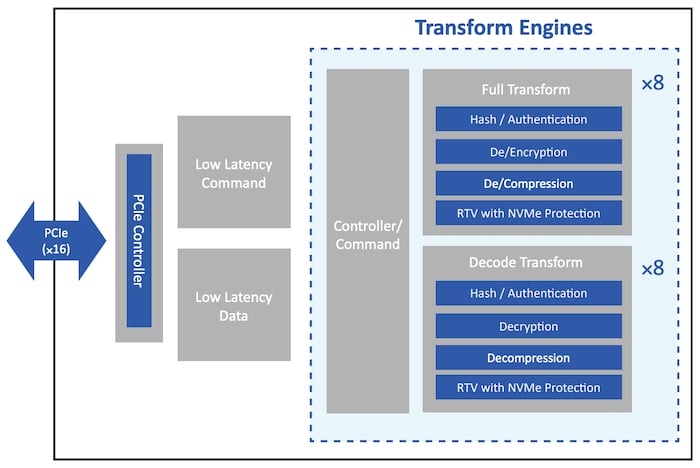
MaxLinear’s Panther V platform accelerates OpenZFS storage for AI, cloud, and hyperscale infrastructure. Image used courtesy of MaxLinear
The platform provides hardware acceleration for compression and decompression, encryption and decryption, and SHA-256 processing used for deduplication. Moving these functions into dedicated hardware is intended to increase storage throughput and reduce latency while leaving more CPU resources available for other workloads. That becomes particularly useful in AI, cloud, and hyperscale systems, where large datasets can make storage services a substantial part of the overall processing load.
CMS plans to use the architecture across enterprise, cloud, hyperscale, and AI storage deployments in Asia. The supplied information does not provide detailed interface speeds, memory capacity, power consumption or physical specifications for the Panther accelerator, so those specifications cannot be established from the available material.
Nordic Cuts Power and Latency in Bluetooth Mesh
Sunricher selected Nordic Semiconductor’s nRF54L15 SoC for its SR-BL9030B-PIR-LBV ceiling-mounted Bluetooth Mesh PIR sensor. The sensor adds occupancy- and ambient-light-based control to existing 0–10-V commercial lighting and includes a 10-A relay. It operates from 100 VAC to 277 VAC.
Sunricher’s Bluetooth Mesh PIR sensor uses Nordic’s nRF54L15 SoC for low-power occupancy detection and wireless lighting control. Image used courtesy of Nordic Semiconductor
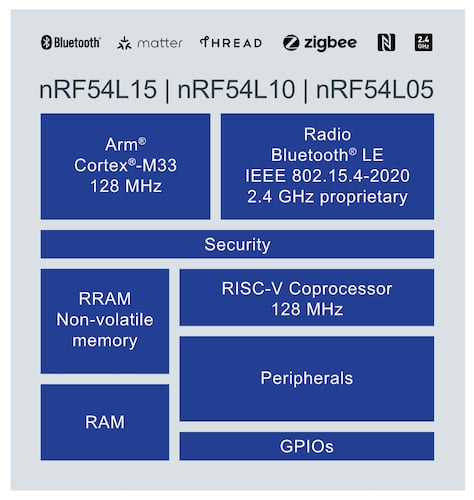
The nRF54L15 is built on a 22-nm process and combines a 128-MHz Arm Cortex-M33 with a 128-MHz RISC-V coprocessor. Wireless specifications include -96-dBm receive sensitivity and up to +8-dBm transmit power, with support for Bluetooth LE, Bluetooth Mesh, Thread, Matter, and proprietary 2.4-GHz applications. Hardware security includes TrustZone, secure key storage, tamper detection, and cryptographic acceleration.
Low power matters because commercial sensors can stay installed for years and spend most of their time waiting for someone to enter the space. Sunricher wanted to keep standby power below 0.5 W without giving up the higher performance in larger Mesh networks. With Sunricher using the nRF54L15, the company reports stable operation with more than 100 nodes, response times below 80 ms (down from about 200 ms previously), and roughly 35% lower average power consumption for future battery-powered versions.
A Trend Toward Integration
NXP, MaxLinear, and Nordic are addressing different engineering problems, but each design pushes more work into the device itself. NXP combines UWB ranging and radar for vehicle access and occupant detection; MaxLinear accelerates OpenZFS data services to reduce CPU overhead; and Nordic provides the processing, wireless performance, and low-power operation needed for commercial Bluetooth Mesh sensing.