Facebook
 Google
 GitHub
 Linkedin
January Tech Shorts: Stacked Analog ICs, SPAD Image Sensors, and More
In this Tech Shorts, we highlight six products, certifications, and collaborations, setting a fast pace for innovation in 2025.
Product teams have had a busy few weeks, with several new announcements by the likes of Micro Devices, Nexperia, and MediaTek. Here’s a roundup of some announcements that have caught our eye this month.
1. Nisshinbo Micro and OKI Stack Analog ICs
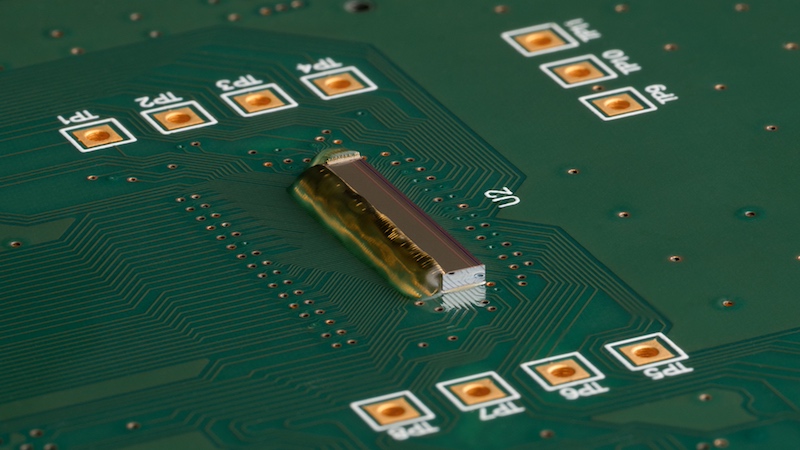
Nisshinbo Micro Device, in collaboration with OKI Electric Industry, has developed 3D-integrated analog ICs combining Nisshinbo's localized shielding technology and OKI's Crystal Film Bonding (CFB) technology.

Nisshinbo's 3D analog IC built using thin-film chiplet technology. Image (modified) used courtesy of Nisshinbo Micro Device
The companies stacked two two-channel operational amplifiers (op-amps), creating a four-channel op-amp that takes up 30% less space than a conventional four-channel version. A four-layer stack can shrink the chip to one-fourth of its original size. The stacked chips are also thinned, so they still fit into standard semiconductor packages. Miniaturizing analog ICs is typically a difficult task because their performance depends on signal strength. Making them smaller can reduce voltage tolerance and increase noise. Nisshinbo Micro Devices and OKI's method reportedly avoids those issues while shrinking chip size significantly.
Localized shielding reduces crosstalk noise by shielding only the areas where interference happens. This allows the chip to handle high-voltage output (20 Vpp) while keeping signal integrity. Unlike other stacking methods, this approach doesn’t need through-silicon vias (TSVs), which lowers production costs. These smaller, more efficient analog ICs are designed for AI-driven applications such as autonomous vehicles and ADAS. Production is scheduled for 2026.
2. Espressif’s Wi-Fi 6 SoCs Gets Thread 1.4 Certified
Espressif Systems recently announced that its Wi-Fi 6 SoC, the ESP32-C6 (datasheet linked), has achieved the Thread 1.4 Interoperability Certification. This makes the ESP32-C6 compatible with the latest Thread protocol. It supports secure device commissioning using Thread Commissioning Over Authenticated TLS (TCAT), which simplifies large-scale IoT deployments with certificate-based security.
The update includes advanced diagnostic tools that improve network reliability and help developers troubleshoot issues and collect data. The ESP32-C6 also optimizes energy efficiency by supporting different device roles, including full-Thread devices (FTD), minimal-Thread devices (MED), and sleepy-end devices (SED), ensuring lower power consumption while maintaining connectivity.
Thread 1.4 improves internet connectivity by supporting both IPv6 and IPv4. It enables Thread devices to obtain globally routable IPv6 addresses through DHCPv6 Prefix Delegation, allowing direct communication with other IPv6-enabled services.
3. Singular Photonics Unveils SPAD-Based Image Sensors
Singular Photonics has emerged from stealth mode with a new generation of SPAD-based image sensors that integrate advanced computation directly into the sensor. These sensors perform in-pixel and cross-pixel processing, enabling more detailed information extraction from light at the lowest levels. This approach combines 3D-stacked SPAD sensors with layers of computation, similar to how FPGAs and GPUs revolutionized computing.
Singular Photonics' Sirona, a 512-pixel line sensor. Image used courtesy of Singular Photonics
The company offers two sensors. The first is Andarta (datasheet linked), a compact sensor optimized for medical imaging, including cerebral blood flow monitoring. It supports in-pixel autocorrelation for deep tissue analysis. The second is Sirona (datasheet linked), a 512-pixel line sensor designed for time-correlated single photon counting (TCSPC) and applications like Raman spectroscopy, fluorescence lifetime imaging, and time-of-flight.
Singular’s sensors capture depth and time, generating 4D images for use in fields like consumer electronics, automotive, science, and medicine. The company has already secured multiple deals with leading firms and plans to expand its product line in 2025.
4. Power Integrations Upgrades Software Suite for BLDC Inverters
Power Integrations has released MotorXpert v3.0, a software suite designed for configuring, controlling, and sensing BLDC inverters with BridgeSwitch motor-driver ICs. This version supports shuntless and sensorless field-oriented control (FOC) and includes new features like advanced modulation schemes and startup under any load condition. It also improves waveform visualization and debugging tools, making the process more efficient.
MotorXpert v3.0 includes three main components: algorithms running on the MCU or DSP that control switching patterns, a host-side application that provides data for analysis, and an easy-to-use interface for quick development. The software works with a range of MCUs and follows common C language standards.
The software also offers tools like a digital oscilloscope for parameter design, motor tuning, and debugging. New features include both V/F and I/F control for motor startup in any load condition and a two-phase modulation scheme that reduces switching losses by 33%. This is especially useful for high-temperature applications, such as hot-water pumps, where it helps reduce cooling needs.
5. Nexperia Announces New Step-Down DC-DC Converter
The NEX30606 (datasheet linked) is a step-down converter that offers 16 resistor-settable output voltages, with input voltages ranging from 1.8 V to 5.0 V. It can deliver up to 600 mA of output current and has a very low quiescent current of 220 nA. This makes it well-suited for wearable devices and battery-powered industrial applications. The converter provides over 90% efficiency and only 10 mV of output ripple when stepping down from 3.6 V to 1.8 V.

Functional block diagram of the NEX30606. Image used courtesy of Nexperia
The NEX40400 converter also offers high efficiency, delivering up to 8% better efficiency than competitors at low-to-mid load conditions. It operates with a low quiescent current of 60 μA and supports a wide input range of 4.5 V to 40 V, providing up to 600 mA of output. It uses pulse frequency modulation (PFM) for efficiency at lower loads and spread spectrum technology to reduce EMI. This converter is designed for industrial power systems and smart meters. Nexperia also plans to release an AEC-Q100 version in 2025 for automotive applications.
6. MediaTek Accelerates 2-nm Design With Cadence's AI-Based EDA Tools
MediaTek is using Cadence’s Virtuoso Studio and Spectre X Simulator with Nvidia's accelerated computing platform for its 2-nm development. MediaTek claims this setup is helping it meet the performance and turnaround time (TAT) needs for its high-speed analog IP. The tools, powered by AI, reportedly boost productivity by 30%.
MediaTek integrated its AI-powered optimization algorithm with Cadence’s Virtuoso ADE Suite to improve circuit design efficiency. Spectre X on Nvidia H100 GPUs offers up to 6x faster performance for post-layout simulations while maintaining accuracy. MediaTek also adopted Virtuoso’s Layout Suite for routing custom digital blocks in 2-nm technology, increasing layout productivity. Additionally, using AI and Virtuoso’s open platform to customize placement and low-power prediction flows provides another 30% boost in productivity.