Facebook
 Google
 GitHub
 Linkedin
Lab on a Tag: NFC Chips Power Medical Sensors—No Batteries Required
Silicon Craft is graduating NFC from a passive data carrier to a complete electrochemical measurement system. With this technology, a simple phone tap can both power and execute a diagnostic test.
During a recent visit to Silicon Craft Technology in Bangkok, Thailand, All About Circuits learned how near-field communication (NFC) is being pushed beyond its conventional role as a passive data link. By integrating precision analog circuitry into a standard NFC tag, the company is demonstrating how a smartphone can power and interrogate disposable medical sensors without batteries or bulky readers.

Silicon Craft’s engineers demonstrate various applications of its sensor interface IC with built-in NFC to reporters at its Bangkok headquarters.
Most engineers think of NFC as a way to exchange data over short distances. The magnetic field generated by a reader at 13.56 MHz, however, also provides a modest but reliable energy source. For decades, that energy has been enough to power memory and logic in contactless cards. Silicon Craft’s innovation lies in using the same harvested energy to run precision mixed-signal circuitry that normally lives inside laboratory instruments.
More Than Data
The company’s flagship sensor IC, the SIC4341 (datasheet linked), is built as an NFC Type 2 tag compliant with ISO 14443A. Instead of offering only EEPROM storage, it incorporates a miniature potentiostat and a sigma-delta analog-to-digital converter. With these blocks on chip, the device can bias an electrochemical cell within a programmable range of roughly ±0.8 V and measure the resulting currents with resolution down to the nanoamp scale.

A schematic of the basic connection of the SIC4341 IC with a three-electrode chemical sensor.
“The SIC4341 is designed to excite the sensor by applying a bias voltage and measuring the current signal generated from the electrochemical reaction,” said Aricha Olarnwanich, assistant product manager of Silicon Craft’s sensor and emerging business group.
“Its main components include RFID, an ADC, a DAC, and an internal voltage reference. To achieve high signal integrity, the design incorporates a carefully planned floor layout with noise management and an architecture robust to interference.”
A “Lab on a Tag”
Electrochemical testing is central to a wide range of diagnostic methods, from glucose monitoring to immunoassays. Conventionally, such measurements require a benchtop potentiostat or at least a battery-powered portable reader. By collapsing that system into a 1.2 mm² silicon die, Silicon Craft has effectively created a “lab on a tag.”
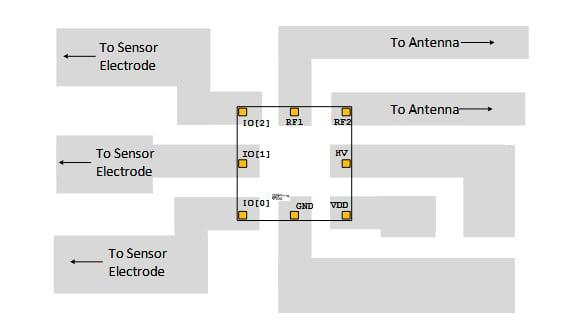
An example of the inlay design for the flipped chip with antenna and sensor interface.
Electrodes from a sensor strip can be wired directly to the chip, which then maintains the required electrode potentials, measures the current flowing through the working electrode, and encodes the digital result in tag memory. A smartphone or dedicated reader not only supplies the energy to run the measurement but also retrieves the stored data through standard NFC protocols. This is only possible because of careful attention to the chip’s power budget.
“This chip uses a low-power component design that operates in the microamp range, while an NFC Type 2 tag can harvest energy in the milliamp range,” Olarnwanich said. “The architecture was selected to fit within the power budget, with tradeoffs in data conversion rate and reading distance.”
That balance means that while measurement cycles are constrained, they remain practical for point-of-care tests. SIC4341 has already been demonstrated to be compatible with a wide range of electrochemical sensors. Printed electrodes and other sensor types are generally compatible with the SIC4341, provided the measurement conditions fall within the supported bias voltage and current ranges. Examples include enzyme-based glucose, ketone, and uric acid sensors; immunosensors for hepatitis B, ovarian cancer (CA-125), and cardiac biomarkers (CRP); and DNA-based tests for COVID-19 and gonorrhea.
Silicon Craft also confirmed that SIC4341 has been validated in clinical trial phases by some of its partners, highlighting that its NFC sensor interface IC technology has moved beyond laboratory prototypes and into early healthcare validation.
Why NFC Is an Ideal Fit
The choice of NFC as the interface is not incidental. Inductive coupling at 13.56 MHz is largely unaffected by the human body and liquids, making it well-suited for biosensing applications. The limited range is an advantage rather than a drawback: energy is delivered only when the user deliberately brings a phone close to the sensor, which ensures that disposable patches or strips remain completely dormant until needed. Data transfer is handled by leveraging standard NFC protocols with custom extensions.
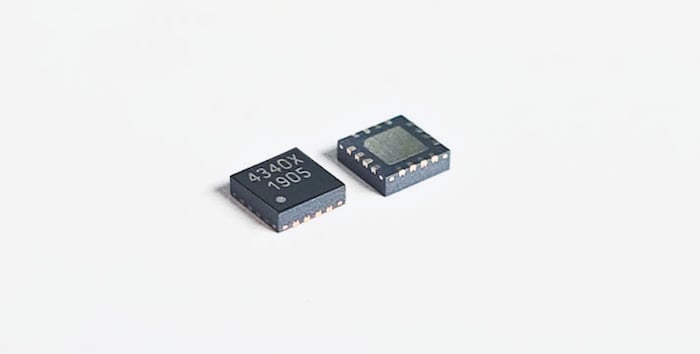
Silicon Craft's potentiostat sensor interface with NFC Type 2, the SIC4341.
“Custom commands in ISO14443A are used for chip configuration and signal acquisition, which can be streamed throughout the scan session,” Olarnwanich said.
Because the chip does not retain measurement data internally, the responsibility for privacy is shifted to the phone or application layer.
“The measured signal is sent to the reader or smartphone via an NFC custom command without being stored in the chip’s memory,” Olarnwanich said. “Data privacy can therefore be managed at the mobile application level.”
Silicon Craft sees the most promising healthcare applications in quantitative point-of-care diagnostics and testing, such as chronic disease biomarker detection and smart sweat and wound sensors. Looking ahead, they anticipate broader uptake in preventive healthcare.
“Non-invasive disease biomarkers for preventive healthcare could be the first set of applications for a large-scale ecosystem roll-out,” Olarnwanich said. “The key driver is enabling reliable, accurate quantitative data for home use while reducing the cost of healthcare management with a focus on preventive care.”
Beyond healthcare, industrial and environmental sensors are also in scope. In both contexts, the appeal is the same: maintenance-free, battery-free sensing with simple smartphone-based readout.
A Tap as a Test
What emerges from Silicon Craft’s work is a redefinition of what an NFC tag can be. No longer just a passive data carrier, it can function as a complete electrochemical measurement system. A simple tap of a phone becomes the act that both powers and executes a diagnostic test.
“For future disease diagnostics, edge signal processing could play a key role in analyzing measured data. We see opportunities to deploy lightweight AI inferencing directly on-chip,” Olarnwanich said. “In the short term, however, our focus remains on effective data acquisition and ease of use.”
All images used courtesy of Silicon Craft.
Related Content