Facebook
 Google
 GitHub
 Linkedin
Melexis Introduces First Automotive SMD Infrared Temperature Sensor
NTC thermistors work well enough—until they don't. Melexis is picking up the slack with the first automotive-qualified infrared thermometer available as an SMD.
Automotive engineers working on electric powertrains have wrestled with the same problem for years: how do you monitor the temperature of critical components quickly and accurately, without introducing wiring complications that turn into reliability headaches? The typical answer has been a negative-temperature-coefficient (NTC) thermistor. It’s cheap, it’s familiar, and it does the job well enough—until it doesn’t. High-voltage environments, noise, isolation requirements, and assembly constraints all expose the limits of contact-based sensing.
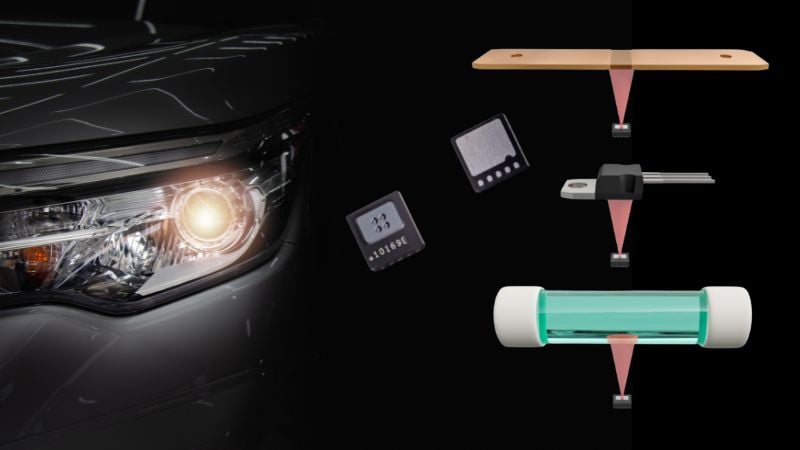
The MLX90637 brings non-contact infrared temperature sensing to compact automotive-grade SMD packaging for EV thermal management.
Melexis is stepping into that gap with the MLX90637, the first automotive-qualified infrared thermometer available as a surface-mount device (SMD). It’s small (3 mm × 3 mm) and built for automated PCB assembly. But the real story is what that packaging enables inside modern EV platforms. By bringing non-contact sensing into a mass-production format, Melexis aims to shift how temperature is monitored in inverters, motors, and HVAC systems as vehicle electrification becomes more demanding.
Designed for the Hot Zones of an EV
Electric powertrains live or die by thermal margins. Inverters swing between the battery and the motor with high current density. Busbars can heat sharply under load. HVAC heat pumps depend on stable thermal readings to maintain efficiency. These systems require accuracy and speed; lagging temperature measurements can lead to derating or, in the worst case, failed components.
The MLX90637 is built for precisely these environments. Instead of reading temperatures through physical contact, it uses far-infrared radiation to monitor surfaces such as inverter busbars, casing material, or motor housings without introducing galvanic pathways. The sensor maintains its accuracy across a wide ambient range (-40°C to 125°C), and its object-temperature window stretches from 40°C to 200°C—enough headroom for stressed power electronics.
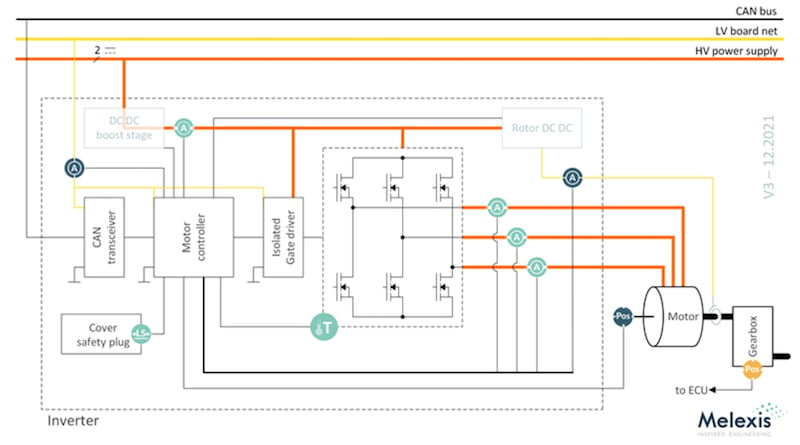
An EV inverter layout showing the high-voltage paths, switching stages, and thermal hotspots where precise non-contact temperature monitoring becomes critical.
The optical filter integrated into the device blocks visible and near-IR light, preventing stray ambient conditions from contaminating measurements. Melexis calibrates every unit at the factory using embedded constants stored in EEPROM, so calculations remain consistent even as the environment fluctuates.
A 50° field of view gives engineers flexibility in placement, especially when monitoring broader heat-spreading surfaces. And because the sensor’s response time is fast, it can identify changes quickly, an advantage in dynamic load scenarios inside inverters or traction motors.
Why Not Stick With NTC Thermistors?
NTC thermistors earn their place in automotive design because of their price point and simplicity. But they pay for it with wiring complexity, susceptibility to noise, and the need for strict isolation when used near high-voltage components. Long wire runs can pick up electromagnetic interference, and designers must work around insulation, mounting, and contact pressure. A non-contact FIR sensor avoids all that.
There’s no electrical connection between the measurement point and the low-voltage control electronics because the MLX90637 senses temperature optically. That intrinsic galvanic isolation eliminates one of the significant design pains in EV systems: safely separating high-voltage and low-voltage domains. It also sidesteps the “NTC wire antenna” effect, in which long leads behave like noise receivers within an inverter enclosure.
From a production standpoint, thermistors often require manual placement and attachment to the monitored surface. The MLX90637 is simply soldered to the PCB: no bonding clips, no adhesive pads, no custom harnesses. In high-volume EV manufacturing, those saved seconds matter. Melexis even points out that SMD assembly offers meaningful cost advantages over both NTC sensors and TO-CAN infrared devices, whose packaging and placement can add to the bill of materials and labor costs.
Performance Advantages That Support EV Demands
Resolution is one of the headline features of the MLX90637. Melexis claims the device can resolve 0.02°C changes, far finer than most contact-based automotive sensors in this class. That level of granularity is practical for inverter busbars, where small rises can signal increasing current loads or deteriorating cooling conditions. A stable sampling approach, supported by Melexis’ internal signal conditioning and digital filtering, helps the sensor maintain accuracy even in turbulent thermal environments.

Block diagram of the MLX90637.
The device is AEC-Q100 qualified, with EMC behavior engineered for noisy EV environments. It runs on 3.3 V, communicates over I²C, and includes an adjustable address via an external pin, which is helpful if a designer wants multiple sensors on the same bus. Its sleep current sits below 2.5 μA, which matters in systems that stay partially powered while the vehicle is off.
Because the sensor calculates temperature from a combination of thermopile readings and an ambient-temperature correction, it avoids the “thermal lag” of contact sensors that must first absorb heat through the mounting hardware. When the system is at thermal equilibrium, the device’s accuracy is within ±0.5°C across common automotive ambient conditions.
A Practical Fit for Real EV Architectures
Melexis designed the MLX90637 to target the thermal problem areas of EVs: inverter and motor monitoring, HVAC systems, and general high-precision temperature measurement. Because the device is so compact, designers can integrate it into crowded PCB assemblies inside power electronics housings.
Unlike TO-CAN infrared sensors that require standoffs or special mounting windows, the SMD package allows tight placement close to the monitored component without redesigning mechanical layouts. A simple 100-nF decoupling capacitor placed within 10 mm is essentially the only supporting component required.

Recommended application diagram of the MLX90637.
Bringing IR Sensing Into Automated Volume Production
The broader story here is about enabling a new class of temperature measurements in EVs. Infrared sensing has long been available, but not in a format that plays nicely with automotive manufacturing. The MLX90637 is Melexis’ attempt to bridge that gap: it provides the accuracy of FIR sensing, the robustness expected in automotive systems, and a tiny SMD package that fits straight into standard reflow soldering.
Melexis positions this device as a “world’s first” in its FIR line. Still, the more important point is what it allows engineers to stop doing: routing noisy thermistor wires, designing contact interfaces, and compensating for the failure modes of legacy sensors. With EV powertrains relying increasingly on precise thermal control to squeeze out efficiency, range, and longevity, tools like this one give designers a cleaner path forward.
All images used courtesy of Melexis.
Related Content