Facebook
 Google
 GitHub
 Linkedin
Microchip Specializes GNSS Disciplined Oscillator Modules for Defense
The new timing solutions bring precise synchronization to harsh or signal-denied environments.
Microchip recently announced a trio of GNSS disciplined oscillator (GNSSDO) modules. Designed for precise timing applications, the LM-010, MD-300, and MD-013 Ultra Clean modules combine embedded oscillator technology with satellite synchronization to offer stable outputs under extended holdover conditions or in GNSS-denied scenarios.

Microchip is targeting these compact timing systems at aerospace and defense applications.
Each module is meant to serve distinct use cases with distinct operational requirements.
The LM-010 for LEO Systems
The LM-010 (datasheet linked) is a radiation-tolerant, PPS-disciplined oscillator module for low Earth orbit (LEO) missions. Meant for exo-atmospheric platforms, the device offers either a digitally corrected OCxO or a SA45S chip-scale atomic clock (CSAC) solution. The module generates 1 PPS TTL and 10-MHz sine wave outputs that are disciplined to an external reference input (from 1 PPS up to 75 MHz). Alternate RF frequencies are available for the OCxO-equipped model.
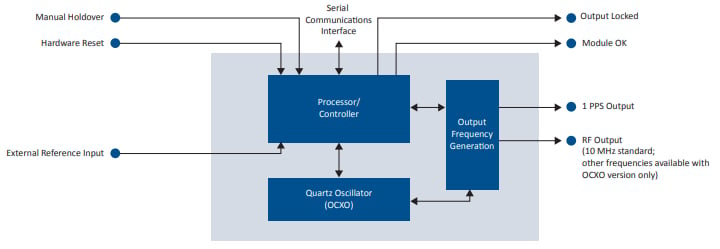
Block diagram of the LM-010.
The module’s holdover performance is particularly notable. Over a 24-hour holdover period with a 2°C temperature change, the OCxO and CSAC variants accumulate 60 µs and 2 µs of error, respectively. The device also offers adaptive aging correction during holdover to minimize drift. Phase noise measures -135 dBc/Hz and -128 dBc/Hz (1 kHz offset) for the OCxO and CSAC configurations, respectively. With a voltage supply of 12 V or 5 V, the module consumes 2 W in steady state and 7.5 W during warmup.
The LM-010 is also hardened against radiation up to 50 krad (Si) for the OCxO version and 20 krad (Si) for the CSAC version, and meets MIL-STD shock, vibration, and thermal cycling standards.
The MD-300 MEMS-Based GNSSDO
Microchip’s MD-300 (datasheet linked) is a MEMS-based GNSS disciplined oscillator that combines compact form factor with ruggedized performance. Designed around a MEMS OCxO or TCxO, the MD-300 integrates a dual-band GNSS receiver supporting GPS, Galileo, BeiDou, and NavIC.
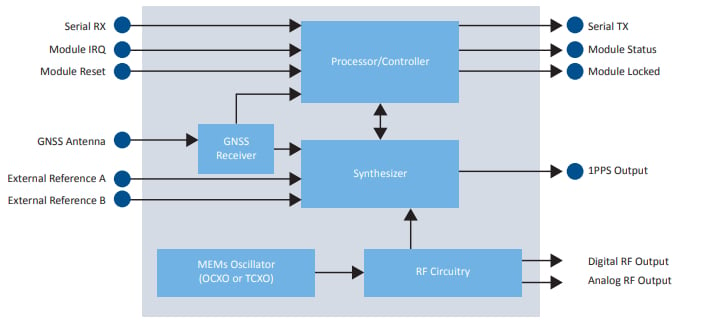
Functional block diagram of the MD-300.
From a performance perspective, the oscillator achieves ±1-ppb temperature stability with the OCxO and ±5 ppb with the TCxO across a -40°C to +85°C range. Testing shows that, in a 24-hour holdover, the OCxO maintains a maximum accumulated time error of 2.0 µs. At the same time, the GNSS receiver supports tracking sensitivity down to -167 dBm and provides 5-ns timing accuracy in fixed-position mode. Phase noise performance for the OCxO version reaches -165 dBc/Hz at 1-MHz offset.
Another notable feature is its dual external reference inputs, which support both 1 PPS and frequency references up to 120 MHz. The MD-300 is rated for high shock (1,500g) and vibration (up to 9.26 Grms) per MIL-STD-202H, and its MTBF exceeds 3.7 million hours in ground environments.
The MD-013 Ultra Clean With Low Phase Noise and Allan Deviation
Microchip claims the MD-013 Ultra Clean GNSS disciplined oscillator (datasheet linked) delivers its highest performance for applications demanding ultra-low phase noise and minimal short-term instability. The module integrates a digitally assisted OCxO and a 72-channel GNSS receiver supporting GPS, Galileo, and GLONASS. An integrated barometric pressure correction mechanism further improves timing accuracy during holdover.
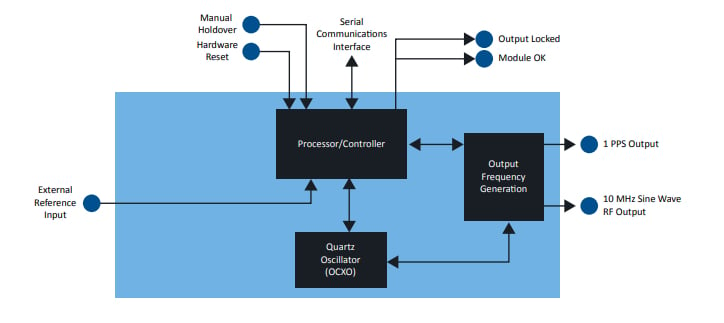
Functional block diagram of the MD-013 Ultra Clean.
The module outputs a 10-MHz sine wave and a square wave, as well as a 1-PPS TTL signal, which is disciplined to either the embedded GNSS receiver or an external reference. Its oscillator maintains ±1-ppb temperature stability and accumulates only 4.0 µs of error over 24 hours of holdover with a 2°C temperature change. Meanwhile, phase noise performance reaches -165 dBc/Hz at 100-kHz offset, and Allan Deviation remains under 1E-12 even in holdover, achieving 3E-13 at 1 s and 9E-13 at 100 s while locked.
The MD-013’s embedded receiver achieves timing accuracy of 20 ns (1 σ) under ideal conditions and supports tracking sensitivity to -167 dBm.
Deployment Flexibility for Precision Timing Systems
From the LM-010’s radiation-tolerant construction for satellite systems to the MD-300’s rugged MEMS architecture for UAVs and the MD-013’s ultra-low noise profile for fixed installations, Microchip’s new portfolio is a rather comprehensive offering. All three modules are currently available through authorized Microchip distribution channels and can be tested using the MD-01X evaluation kit.
All images used courtesy of Microchip.