Facebook
 Google
 GitHub
 Linkedin
Micron Claims Industry’s Highest Density SLC NAND for Space
Micron’s 256-Gb radiation-tolerant SLC NAND meets tight aerospace reliability benchmarks.
Micron recently released its space-qualified, 256-Gb single-level-cell (SLC) NAND—the so-called industry’s highest-density, radiation-tolerant NAND of its type.
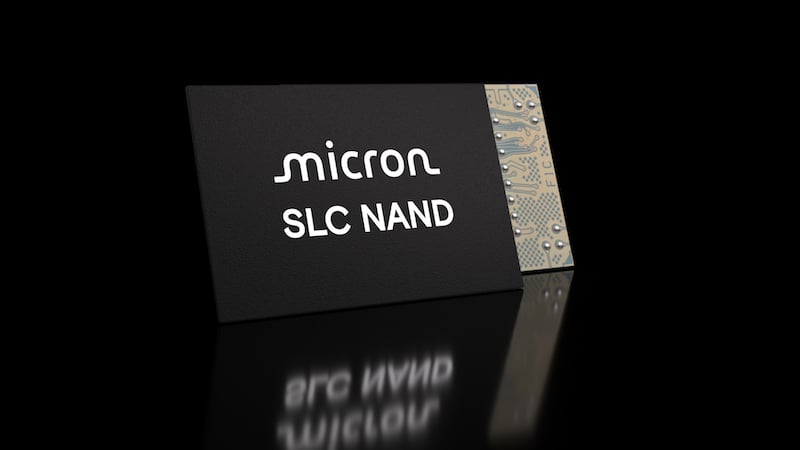
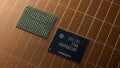
Micron’s new space-qualified SLC NAND flash.
The new memory product is Micron’s first entry in its expanded aerospace portfolio, which will include additional NAND, NOR, and DRAM solutions for space operations. By offering this product, Micron becomes the first major memory manufacturer to deliver space-qualified NAND at this density level.
256-Gb SLC NAND for Aerospace
Micron built the 256-Gb SLC NAND flash for the rigors of orbital deployment, integrating features to satisfy demanding environmental and operational requirements. Manufactured using a mature and proven process node, the device delivers high capacity in tandem with a level of radiation tolerance uncommon in commercially available memory.
The NAND employs an 8-bit I/O bus that supports both asynchronous and synchronous interfaces. In synchronous mode, it achieves timing mode 5 with a clock cycle of 10-ns DDR that yields data transfer rates up to 200 megatransfers per second per pin. The memory's operational metrics include a maximum page read time of 35 µs, a typical page program time of 350 µs, and a typical block erase duration of 1.5 ms.
Radiation performance was validated under NASA's PEM-INST-001 Level 2 qualification flow. This included total ionizing dose (TID) testing at low dose rates and single event effect (SEE) testing compliant with JEDEC JESD57 and ASTM F1192 standards. Micron demonstrated thermal robustness over 20 temperature cycles between -55°C and +125°C; extended burn-in at 85°C may provide confidence in long-term stability.
The part comes in a 100-ball leaded LBGA package measuring 12 mm x 18 mm x 1.4 mm and uses a polyimide process to enhance package integrity.
Radiation Tolerance in Spaceborne NAND
Radiation tolerance is a non-negotiable design requirement for memory devices used in space. Unlike electronics on Earth that are protected by the atmosphere, electronics in space are exposed to high-energy particles from solar flares and cosmic rays that can degrade materials and disrupt circuit behavior. Two specific concerns for NAND devices in orbit are total ionizing dose (TID) and single event effects (SEE).
TID represents the cumulative energy deposited by ionizing radiation over time. In flash memory, this can gradually alter transistor thresholds and lead to read/write failures. Engineers can mitigate TID by optimizing oxide thickness and doping profiles via process controls validated by MIL-STD-883 TM1019 Condition D.
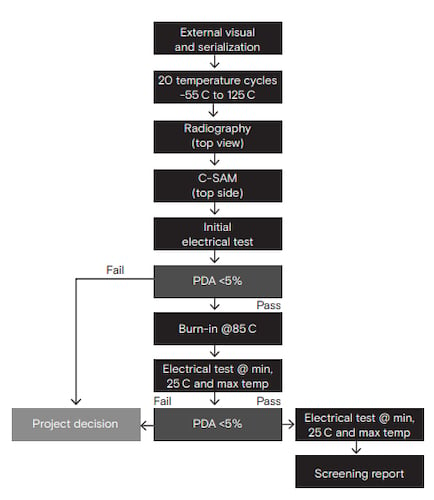
The validation test flow used by Micron.
SEE occurs when a high-energy particle directly strikes a semiconductor node. Such an event can cause transient bit flips (soft errors) or even permanent latch-up in severe cases. SLC architectures offer an advantage here due to their simpler bit-cell structure and lower per-cell vulnerability compared to multi-level cells. As such, SEE characterization allows engineers to determine safe operating margins and implement error correction schemes accordingly.
To approach these issues, companies must adhere to strict qualification flows to simulate orbital radiation conditions, validate component longevity, and inform system-level mitigation strategies. These flows typically include thermal cycling, dynamic burn-in, and exhaustive radiation testing over extended periods that can sometimes span months or even a full year.
High-Capacity Edge Intelligence in Orbit
Micron’s 256-Gb SLC NAND is a notable advance in space-capable memory that combines radiation tolerance with high data throughput and improved density. The 256-Gb SLC NAND is available now for aerospace customers and system developers. The company plans to continue introducing additional space-qualified storage and memory solutions in the coming year.
All images used courtesy of Micron.