Facebook
 Google
 GitHub
 Linkedin
New Sensors Survive Salt Water, Contamination, and Being Cut in Half
In this roundup, we cover three sensors pushing the boundaries of durability.
From wearable electronics to underwater robotics and water safety, recent advances in sensor technology are redefining what’s possible at the intersection of materials science and intelligent systems.
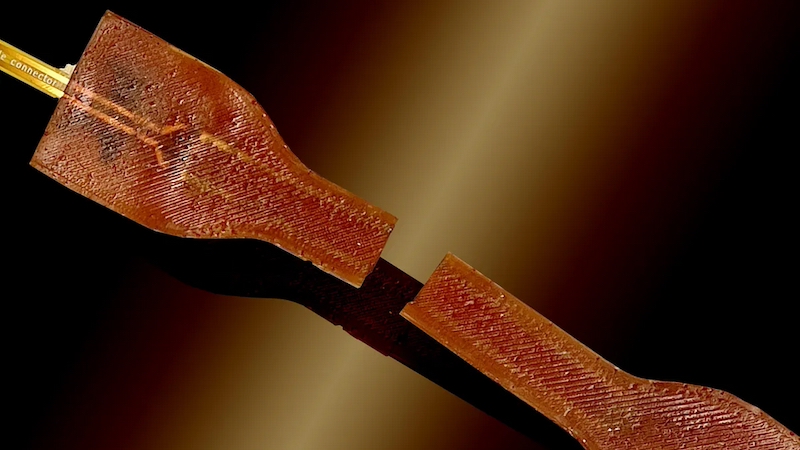
European researchers have employed self-healing polymers for wearable sensors. Image (modified) used courtesy of IEEE Spectrum
Three new research breakthroughs exemplify this shift: a stretchable sensor that self-heals after being cut in half, a biologically inspired memory sensor that adapts to salt exposure without power, and a palm-sized microwave biosensor that detects E. coli in minutes.
Self-Healing Stretchable Sensor Recovers From Complete Rupture
In a significant advancement for wearable electronics and soft robotics, researchers from Vrije Universiteit Brussel and Imec have developed a self-healing, recyclable strain sensor that can survive complete mechanical rupture. Leveraging a custom-designed Diels-Alder polymer as the encapsulant and Galinstan liquid metal as the conductive medium, the sensor exhibits exceptional resilience, restoring up to 80% of its mechanical integrity and fully recovering its sensing capabilities after being sliced in half and healed at 60°C for four hours.
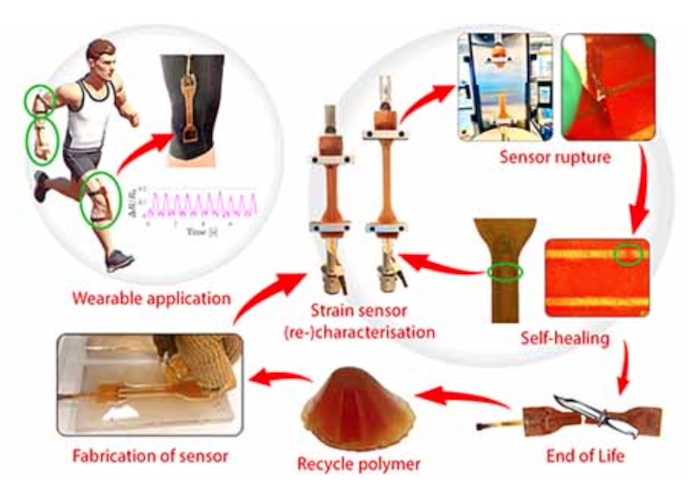
The new self-healing, reusable stretchable strain sensor is based on liquid metal and a Diels–Alder polymer. Image used courtesy of IEEE Sensors Journal
Electromechanical testing revealed that the sensor withstood six cut-heal cycles, maintained a gauge factor of 2.4 at 50% strain, exhibited less than 1% electrical hysteresis, and demonstrated strain-rate-independent behavior. These are key performance attributes that address the limitations of conventional stretchable sensors, such as delamination, low durability, and signal drift under cyclic loading. Even after 800 cycles of 20% strain, the drift in the pristine sensor remained below 5%. Under repeated damage and healing, sensor function remained robust, with minimal recalibration required.
The device’s architecture offers multiple innovations that promise longer life, higher accuracy, and sustainability. The DA polymer not only enables reversible bonding for mechanical healing but also enhances interfacial adhesion, reducing delamination between substrate layers. The embedded Galinstan channel, shielded by a self-forming oxide layer, ensures electrical continuity even post-damage. The team’s research is published in IEEE Sensors Journal.
'Memsensor' Remembers Salt Exposure Without Power or Processing
Researchers at UC Berkeley have developed a new energy-efficient “memsensor” that can detect and retain information about its environment, even in harsh, wet, and salty conditions, by mimicking how neurons in living organisms respond to stimuli.
Built from a thin layer of vanadium dioxide bonded to a sliver of indium, the sensor undergoes a reversible phase transition from insulator to metal when exposed to saltwater. This change is driven by ion exchange at the material’s surface, enabling the memsensor to autonomously “remember” the salinity level by maintaining a shifted conductivity state long after it is removed from the liquid. The rate of resistance change correlates with salt concentration, making the sensor both quantitative and memory-capable, all without any external power source or data acquisition system.
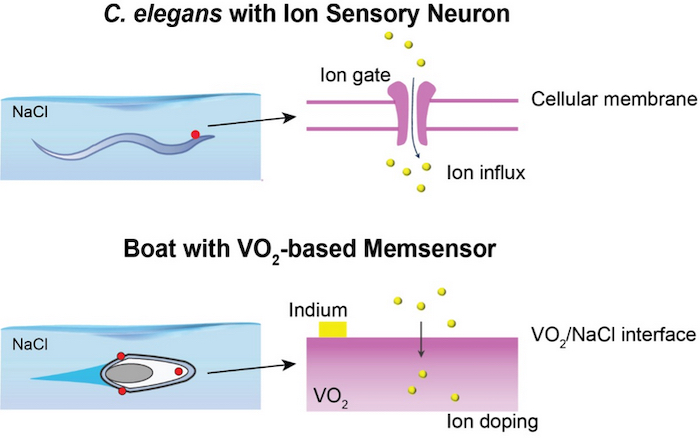
The nematode C. elegans uses specialized neurons to remember salt exposure and guide its movement toward or away from environments while foraging for food. Mimicking this adaptive behavior, the new memsensor navigates a small robotic boat through varying salt gradients. Image used courtesy of Nature Materials
The memsensor's design takes inspiration from the salt-sensing neurons of C. elegans, a nematode that adapts its behavior based on prior chemical exposure. Similarly, the research team demonstrated how their sensor could steer a robotic boat through a salt gradient, autonomously navigating toward or away from zones based on previous environmental encounters.
This passive sensing and memory functionality opens a path toward neuromorphic, adaptive systems with embedded chemical intelligence in aqueous environments. Applications span from autonomous underwater exploration to contamination-aware soft robots, and the work hints at a future where brain-like computing could emerge in liquid mediums. Published in Nature Materials, this work marks a leap in fusing materials science with biomimetic computation and robotics.
Microwave Biosensor Shrinks E. Coli Detection to Minutes
Researchers at the University of Waterloo have developed a low-cost, portable microwave biosensor that can detect E. coli O157:H7 in water samples within minutes, without the need for reagents, specialized training, or centralized laboratory facilities.
The sensor integrates a functionalized split-ring resonator on a PCB substrate with a thin gold layer, coated with strain-specific antibodies that selectively bind to E. coli. When exposed to contaminated water, the binding events alter the dielectric environment near the sensor’s capacitive gap, triggering a detectable resonance frequency shift captured via a vector network analyzer. The sensor achieved a detection limit of 647 CFU/mL in deionized water, which can be lowered to 6.47 CFU/mL when paired with a simple pre-concentration step.
_with_a_small_sensor.jpg)
Researchers paired a vector network analyzer (VNA) with a small sensor to create a handheld device that can rapidly detect E. coli bacteria in water. Image used courtesy of the University of Waterloo
To ensure field applicability, the team validated the device in household water samples from rural Ontario, confirming strong sensitivity and specificity even in real-world conditions with complex contaminants. Unlike traditional E. coli assays that require culturing or molecular techniques, this method is rapid, label-free, and enables on-site deployment using a $70 palm-sized NanoVNA.
The entire system was optimized through simulation and surface chemistry protocols adapted from previous SARS-CoV-2 detection work. With the sensor demonstrating robust performance across multiple concentrations and minimal cross-reactivity, the technology is positioned as a promising solution for water safety monitoring in both industrialized and resource-limited settings.