Facebook
 Google
 GitHub
 Linkedin
NXP Ushers Agentic AI to the Edge with New AI Development Tools
Announced today at CES, the new tools focus on inference-first deployment to embedded processors rather than retrofitting cloud-native workflows.
Today at CES, NXP Semiconductors announced a major expansion of its edge AI software portfolio, introducing the cloud-based eIQ AI Hub, an updated eIQ AI Toolkit, and a new eIQ Agentic AI Framework. These announcements acknowledge that while most AI software stacks are optimized for cloud infrastructure, edge systems have strict limits on power, memory, latency, and data sovereignty. With the new tools, NXP wants to reframe AI development around embedded inference rather than simply retrofitting cloud-native workflows for constrained hardware.

All About Circuits spoke with Ali O. Ors, NXP's global director of AI and machine learning strategies and technology, to learn how these tools take a new approach.
eIQ AI Hub Architecture and Development Flow
The eIQ AI Hub is a cloud-hosted front end for NXP’s AI development tools and services. NXP doesn't intend for the hub to replace on-premise workflows; instead, it provides a parallel entry point for quick evaluation and prototyping. Developers can access model optimization, benchmarking, functional simulation, and hardware board farms without installing local SDKs or provisioning physical hardware. In this way, the architecture reduces bottlenecks during early-stage development while maintaining the option to migrate tooling on-premise for production environments that restrict cloud access.
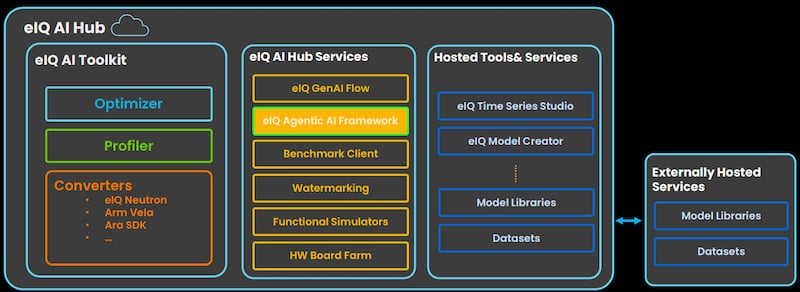
The eIQ AI Hub.
“We saw there was friction, especially with newer customers coming in and having to install tools and understand BSPs and SDKs,” Ors explained. “We wanted to give them a quick way to get up and running.”
From an architectural standpoint, the hub aggregates previously discrete tools into a service-oriented platform. This includes:
- Functional simulators that allow designers to evaluate model behavior and latency against specific NXP targets
- Hardware board farms that execute on real silicon, including i.MX application processors and Ara discrete NPUs
- Benchmarking clients and watermarking services for validation and IP protection
An Updated eIQ AI Toolkit
The flagship of the announcement is a reworked eIQ AI Toolkit focused on model optimization for edge hardware.
The toolkit supports TensorFlow, PyTorch, and ONNX models, but is primarily focused on how these models map to NXP’s heterogeneous compute engines. Specifically, a built-in optimizer performs quantization, operator fusion, pruning, and NXP-focused architectural mapping in a coordinated flow. The unified approach avoids cascading errors that often result from performing optimizations in disconnected steps, which can break model accuracy or produce nonfunctional binaries late in the deployment process.
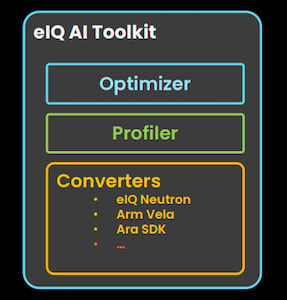
The eIQ AI Toolkit.
“With eIQ, you’re no longer quantizing, then pruning, then doing other optimizations where each step can break what the previous one did,” Ors said. “This is about maintaining that flow so the model actually works at the end.”
The profiler complements the optimizer by exposing how each transformation affects performance, memory footprint, and execution behavior. NXP provides a unified optimization path that designers can scale from microcontroller-class devices to multi-NPU edge platforms.
Generative AI Within Edge Constraints
Generative AI poses a distinct challenge at the edge because transformer-based models require significant memory and bandwidth. NXP’s eIQ GenAI Flow solves this obstacle by focusing on domain-specific generative workloads rather than general-purpose chat interfaces. By combining optimized models with local data sources, the GenAI Flow facilitates speech interfaces and contextual reasoning without continual cloud connectivity. Ultimately, the tooling assumes that edge generative AI will prioritize determinism and low-latency inference over open-ended language generation.
eIQ Agentic AI Framework and Autonomous Edge Workflows
The eIQ Agentic AI Framework will leverage NXP’s software stack. Ors explained the impetus of the framework:
“A lot of people have agentic AI helping them plan vacations, but that’s all in the cloud. What does that mean if you’re trying to bring this to industrial or automotive edge deployments?”
The framework defines a modular architecture centered on an API layer, a gateway, an orchestrator, a connector, and an agent. Agents are either LLM-based or multimodal components that process inputs from cameras and other time-series sensors. An orchestrator coordinates decision logic and task sequencing, while the connector bridges AI inference with physical hardware such as sensors and communication interfaces.
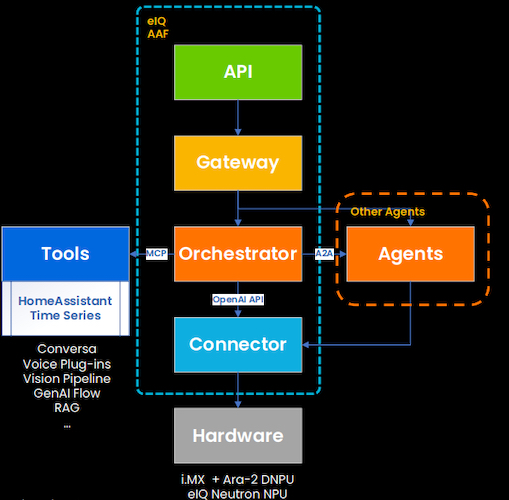
The eIQ Agentic AI Framework.
The framework also supports interoperability with industry standards, such as the Model Context Protocol and Agent-to-Agent communication, as well as integration with external agent development kits and OpenAI-compatible APIs. NXP hopes the design will help edge systems coordinate multiple agents locally while selectively interacting with external services as needed.
Deployment Implications
Taken together, the eIQ AI Hub, updated toolkit, and agentic framework are NXP’s way of positioning its software strategy around real, deployable edge intelligence.
“We always look at what’s practical—solutions that our customer base would be developing and deploying into industrial, automotive, and healthcare markets,” Ors said.
As edge AI applications mature, such hardware-aligned software stacks may prove more consequential than incremental gains in model size or raw compute performance.
Images used courtesy of NXP Semiconductors.