Facebook
 Google
 GitHub
 Linkedin
Pico Technology Claims ‘Industry’s First’ 4 Channel 16-Bit Oscilloscope
The PicoScope 5000E Series delivers a 22-µV RMS noise floor and up to 5-GS/s sampling in a USB-C-powered package.
Pico Technology has launched the PicoScope 5000E Series of PC-based USB-C oscilloscopes. Claiming to be the first to deliver 16-bit resolution across all four analog channels simultaneously, the new family may offer engineers a unique package of resolution, sampling rate, and capture memory.
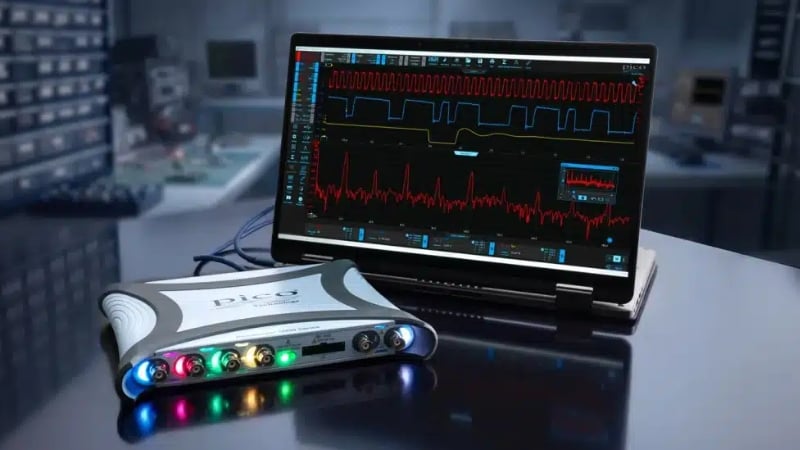
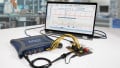
Pico Technology’s 500E Series oscilloscopes connect to a PC via USB-C.
Highlights of the New PicoScope
The most notable feature of the PicoScope 5000E Series is its native 16-bit ADC on each of its four channels, which increases vertical resolution from 256 steps (as found in many 8-bit ADC oscilloscopes) to 65,536 discrete steps. According to Pico Technology, this large increase in vertical resolution helps engineers measure power supply ripple, harmonic distortion, and millivolt-level transitions that fall below the noise floor of a conventional scope. Because all internal math channels and filtering operations maintain at least 16-bit resolution, engineers can zoom into low-level signals without encountering quantization artifacts.
As part of its accuracy, the 5000E Series' front-end design supports that resolution with a noise floor of 22-µV RMS at 20 MHz. To reach that figure, Pico Technology engineered the inputs with shielded construction and a channel-to-channel isolation ratio better than 500:1, which the company says allows engineers to detect microvolt-level signals that other instruments obscure in their own noise.
That 22-µV figure holds on the ±5 mV and ±10 mV input ranges with the 20-MHz bandwidth filter engaged. Relaxing that filter, however, captures faster signals and raises the noise floor. For example, at 100 MHz, the noise floor rises to 51-µV RMS in the ±5-mV range, consistent with the physics of wideband amplifier design.
Meanwhile, for engineers who need speed alongside precision, the 5000E Plus models feature FlexRes technology, enabling switching between 16-bit and 8-bit resolution modes on the same hardware. In 8-bit mode, the sampling rate doubles from 2.5 GS/s to 5 GS/s, capture memory doubles from 1 GS to 2 GS, and bandwidth increases from 200 MHz to 500 MHz.
Vertical Resolution and Front-End Noise in Oscilloscope Design
When dealing with extremely small signals, engineers should consider their oscilloscope’s vertical resolution and noise floor.
Oscilloscope vertical resolution determines how finely an instrument can distinguish voltage levels within its input range. For example, an 8-bit ADC divides its full-scale range into 256 discrete steps, and, on a scope set to ±1 V, each step represents approximately 7.8 mV. In this case, any signal change smaller gets lost to quantization noise. Since engineers working with switching power supplies and precision sensors must routinely resolve millivolt-level variations on top of larger DC offsets, 8-bit scopes are not feasible.
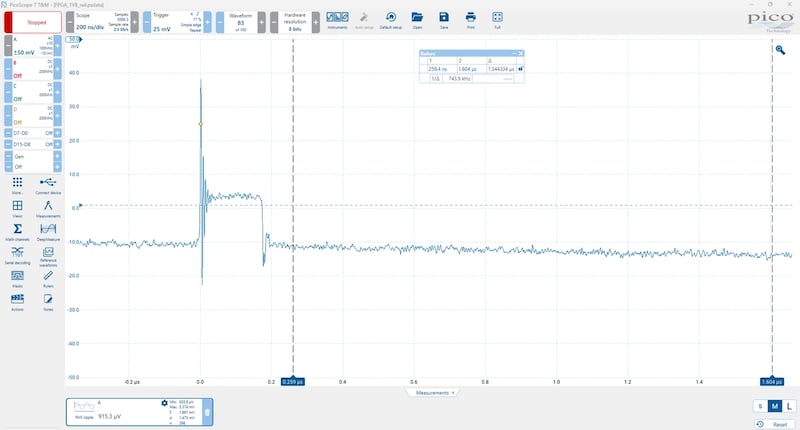
The 500E Series features a noise floor of 22-µV RMS.
Meanwhile, the noise floor is distinct from quantization noise but equally constraining. Noise floor reflects the combined contribution of the input amplifier, ADC thermal noise, and board-level interference. Even a high-resolution ADC can’t extract a signal buried below the instrument's own noise. As such, engineers targeting the lowest measurable signals need an instrument with a noise floor below the minimum signal amplitude of interest, regardless of ADC bit depth.
Available in 12 Configurations
Pico Technology offers the PicoScope 5000E Series in 12 configurations across the 5000E and 5000E Plus families, all of which are available today.
All images used courtesy of Pico Technology.